

General |
Common Mistakes in Contract Law Singapore: A Guide for Businesses

A Singapore supplier sends a WhatsApp message saying, “We will invoice after delivery as usual,” but the written agreement says payment is due only after written acceptance of the goods. When the invoice is later disputed, both sides realise the contract never clearly dealt with payment timing, rejection rights, or who had final approval.
Situations like this are common in Singapore because many businesses rely on template agreements, email exchanges, or copied clauses without checking whether they fit the deal. The result can be uncertainty, delay, and expensive disputes. Understanding where contract risk starts is the first step to protecting your rights.
The True Cost of Contract Mistakes in Singapore
Contract mistakes are not just drafting issues. In Singapore, they can affect whether a term is enforceable, how much you can recover, and whether a dispute ends in court, arbitration, or settlement.
A vague clause may force the parties to rely on the court to interpret what was intended. A missing clause may leave a gap that becomes difficult to prove later. In some cases, an unfair or poorly drafted term may be challenged under the Unfair Contract Terms Act (UCTA), while employment contracts may fail to meet requirements under the Employment Act and Ministry of Manpower (MOM) guidelines.
The financial impact can include:
- Unpaid invoices
- Staff disputes
- Delayed projects
- Legal fees
- Business disruption
For employers, weak employment agreements can create disputes over notice, overtime, leave, bonuses, or termination. For commercial contracts, unclear terms can damage supplier relationships and complicate payment recovery.
7 Common Mistakes in Contract Law to Avoid
Before signing any agreement, it is important to recognise the most common contract pitfalls that can expose your business to unnecessary risk. Many disputes do not arise from bad intentions, but from unclear drafting, missing terms, or misunderstood clauses.
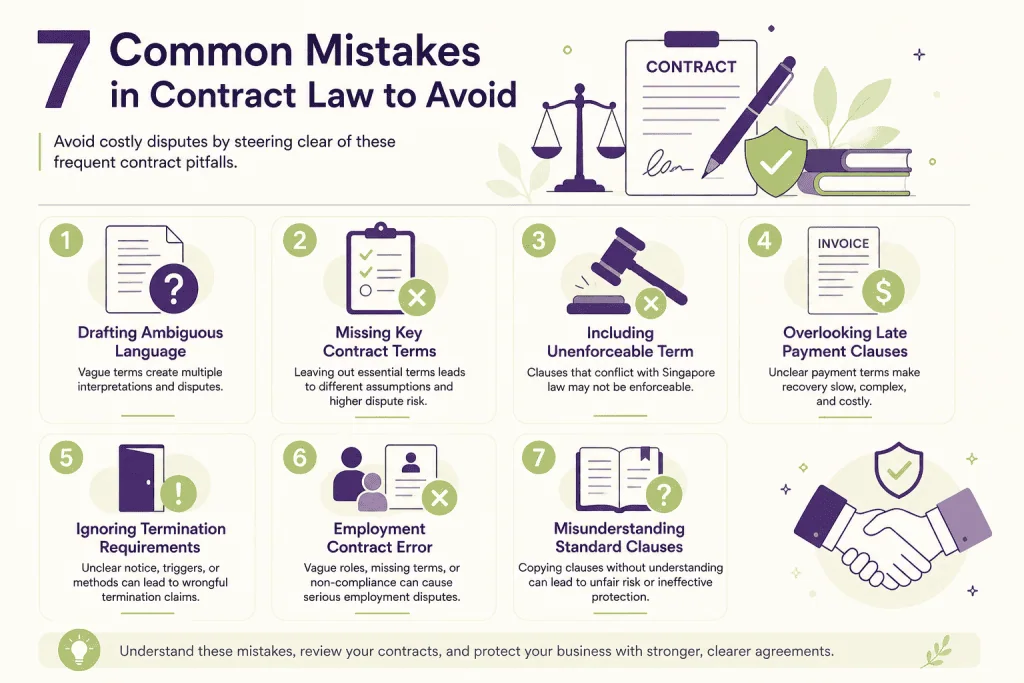
Below are seven common mistakes to watch out for—along with why they matter.
1. Drafting Ambiguous Language
Ambiguous wording is one of the most frequent sources of contract disputes. Terms such as “reasonable time”, “as soon as possible”, or “subject to approval” may seem flexible, but they leave room for multiple interpretations. When expectations are not clearly defined, disagreements are almost inevitable. As a general rule, if a clause can be read in more than one way, it is too vague and should be clarified.
2. Missing Key Contract Terms
Some contracts fail not because of what they say, but because of what they leave out. Essential elements like scope of work, payment milestones, late payment terms, confidentiality obligations, dispute resolution processes, and governing law must be clearly stated. Without these, parties may operate under different assumptions, making enforcement difficult and increasing the risk of disputes.
3. Including Unenforceable Term
Not all clauses are legally enforceable, even if they are written into the contract. Terms that conflict with Singapore law—such as overly broad liability exclusions or provisions that override statutory rights—may not hold up in a dispute. Under frameworks like UCTA and employment regulations, poorly drafted clauses can fail to provide the protection businesses expect.
4. Overlooking Late Payment Clauses
Payment issues are one of the most common commercial disputes, yet many contracts do not clearly address them. A well-drafted payment clause should specify deadlines, invoice requirements, dispute procedures, and any interest on late payments. Without these details, recovering outstanding payments can become slow, complicated, and costly.
5. Ignoring Termination Requirements
Termination clauses often receive attention only when a relationship begins to break down—by then, it may be too late. Common issues include unclear notice periods, vague termination triggers, or incorrect methods of delivering notice. These gaps can result in wrongful termination claims or disputes over whether the contract was ended properly.
6. Employment Contract Error
Employment agreements require particular care because they affect both legal compliance and day-to-day operations. Common mistakes include unclear job scope, missing probation terms, vague bonus structures, and inconsistent leave or overtime provisions. Contracts that do not align with the Employment Act and MOM guidelines can quickly lead to disputes between employers and employees.
7. Misunderstanding Standard Clauses
Standard clauses are often copied from templates without fully understanding their function. Provisions such as indemnity clauses, force majeure, entire agreement clauses, and limitation of liability can significantly affect risk allocation. However, if they are not properly drafted or aligned with the rest of the contract, they may not work as intended when needed.
Understanding these common mistakes is the first step toward stronger, more reliable contracts. By reviewing your agreements carefully and addressing these risks early, you can reduce uncertainty, prevent disputes, and protect your business more effectively in the long run.
Also Read: Non-Compete Clause in Singapore Employment Contracts: Are They Enforceable?
Common Clause Mistakes Overview
| Clause Type | Common Mistake | Singapore Law Implication |
|---|---|---|
| Late Payment | No clear due date, interest rate, or invoice dispute process | Harder to recover sums and resolve payment disputes efficiently |
| Termination | No notice period, unclear trigger, or wrong service method | Risk of wrongful termination or disputed end date |
| Employment Duties | Job scope, hours, or benefits are vague or incomplete | Possible conflict with the Employment Act or MOM expectations |
| Limitation of Liability | Clause is overly broad or inconsistent with the contract | May be limited by UCTA or fail to operate as intended |
| Dispute Resolution | No escalation path, forum, or governing law clause | Longer and more costly disputes over process and jurisdiction |
Your Essential Contract Review Checklist
Use this checklist before signing, renewing, or relying on any agreement:
- Parties: Are the legal names and signing authority correct?
- Scope: Is the work, supply, or employment role described clearly?
- Payment: Are payment dates, invoices, interest, and dispute steps stated?
- Termination: Are notice requirements, grounds, and service methods clear?
- Liability: Are exclusions and caps reasonable and legally sound?
- Employment terms: Do salary, leave, overtime, and notice terms match practice?
- Dispute resolution: Is there a clear process for escalation and enforcement?
- Law and jurisdiction: Does the contract identify the governing law and forum?
- Consistency: Do all clauses work together without contradiction?
The best time to review a contract is before a dispute starts. A structured review can quickly reveal gaps that are easy to miss in day-to-day business. If you manage multiple contracts, this checklist can also be used as an internal control tool for procurement, sales, and HR teams.
Also Read: Tort Claims in Singapore: What to Do When Someone’s Negligence Harms You
When to Seek Lawyer Contract Advice in Singapore
You should consider professional advice if the agreement involves high-value work, recurring payments, staff terms, confidentiality, intellectual property, or possible termination exposure. Legal review is also useful if the document is a template you use often, because one weak clause can repeat the same risk across many deals.
Seek advice sooner if you notice conflicting clauses, unusual liability wording, missing signatures, or employment terms that do not match the Employment Act or MOM guidance.
Early review is especially important where the contract may be relied on in a dispute, recovery action, or employment termination. RBN Chambers assists businesses with contract drafting, review, and dispute strategy so issues can be fixed before they escalate.
How RBN Chambers Can Help You
Contract mistakes are easier and cheaper to fix before a dispute starts. At RBN Chambers, we help businesses in Singapore review, draft, and strengthen their agreements — from payment clauses to employment terms.
We are unique in combining legal expertise with accounting and finance knowledge, giving you well-rounded advice. We are current, adopting AI and technology as one of Singapore’s SMARTLAW-accredited law firms. And we are savvy, delivering practical, value-driven legal representation that works for your business.
Contact RBN Chambers today to review your contracts before they become a problem. Click here to contact us!
FAQ About Common Contract Mistakes
What is a mutual mistake in Singapore law?
A mutual mistake occurs when both parties share the same fundamental misunderstanding about a key fact at the time of signing. Under Singapore law, this may render a contract void if the mistake is serious enough, such as both parties being unaware that the subject matter no longer exists. Courts apply a strict threshold, so not every shared misunderstanding will void an agreement.
What is an example of a mistake in contract law?
A common example is when both parties sign a contract believing they refer to the same property, but each had a different one in mind. Another example is agreeing to sell goods that had already been destroyed without either party knowing. In both cases, the contract may be challenged on grounds of mistake, depending on the type and severity of the error.
What are the 4 types of breach of contract?
The four main types are: a minor breach, where a small obligation is missed but the contract is mostly fulfilled; a material breach, which is serious enough to justify termination and damages; an anticipatory breach, where one party signals in advance they will not perform; and an actual breach, where a party fails to deliver on the agreed date or terms.
What is the difference between a void and voidable contract?
A void contract has no legal effect from the start, it is treated as though it never existed, often due to serious mistake or illegality. A voidable contract is valid unless one party chooses to set it aside, such as where misrepresentation or duress was involved.
The distinction matters practically: recovery under a void contract may depend on unjust enrichment principles, while rescission of a voidable contract generally restores both parties to their original positions.
Delivering Solutions not just Answers to your legal disputes
We provide solutions to all our clients regardless of the scale or complexity of the cases. Let us know how we can help.
Contact UsAny information of a legal nature in this blog is given in good faith and has been derived from resources believed to be reliable and accurate. The author of the information contained herein this blog does not give any warranty or accept any responsibility arising in any way, including by reason of negligence for any errors or omissions herein. Readers should seek independent legal advice.