

Business |
Business Structure in Singapore for SMEs Explained

You have a client ready to sign, but the contract says the work must be invoiced by a registered entity, and your WhatsApp thread with the supplier already mentions payment terms under your name.
That is often the moment many Singapore founders pause and wonder whether they should register as a sole proprietorship, partnership, limited liability partnership, or private limited company. The choice affects liability, tax treatment, bank account setup, and what ACRA expects from you from day one.
In Singapore, getting the structure right is not just about paperwork. It can shape how safely you grow, hire, and contract. Before you pay for incorporation services, it helps to understand your rights and obligations clearly.
Business Structure Options for Singapore SMEs
For most SMEs in Singapore, the decision comes down to how much risk you want to separate from your personal assets, how you want profits taxed, and how much administration you are prepared to maintain. A business structure is not only a registration formality. It affects whether you are personally liable for debts, whether you can bring in shareholders or partners, and whether you can scale into new markets later.
Business entities must be registered with ACRA before carrying on business in Singapore, and for tax treatment, IRAS looks at the legal form of the business rather than the industry you operate in. That is why founders should compare structure first, then register.
Sole Proprietorship
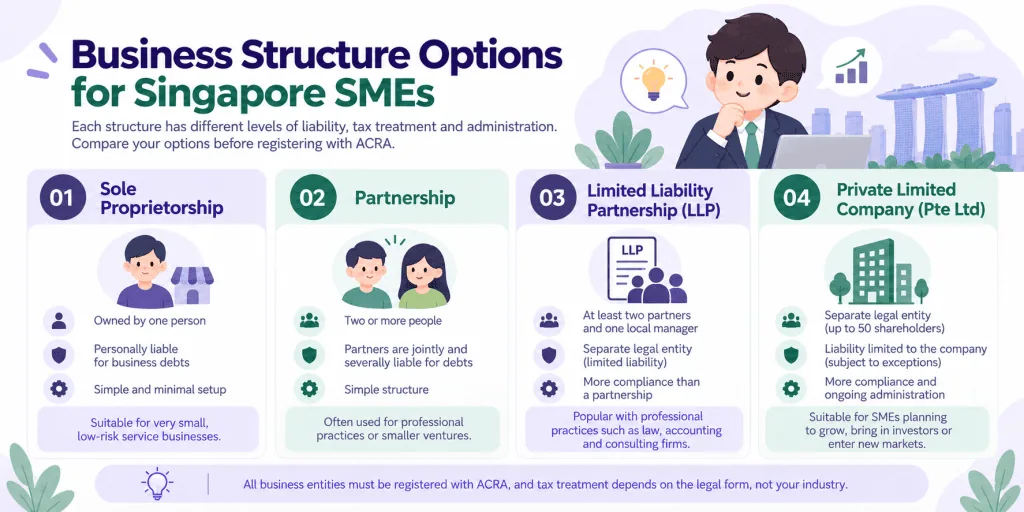
A sole proprietorship is the simplest structure. It is owned by one person and is not a separate legal entity from the owner. That means the owner is personally responsible for business debts and obligations. If the business is sued or owes money, the owner’s personal assets may be at risk. This suits very small, low-risk service businesses where the owner wants full control and minimal setup.
Partnership
A general partnership is used when two or more people carry on business together without registering as an LLP or company. Partners are typically jointly and severally responsible for the business’s obligations, which means each partner can be held liable for debts incurred by the others.
Partnerships are often suitable for professional practices or smaller ventures where the partners know each other well and have a clear agreement, but many founders move to an LLP or company once the business starts hiring or entering larger contracts.
Limited Liability Partnership
A limited liability partnership, or LLP, combines the operational flexibility of a partnership with liability protection closer to that of a company. It is a separate legal entity from its partners. An LLP needs at least two partners, who can be individuals or corporate bodies, local or foreign, and at least one manager who is ordinarily resident in Singapore, at least 18 years old, and of full legal capacity.
Partners in an LLP are generally not personally liable for the LLP’s debts or for the wrongful acts of other partners, though each partner remains liable for their own negligence or misconduct.
For tax purposes, an LLP is treated as a pass-through entity: profits are taxed at each partner’s personal income tax rate rather than at the corporate tax rate, and the LLP itself does not file for corporate tax exemptions. This structure is popular with professional practices, such as law, accounting, and consulting firms, where partners want liability protection without taking on full company compliance.
Private Limited Company
A private limited company, usually called a Pte Ltd, is a separate legal entity from its shareholders. This separation is one of the biggest reasons many SMEs choose incorporation. It can help contain liability within the company, subject to exceptions such as personal guarantees or wrongdoing. It also gives a more formal structure for contracts, investors, and future hiring, and supports up to 50 shareholders.
From a tax perspective, a Pte Ltd may benefit from Singapore’s corporate tax exemption schemes, provided the company meets the relevant conditions, which can be more efficient than having business profits taxed directly in the owner’s personal hands.
If you are comparing incorporation options, this is usually the structure to consider first, and it pairs naturally with services such as company incorporation, accounting, and tax advisory to keep ongoing compliance under control.
Here is a quick comparison for founders deciding between the four structures.
| Feature | Sole Proprietorship | Partnership | LLP | Private Limited Company |
|---|---|---|---|---|
| Legal status | Not a separate legal entity | Not a separate legal entity | Separate legal entity from partners | Separate legal entity from shareholders |
| Owners | One individual | Two or more partners | At least two partners | One to 50 shareholders |
| Personal liability | Unlimited | Unlimited, joint and several among partners | Limited, but partners remain liable for their own negligence | Limited, subject to personal guarantees and legal exceptions |
| Tax treatment | Personal income tax rates on the owner | Personal income tax rates on each partner | Personal income tax rates on each partner (pass-through) | Corporate tax rate, with SME exemptions where eligible |
| Best suited for | Very small, low-risk solo ventures | Professional or family businesses with shared ownership | Professional practices wanting liability protection with partnership flexibility | Growth-focused SMEs planning to hire, raise capital, or scale |
Also Read: How to Legally Start a Business in Singapore (2026)
Business Registration Requirements in Singapore
Before you register, it is important to match your structure with ACRA’s filing rules. Whichever structure you choose, sole proprietorship, partnership, LLP, or private limited company, ACRA sets clear requirements for officers, registered address, and ongoing filings before you can start operating.
General Registration Requirements
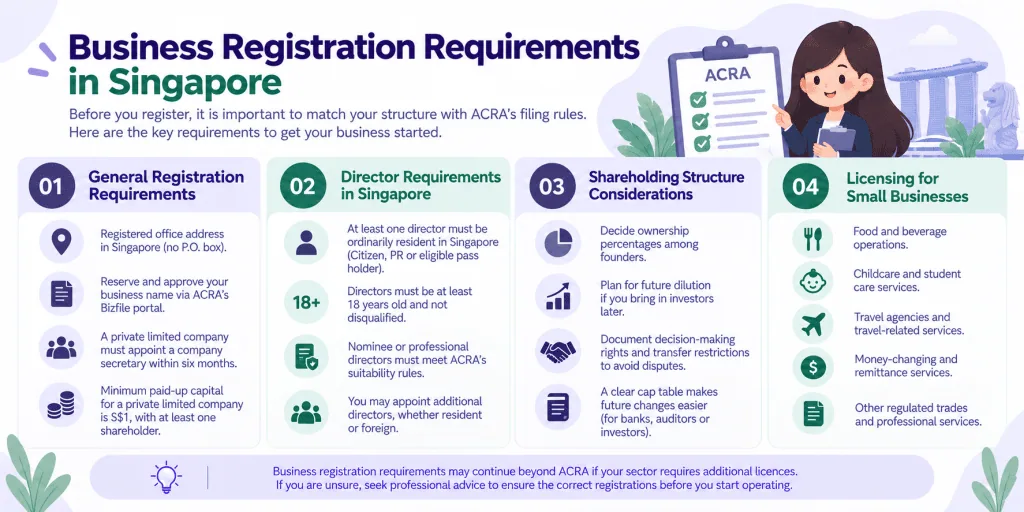
- A registered office address in Singapore is required; P.O. boxes are not accepted.
- The business name must be reserved and approved through ACRA’s Bizfile portal before registration.
- A private limited company must appoint a company secretary within six months of incorporation.
- Minimum paid-up capital to incorporate a private limited company is S$1.
- At least one shareholder is required, who may be an individual or a corporate entity, local or foreign.
Director Requirements in Singapore
- At least one director must be ordinarily resident in Singapore, meaning a Citizen, Permanent Resident, or eligible pass holder.
- Directors must generally be at least 18 years old and not disqualified from acting as a director under Singapore law.
- Nominee or professional directors appointed to meet the residency requirement must still satisfy ACRA’s suitability rules.
- The company may appoint additional directors, whether resident or foreign, beyond the required local director.
This is one reason founders often work with a corporate services firm or law firm early. Director appointments are not just about convenience. They affect whether your company can be formed and maintained in compliance.
Shareholding Structure Considerations
Shareholding structure refers to how ownership is divided among the company’s shareholders. For SMEs, this often starts with the founders deciding who owns what percentage and how future dilution will work if investors come in later.
A well-planned shareholding structure helps avoid disputes and makes future changes easier. Common issues include unequal capital contributions, different levels of management control, and unclear exit rights. If there are co-founders, it is wise to document not only ownership percentages but also decision-making rights and transfer restrictions, so that banks, auditors, or investors have a clean cap table to review later.
Licensing for Small Businesses
Not every business needs a separate license, but many do depending on the activity, including:
- Food and beverage operations
- Childcare and student care services
- Travel agencies and travel-related services
- Money-changing and remittance services
- Certain other regulated trades and professional services
The business registration requirements do not end with ACRA incorporation if your sector needs additional approval. This is especially important if you are planning to operate from a home office, a retail unit, or an online platform that still falls within a regulated category. If you are unsure, a consultation can help you identify the correct registrations before you incur avoidable delays or enforcement risk.
SME Corporate Tax Rates and Exemptions
Tax is often one of the biggest reasons SMEs choose to incorporate as a Pte Ltd rather than register as a sole proprietorship or partnership. Singapore’s headline corporate tax rate is a flat 17%, but very few profitable companies actually pay that rate on every dollar earned, because two exemption schemes and an annual rebate sit on top of it.
| Scheme | Exemption | Applies to |
|---|---|---|
| Start-Up Tax Exemption (SUTE) | 75% exemption on the first S$100,000 of normal chargeable income, plus 50% on the next S$100,000, up to S$125,000 exempted per Year of Assessment | Qualifying new companies, for their first three consecutive Years of Assessment |
| Partial Tax Exemption (PTE) | 75% exemption on the first S$10,000 of normal chargeable income, plus 50% on the next S$190,000, up to S$102,500 exempted per Year of Assessment | All companies that no longer qualify for SUTE, or never qualified |
| YA 2026 Corporate Income Tax Rebate | A capped rebate of tax payable, with a minimum cash grant for active companies that employed at least one local employee | Companies filing for Year of Assessment 2026 |
Investment holding companies are excluded from SUTE and fall back on PTE instead. Both exemptions are applied automatically when a company files its Estimated Chargeable Income and tax return, so there is no separate application.
Because rebate rates and thresholds are set fresh each Budget, founders should verify the prevailing figures on IRAS’s corporate tax exemption schemes page before relying on them for planning.
CPF Obligations for Business Owners
Many founders ask whether CPF applies to them once they start a business. The answer depends on whether you are self-employed or drawing a salary as an employee.
CPF for Sole Proprietors and Partners
Sole proprietors, and partners in a general partnership or an LLP, are classified as Self-Employed Persons for CPF purposes. The only compulsory contribution is to your own MediSave Account, and it only kicks in once your annual Net Trade Income exceeds S$6,000. Contributions to your Ordinary Account and Special Account remain entirely voluntary. Net Trade Income is assessed by IRAS from your tax return, so there is no separate declaration to CPF Board.
CPF for Company Directors
If you are paid a salary as an employee-director of your own Pte Ltd, you are treated as an employee for CPF purposes. Full CPF contributions across the Ordinary, Special, and MediSave accounts apply if you are a Singapore Citizen or Permanent Resident, subject to the prevailing wage ceilings, and the company must pay the employer’s share on top of the employee’s share. Director’s fees and dividends are treated differently from salary, so the exact CPF outcome depends on how your remuneration is structured.
Because CPF rules are specific to income type and residency status, founders should refer to CPF Board’s guidance for self-employed persons before setting payroll, especially where a company has a local director drawing salary alongside shareholder returns.
To keep compliance manageable, some SMEs combine incorporation with accounting support and digital company secretary services, so statutory requirements are tracked properly while the founder focuses on the business itself.
Also Read: The Complete Legal Audit Checklist for Singapore Companies (2026)
Get Structuring Advice From RBN Chambers
Choosing between these structures is rarely just a tax question, and the wrong choice at incorporation can be expensive to unwind later. RBN Chambers advises Singapore founders on structuring, incorporation, and shareholder agreements, and Ramesh Bharani Nagaratnam has worked with SME clients through exactly these decisions, from first registration through to shareholder disputes further down the line.
If you are still weighing sole proprietorship against an LLP or a Pte Ltd, or you need your shareholding structure and director appointments documented properly before you sign your next contract, a consultation with RBN Chambers team can help you set up on the right footing from day one. Contact us here!
Frequently Asked Questions
What are the minimum director requirements in Singapore?
A Singapore private limited company must have at least one director who is ordinarily resident in Singapore, and directors must meet ACRA’s suitability requirements, including being at least 18 years old.
Do I need to pay CPF for myself as a business owner?
Sole proprietors and partners only owe compulsory MediSave contributions once their annual Net Trade Income exceeds S$6,000. If you draw a salary as an employee-director of your own company, full CPF contributions apply instead, subject to the prevailing wage ceilings.
Does an LLP pay corporate tax like a private limited company?
No. An LLP is a pass-through entity for tax purposes, so its profits are taxed at each partner’s personal income tax rate rather than at the corporate tax rate that applies to a private limited company.
How much tax can a new Singapore company save under the Start-Up Tax Exemption?
A qualifying new company can exempt up to S$125,000 of chargeable income per Year of Assessment under the Start-Up Tax Exemption scheme, for its first three consecutive Years of Assessment.
Do I need a specific license for my small business?
Some businesses do. Licensing depends on the industry and activity, so founders should check whether their small business needs sector-specific approval before starting operations.
Delivering Solutions not just Answers to your legal disputes
We provide solutions to all our clients regardless of the scale or complexity of the cases. Let us know how we can help.
Contact UsAny information of a legal nature in this blog is given in good faith and has been derived from resources believed to be reliable and accurate. The author of the information contained herein this blog does not give any warranty or accept any responsibility arising in any way, including by reason of negligence for any errors or omissions herein. Readers should seek independent legal advice.