

General |
Is Doxxing Illegal in Singapore? Penalties, POHA & Legal Defences

Yes, doxxing is a criminal offence in Singapore. It is governed by the Protection from Harassment Act 2014 (POHA), which was amended with effect from 1 January 2020 to specifically criminalise the publication of another person’s personal information with the intention to harass, threaten, or facilitate violence against them. Offenders can face a fine of up to $5,000, imprisonment of up to 12 months, or both, depending on which of the three doxxing offences is committed.
With more personal information being shared and searchable online, doxxing has become increasingly common in Singapore, ranging from vigilante “exposes” on social media to the circulation of someone’s home address or workplace during a dispute.
Whether you are a victim trying to understand your options, or you have been accused of doxxing and want to know where you stand, this guide sets out what the law says, the penalties involved, and the legal remedies available.
What Is Doxxing Under Singapore Law
Doxxing refers to the publication of a person’s personal or identifying information without their consent, done with the intention to harass, threaten, or facilitate violence against them. This can include a person’s full name, photograph, home address, phone number, workplace, or details about their family members, and can happen through social media posts, online forums, messaging apps, or even offline through printed flyers.
Doxxing offences under POHA can only be committed against an individual a company or organisation cannot be a “victim” of doxxing in the legal sense, even though a company or other entity can be held liable as the party who published the information.
POHA also has extraterritorial reach: an offender based overseas can still be prosecuted in Singapore if they knew, or had reason to believe, that the victim was in Singapore at the time.
Penalties for Doxxing in Singapore
Penalties for doxxing depend on which POHA provision the conduct falls under.
Under Section 3, an offender who publishes personal information with the intention of causing harassment, alarm, or distress and who does in fact cause that harm faces a fine not exceeding $5,000, imprisonment for up to 6 months, or both. Under Section 5, where the conduct is intended, known, or reasonably believed to cause fear of violence or to facilitate violence, the maximum penalty rises to a fine not exceeding $5,000, imprisonment for up to 12 months, or both.
These maximum penalties are doubled for repeat offenders. Enhanced penalties may also apply where the offender and victim were in an intimate relationship, or where the victim is a vulnerable person, such as someone with a physical or mental disability.
Also Read: How to Sue Someone in Singapore? 8 Steps (2026)
3 Types of Doxxing Offences Under POHA
There are three distinct doxxing offences under POHA, and the offence that applies depends on the offender’s intent and the effect of the publication rather than simply the act of publishing information.
Causing Harassment, Alarm or Distress
Under Section 3(1)(c) of POHA, it is an offence to publish personal information about a person, or someone related to them, with the intention of causing harassment, alarm, or distress, where that harm is in fact caused. For instance, if A publishes B’s home address on a public forum intending to distress B, this may be an offence even if it is someone related to B, rather than B, who ends up feeling harassed.
Causing Fear of Violence
Under Section 5 of POHA, it is an offence to publish personal information intending, knowing, or having reasonable grounds to believe that doing so is likely to cause the victim to believe that unlawful violence will be used against them or someone related to them. Unlike the Section 3 offence, actual intent to cause fear is not required, it is enough that the offender knew, or ought reasonably to have known, that this would be the likely effect.
Facilitating the Use of Violence
Also under Section 5, it is separately an offence to publish personal information intending, knowing, or having reasonable grounds to believe that it is likely to facilitate the use of unlawful violence against the victim or someone related to them. This applies even if the victim is unaware that the information was published, so long as the offender’s intent was to facilitate violence against them.
| Offence | Provision | Intent Required | Maximum Penalty (First Conviction) |
|---|---|---|---|
| Causing harassment, alarm or distress | Section 3, POHA | Intended to cause the harm, and harm was in fact caused | Fine up to $5,000 and/or 6 months’ jail |
| Causing fear of violence | Section 5, POHA | Intended, knew, or ought to have known it would cause fear of violence | Fine up to $5,000 and/or 12 months’ jail |
| Facilitating violence | Section 5, POHA | Intended, knew, or ought to have known it would facilitate violence | Fine up to $5,000 and/or 12 months’ jail |
Photography vs Doxxing in Singapore
A common point of confusion is whether simply taking someone’s photo in public counts as doxxing. It generally does not. Singapore law does not recognise a general “right to one’s own image,” and it is generally lawful to photograph or film people in public places without their consent, since Singapore courts have not adopted a broad privacy tort covering this.
The legal line is crossed at the point of publication with intent, not the act of photographing. Taking a photo of someone in public and posting it to identify, shame, or expose them — together with their personal details, and with the intention of causing harassment, alarm, or distress — can amount to doxxing under Section 3 or 5 of POHA.
Separately, filming someone in a private setting, or capturing intimate or voyeuristic images without consent, falls under different offences in the Penal Code rather than POHA, and carries its own separate penalties.
When Sharing Personal Information Is Not Doxxing
Not every disclosure of someone’s personal information is doxxing — context and intent matter. Sharing personal information with the police or other authorities to assist a criminal investigation is not doxxing, nor is publishing a factual, non-malicious account of an incident, such as a video that documents what happened without an intent to harass. Information shared with the subject’s consent also falls outside the scope of the offence.
It is also not a requirement that the information was previously private. Compiling and republishing otherwise scattered public details. For example, combining someone’s name, employer, and neighbourhood into a single post, can still amount to doxxing if it is done with the intention, or likely effect, of causing harassment, fear, or violence.
Also Read: Tort Claims in Singapore: What to Do When Someone’s Negligence Harms You
Legal Remedies for Victims of Doxxing
If you believe you have been doxxed, there are both criminal and civil routes available, and victims often pursue more than one at the same time.
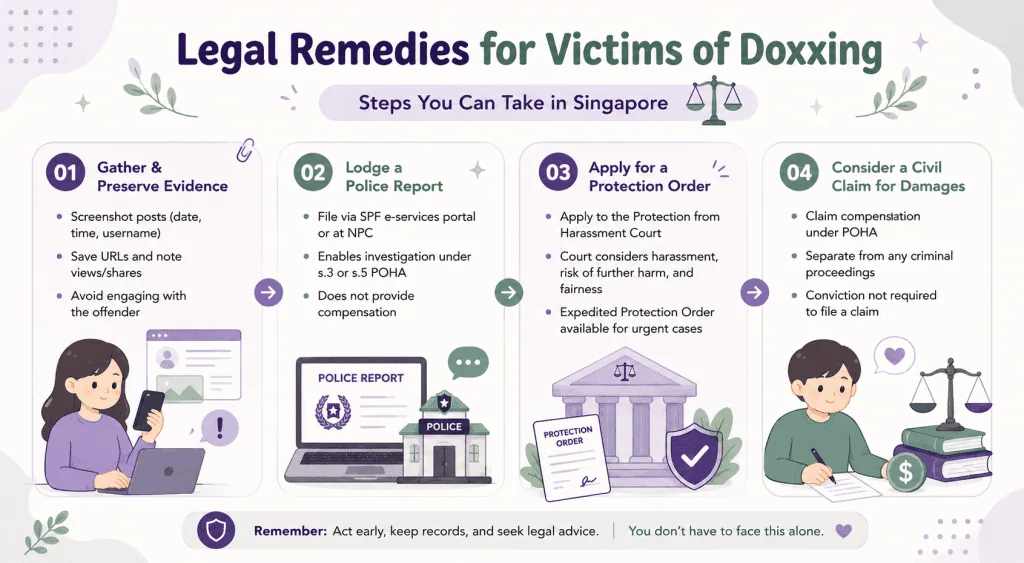
Gather and Preserve Evidence
- Take screenshots of the offending posts, including the date, time, and username or profile of the person who published them
- Save the URL and, where possible, note how many people have viewed or shared the content
- Avoid engaging directly with the person who published the information, as this can complicate your case
Lodge a Police Report
- A police report can be filed through the SPF e-services portal or in person at a Neighbourhood Police Centre
- This opens the door to criminal investigation and possible prosecution under Section 3 or Section 5 of POHA
- A police report does not itself result in compensation for the victim
Apply for a Protection Order
- Victims can apply to the Protection from Harassment Court, a division of the State Courts, for a Protection Order to stop the offender from continuing to publish the information
- The court must be satisfied that an act of harassment was committed, that further harassment is likely, and that it is just and equitable to grant the order
- Where the situation is urgent, an Expedited Protection Order can be sought for faster, temporary relief
Consider a Civil Claim for Damages
- POHA allows victims to bring a civil claim against the publisher for compensation, separately from any police report
- This route does not require the offender to be criminally convicted first
- Our civil litigation team can advise on whether a civil claim is suitable for your situation, and can also assist with related applications under POHA guide.
Defending Against a Doxxing Accusation
If you have been accused of doxxing but believe your conduct was reasonable, you may have a defence. This could include showing that you lacked the requisite intent, that the disclosure was made to assist a criminal investigation, or that the publication was a factual account made without malice.
Because doxxing offences turn heavily on intent and the surrounding context, it is important to speak with an experienced lawyer early, so your case can be properly evaluated before you respond to any allegation.
Facing Doxxing or Harassment? Get Help with RBN Chambers
If you believe you are a victim of doxxing, or you have been accused of publishing someone’s personal information online, the intent behind the publication and the evidence available can significantly affect the outcome of your case.
Acting early whether that means preserving evidence, deciding between a police report and a civil claim, or understanding what defences may apply to you, puts you in a stronger position.
Ramesh Bharani Nagaratnam and the team at RBN Chambers regularly advise both victims and individuals accused of harassment and doxxing under POHA. Contact RBN Chambers for a confidential consultation to discuss your options.
Frequently Asked Questions
Is doxxing illegal in Singapore?
Yes. Since 1 January 2020, doxxing has been a specific criminal offence under the Protection from Harassment Act, covering the publication of personal information with the intention to harass, threaten, or facilitate violence against someone.
Can I go to jail for doxxing in Singapore?
Yes. Depending on the offence, offenders can be jailed for up to 6 months (causing harassment, alarm or distress) or up to 12 months (causing fear of violence or facilitating violence), in addition to or instead of a fine of up to $5,000.
Is it doxxing if the information was already public?
It can still be doxxing even if the underlying information was publicly available. POHA focuses on the offender’s intent and the effect caused, not on whether the information was secret. Compiling scattered public information into one post to harass someone can still amount to an offence.
Is it illegal to take a photo of someone in public in Singapore?
Generally, no. Singapore law does not recognise a general right to one’s own image, so photographing people in public places is usually lawful. The offence arises when the photo, together with identifying details, is published with the intention to harass, threaten, or facilitate violence against the person.
How do I report doxxing to the police?
You can lodge a report through the SPF e-services portal online, or in person at a Neighbourhood Police Centre. It is advisable to have screenshots and other evidence ready before making the report.
Can I sue someone for doxxing me?
Yes. In addition to a police report, POHA allows victims to bring a civil claim for damages against the person who published their information, and separately to apply for a Protection Order to stop the harassment.

Delivering Solutions not just Answers to your legal disputes
We provide solutions to all our clients regardless of the scale or complexity of the cases. Let us know how we can help.
Contact UsAny information of a legal nature in this blog is given in good faith and has been derived from resources believed to be reliable and accurate. The author of the information contained herein this blog does not give any warranty or accept any responsibility arising in any way, including by reason of negligence for any errors or omissions herein. Readers should seek independent legal advice.