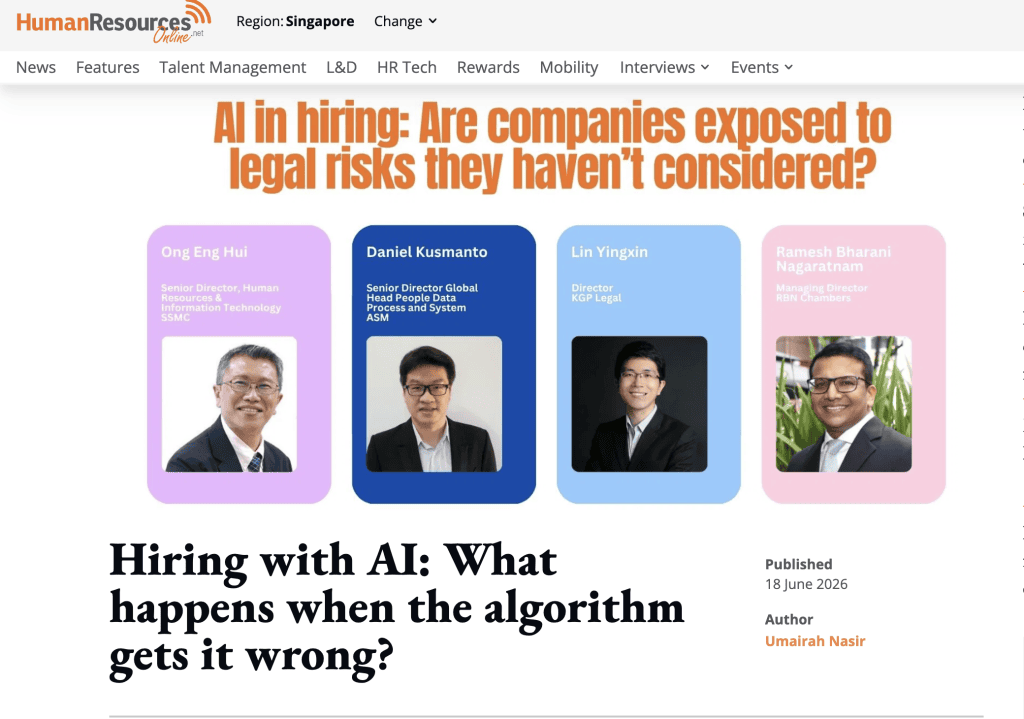
As artificial intelligence continues to reshape recruitment practices across Asia, Ramesh Bharani Nagaratnam, Managing Director of RBN Chambers, has identified three critical legal risks Singapore employers face when deploying AI hiring tools — and has called on organisations to take immediate steps to protect themselves.
Speaking as a featured legal expert in Human Resources Online’s in-depth report, “Hiring with AI: What Happens When the Algorithm Gets It Wrong?”, Ramesh flagged discrimination, data protection, and accountability as the most pressing concerns for employers navigating AI-assisted recruitment.
When asked whether companies could escape liability by using third-party AI vendors, Ramesh was direct: they cannot. Under Singapore’s Tripartite Guidelines on Fair Employment Practices and the upcoming Workplace Fairness legislation, the obligation for fair and compliant hiring rests with the employer — regardless of who built or supplied the technology.
“It remains the employers’ responsibility that the AI they use allows for hiring decisions which are fair, transparent and compliant,” Ramesh stated.
To help employers reduce both legal and reputational risk, Ramesh outlined a practical set of safeguards organisations should put in place before and during AI deployment in hiring.
Before introducing any AI tool into the hiring process, employers should conduct a structured risk assessment.
This means identifying exactly where AI will be applied across the recruitment pipeline, which candidate groups may be inadvertently disadvantaged, and how significant the consequences of those decisions would be. Understanding the scope and potential impact of the technology upfront is essential to managing it responsibly.
Not all AI recruitment tools are built equally. Ramesh advised employers to go beyond marketing materials and request substantive documentation from any AI vendor, including annual self-assessments, ISO audits, internal risk assessments, application security and vulnerability testing, penetration testing results, and confirmation that data is encrypted both in transit and at rest. Employers who skip this step risk inheriting a vendor’s compliance gaps as their own legal liability.
Once deployed, AI must be configured to evaluate candidates strictly on job-related criteria — not proxies that could introduce bias.
Critically, final hiring decisions should always remain in human hands. Employers must also put in place an ongoing monitoring process to ensure that AI-generated outcomes continue to align with the organisation’s hiring policies over time, as systems can behave differently as data evolves.
Employers should proactively inform candidates when AI is being used in the recruitment process — and provide assurance that the final decision on whether to hire will be made by a qualified person within the organisation, not an algorithm.
This is not merely good practice; it builds trust, manages expectations, and reduces the risk of candidates raising concerns about opaque or unexplained outcomes.
Technology alone is not sufficient. HR teams need to be equipped to understand what AI can and cannot do, recognise where it may fall short, and apply human judgement at the right moments. Embedding AI within existing fairness and data protection frameworks — rather than treating it as a separate system — ensures that ethical standards remain consistent across the entire recruitment process.
Ramesh’s framework reflects a broader principle, the adoption of AI in hiring is not simply a technology decision, it is a legal and ethical one. As Singapore moves closer to enacting the Workplace Fairness legislation, the regulatory environment is becoming increasingly clear.
Employers who treat AI as a neutral, hands-off tool do so at their own risk. Those who approach it with deliberate governance, human oversight, and genuine transparency will be far better positioned, both legally and reputationally, in the evolving landscape of AI-driven recruitment.

We provide solutions to the table for all our clients regardless of the scale or complexity of the cases. Let us know how we can help.
Contact Us