

Employment |
Can Employers Reject Annual Leave Requests in Singapore?

Can Employers Reject Annual Leave Requests in Singapore? This is a common question among employees who have had their leave application declined or are unsure about their rights under the Employment Act. While annual leave is a statutory entitlement for eligible employees, employers are not always required to approve leave on the dates requested.
In Singapore, employers may reject annual leave requests for legitimate business reasons such as operational requirements, staff shortages, or peak workload periods. However, leave decisions should be made fairly and consistently to avoid workplace disputes.
This guide explains when employers can reject annual leave requests, whether approved leave can be cancelled, and what employees can do if their application is denied.
Annual Leave Entitlement
Under Singapore’s Employment Act, an employee who has been in service with an employer for at least three months is entitled to paid annual leave. The number of days of leave increases with the length of service.
The minimum annual leave entitlement increases according to the employee’s length of service:
| Years of Service | Minimum Annual Leave Entitlement |
|---|---|
| 1 Year | 7 Days |
| 2 Years | 8 Days |
| 3 Years | 9 Days |
| 4 Years | 10 Days |
| 5 Years | 11 Days |
| 6 Years | 12 Days |
| 7 Years | 13 Days |
| 8 Years or More | 14 Days |
Employers may offer more generous annual leave benefits through employment contracts or company policies, but they cannot provide less than the statutory minimum required by law.
Can Employers Reject Annual Leave Requests?
In Principle: Yes, employers in Singapore can reject an annual leave request. The Employment Act does not explicitly state that employers must grant leave whenever it’s requested.
However, this discretion is not unlimited and must be exercised fairly and consistently.
Peak Season and High-Demand Periods
During busy periods — such as festive seasons, financial year-end, or product launches — employers may decline leave requests to maintain operational continuity. This is one of the most commonly cited and legally recognised grounds for rejection.
Staff Shortages
If too many employees have applied for leave around the same time, an employer may reject requests to ensure adequate staffing levels are maintained. Employers are generally expected to manage leave scheduling in advance to prevent this from becoming a recurring issue.
Project Deadlines and Critical Business Functions
Where an employee’s presence is essential to completing a time-sensitive project or fulfilling a contractual obligation to a client, an employer may defer the leave request until the matter is resolved.
Can an Employer Cancel Approved Annual Leave?
This is a question that arises frequently, and the answer is: it depends. While the Employment Act does not explicitly prohibit employers from cancelling approved leave, doing so without sufficient reason or notice can give rise to grievances and potential claims.
If an employer cancels approved leave at short notice and causes the employee to incur non-refundable costs, such as flight tickets or hotel bookings, the employee may have grounds to seek compensation. Employees in this situation are advised to raise the matter through their HR department first, and if unresolved, approach MOM.
Also Read: Wrongful Dismissal Under Singapore Law: Key Considerations for Employers and Employees
Can an Employer Force You to Take Annual Leave?
The Employment Act 1968 does not directly address whether an employer can direct when annual leave is taken. What it does guarantee is the minimum entitlement itself:
- Disputes should be reviewed case by case — if a disagreement arises over how leave is being scheduled, it’s worth reviewing the employment contract closely, or speaking with an employment lawyer to clarify your position.
- Statutory entitlement scale — 7 days of paid annual leave after the first year of service, increasing by 1 day per year up to a maximum of 14 days from the eighth year onward.
- Directed leave depends on contract terms — whether an employer can require staff to take leave during a specific period, such as a company shutdown, typically comes down to what’s stated in the employment contract or company leave policy, rather than a rule set out in the Employment Act itself.
- Reasonable scheduling is expected — according to MOM’s guidance on annual leave, employers and employees are expected to work out leave scheduling reasonably, balancing business needs against the employee’s entitlement.
Annual Leave Rejection During a Notice Period
Whether you can take annual leave during your notice period isn’t addressed directly in the Employment Act 1968.
According to MOM’s guidance on the notice period, both employer and employee should agree on how the notice period will be spent, including how any leave is planned, and either party can decline. If leave is not taken and no agreement is reached, the employer is still required to compensate the employee for any outstanding annual leave upon termination.
What Should Employees Do If Their Leave Is Rejected?
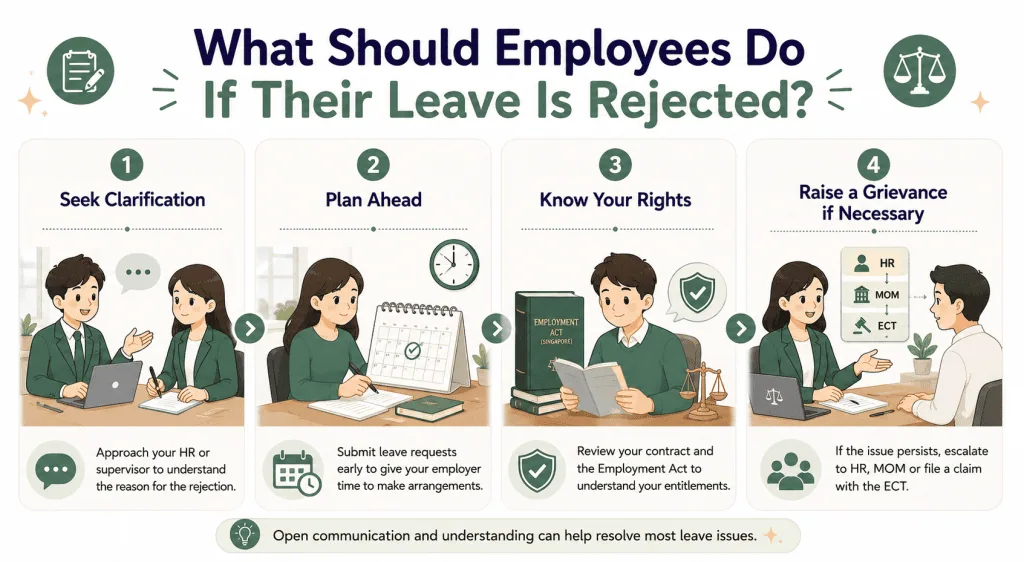
Step 1: Seek Clarification
Approach your HR department or direct supervisor to understand the reason for the rejection. A documented explanation helps both parties and creates a paper trail if the matter escalates.
Step 2: Plan Ahead
Submitting leave requests well in advance gives your employer time to make necessary arrangements and reduces the likelihood of rejection on operational grounds.
Step 3: Know Your Rights
Review your employment contract and the Employment Act to understand your minimum entitlements. If your employer’s leave policy is more generous than the statutory minimum, the terms of your employer’s policy apply to you.
Step 4: Raise a Grievance if Necessary
If your employer repeatedly rejects leave without justifiable reason, you may raise a formal grievance. If the matter remains unresolved, you can approach the Ministry of Manpower (MOM) or file a claim with the Employment Claims Tribunal (ECT).
MOM’s Position on Annual Leave Rejection
MOM does not mandate that employers approve every leave request. However, MOM expects employers to manage annual leave fairly and in good faith. Persistent or unjustified rejection of leave may be treated as an employment dispute, particularly if it can be shown to constitute unreasonable management conduct or forms part of a pattern of workplace harassment.
Employers found to be acting in bad faith may face scrutiny under the Employment Act and, in serious cases, orders from the ECT to compensate employees for denied entitlements.
Also Read: Employment Contract: Key Terms, Legal Protections, and Essential Considerations
Protecting Your Employment Rights With RBN Chambers
Understanding your annual leave rights is one thing — knowing what to do when those rights are not respected is another. Whether you are an employee facing repeated rejections or an employer seeking to implement a fair leave policy, getting the legal framework right from the outset matters.
If you need professional guidance on annual leave disputes, wrongful dismissal, or any employment matter in Singapore, the team at RBN Chambers is ready to help you navigate your rights and obligations under the Employment Act. Contact us here.
Frequently Asked Questions
Can my employer force me to take annual leave during a slow period?
The Employment Act 1968 doesn’t specifically address this. Whether your employer can direct you to take leave during a slow period usually depends on your employment contract or company leave policy, not a fixed rule under the Act. If you’re unsure whether your employer’s approach is fair, it’s best to review your contract or speak with an employment lawyer.
What is the minimum notice period for rejecting a leave request?
The Employment Act does not specify a minimum notice period for rejections. However, employers are expected to act reasonably and inform employees as early as possible.
Can I be fired for taking leave that was rejected?
Taking leave that has been formally rejected by your employer may be treated as unauthorised absence, which can be grounds for disciplinary action. Dismissal on these grounds may or may not be wrongful depending on the circumstances. Seek legal advice if you are in this situation.
Does the Employment Act cover all employees in Singapore?
The Employment Act covers most employees in Singapore, but certain categories — such as managers, executives, and professionals — may have different provisions. Employees not covered by the Act may still have contractual rights under their employment agreements.
Can an employer cancel approved annual leave?
There is no explicit prohibition under the Employment Act, but cancelling approved leave, especially at short notice, may expose an employer to grievance claims, particularly where the employee has incurred costs in reliance on the approval.

Delivering Solutions not just Answers to your legal disputes
We provide solutions to all our clients regardless of the scale or complexity of the cases. Let us know how we can help.
Contact UsAny information of a legal nature in this blog is given in good faith and has been derived from resources believed to be reliable and accurate. The author of the information contained herein this blog does not give any warranty or accept any responsibility arising in any way, including by reason of negligence for any errors or omissions herein. Readers should seek independent legal advice.