

Employment |
Employment Contract in Singapore: Legal Guide & Key Terms

Did you know that a seemingly straightforward document like an employment contract can have significant implications for both your professional and personal life? An employment contract is a legally binding agreement that defines the relationship between an employer and an employee.
It specifies the rights, responsibilities, and obligations of each party, and any breach of its terms may lead to legal consequences.
In Singapore, the Contract of Service, commonly known as an employment contract, is governed by the Employment Act 1968. This law mandates certain requirements that must be included in such agreements. Therefore, it is essential to fully understand the terms and conditions outlined in your employment contract before signing, ensuring that you make an informed decision.
Contract of Service or Contract for Service
Not every working arrangement in Singapore is covered by the Employment Act, and the difference comes down to whether the agreement is a Contract of Service or a Contract for Service. This distinction affects CPF contributions, statutory leave, and who’s responsible for the work being done.
| Key Difference | Contract of Service | Contract for Service |
|---|---|---|
| Relationship | Employer and employee | Client and independent contractor |
| Governed by | Employment Act 1968 | Contract law, not the Employment Act |
| CPF contributions | Employer’s responsibility | Not applicable (self-employed pays own Medisave) |
| Statutory leave and benefits | Employee is entitled | Not entitled |
| Control over work | Employer directs how, when, and where work is done | Contractor controls how the work gets delivered |
If you’re unsure which category applies to your working arrangement, this is worth checking early, since misclassification can create CPF liabilities or leave entitlement disputes down the line.
MOM sets out several factors to help identify whether a working arrangement is a contract of service, including:
- Control — who decides on recruitment and dismissal, how wages are paid, and who determines the process and timing of the work
- Ownership of factors of production — who provides the tools, equipment, and workplace
- Economic considerations — whether the work is carried out on the person’s own account, and how earnings or profits are calculated
There’s no single conclusive test for this, so MOM’s guidance on what is a contract of service is a useful reference for borderline cases.
Is a Verbal Employment Contract Legally Binding in Singapore?
Yes. A verbal agreement between an employer and employee can be legally binding in Singapore, provided the essential elements of a contract, offer, acceptance, and consideration, are present.
That said, MOM requires employers to issue Key Employment Terms (KETs) in writing within 14 days of employment starting, for any employee covered by the Employment Act and employed for 14 days or more.
In practice, a verbal contract is difficult to enforce and prove. If a dispute arises over salary, notice period, or job scope, whoever relies on a verbal understanding has a weaker position than someone with a signed written contract. Employers should always issue a written contract, both to comply with the KETs requirement and to protect themselves in the event of a dispute.
Also Read: PIP Singapore: Performance Improvement Plan & Employee Rights
Key Terms in an Employment Contract
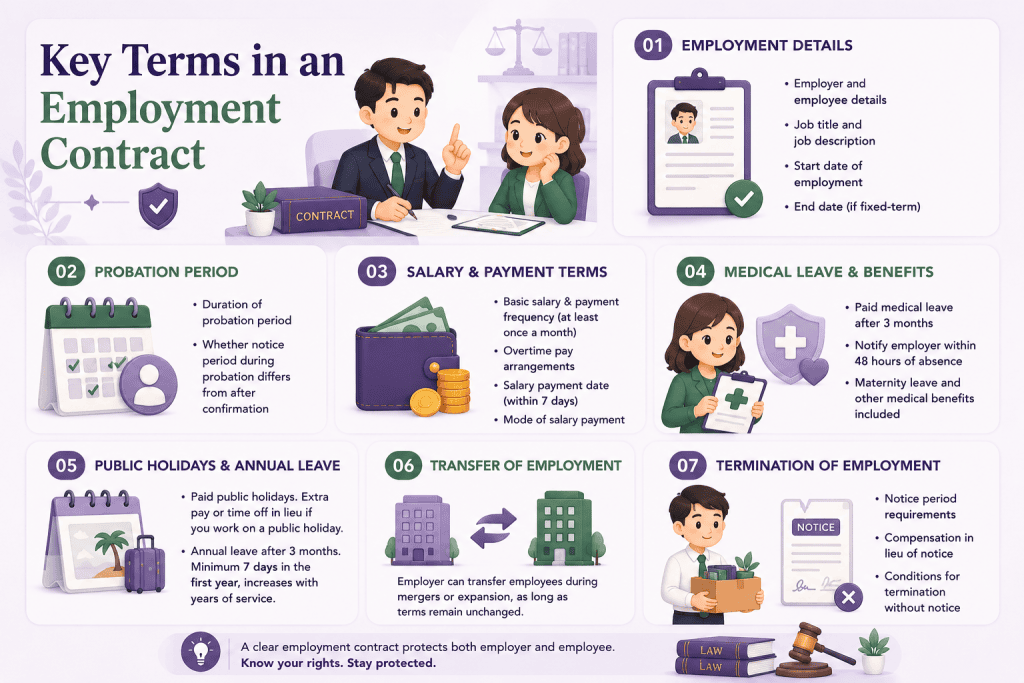
1. Employment Details
Your employment contract should clearly outline:
- Employer and employee details (full names)
- Job title and job description
- Start date of employment
- End date (if it is a fixed-term contract)
2. Probation Period
Not all employment roles require a probationary period. However, if your role includes one, it should be explicitly stated in the contract, including:
- The specific duration of the probation period
- Whether the notice period during probation differs from the notice period after confirmation
Clarifying these details in writing can prevent misunderstandings.
3. Salary and Payment Terms
The salary clause is one of the most important aspects of any employment contract, as salary disputes are common. Your contract should specify:
- Basic salary and payment frequency (at least once a month, as per the Employment Act)
- Overtime pay arrangements
- Salary payment date (should be within seven days of the agreed date)
- Mode of salary payment (e.g., bank transfer, cheque)
Failure to pay an employee’s salary on time is an offence under the Employment Act. Additionally, overtime pay should be agreed upon and clearly stated in the contract.
4. Medical Leave and Benefits
If you are covered under the Employment Act and have worked for at least three months, you are entitled to paid medical leave, provided that:
- You notify your employer within 48 hours of your absence
- Your entitlement is calculated on a pro-rata basis, based on the number of months you have worked
Additionally, maternity leave and other medical benefits should be clearly outlined in the contract.
5. Public Holidays and Annual Leave
- Public holidays: Employees are entitled to paid public holidays. If you are required to work on a public holiday, your employer must compensate you with extra pay or time off in lieu.
- Annual leave: Employees who have worked for at least three months are entitled to annual leave. The minimum entitlement starts at seven days in the first year and increases with years of service.
- These entitlements should be clearly specified in your contract to prevent any misunderstandings regarding leave payment and eligibility.
| Years of Service | Minimum Annual Leave |
|---|---|
| 1st year | 7 days |
| 2nd year | 8 days |
| 3rd year | 9 days |
| 4th year | 10 days |
| 5th year | 11 days |
| 6th year | 12 days |
| 7th year | 13 days |
| 8th year and beyond | 14 days |
6. Transfer of Employment
Employment transfers often occur during company mergers or takeovers. In such cases, an employer has the right to transfer employees as long as the employment terms remain unchanged. If your employer is planning an expansion that may result in your transfer, it is advisable that your contract includes provisions addressing this possibility.
7. Termination of Employment
Termination refers to the ending of the employment contract between an employer and an employee. The termination clause should specify:
- Notice period requirements
- Whether compensation in lieu of notice is allowed
- The conditions under which termination without notice is permitted (e.g., misconduct)
A termination letter is mandatory and should always be in writing. If an employee believes they have been wrongfully dismissed, they have the right to seek legal assistance.
What Should Be Confirmed Before Signing
Before signing an employment contract, whether as an employer issuing it or an employee reviewing it, it helps to confirm the following:
- The job title, salary, and payment terms match what was discussed during negotiation.
- Probation duration and notice periods are clearly stated for both during and after probation.
- Leave entitlements, including annual and medical leave, are specified rather than left to “company policy.”
- Any restrictive covenants, non-compete, confidentiality, or IP clauses, are reasonable and clearly worded.
- The termination clause states the notice period and any conditions for termination without notice.
This isn’t a substitute for legal review, but it’s a useful starting point before either party puts pen to paper.
Drafting a Strong Employment Contract
A legally sound employment contract does more than tick the boxes required by the Employment Act. It should be specific enough to prevent disputes, written in plain language both parties actually understand, and consistent with any company handbook or policy the employee is also bound by.
Employers should review their contract templates periodically, particularly after any change in the Employment Act or MOM guidance, and avoid copying generic templates that don’t reflect the actual role or working arrangement.
Where a role involves sensitive information, client relationships, or specialised knowledge, it’s worth having a lawyer review the restrictive covenants specifically, since these are the clauses most likely to be challenged if a dispute reaches court.
Also Read: Can Employers Reject Annual Leave Requests in Singapore?
Staying Protected with RBN Chambers
An employment contract sets the terms for the entire working relationship, and the clauses that get glossed over at signing, probation, notice periods, restrictive covenants, are often the ones that matter most when something goes wrong. Reviewing a contract carefully before signing, or having one drafted properly from the outset, is far less costly than resolving a dispute after the fact.
RBN Chambers LLC advises both employers and employees on employment contracts, drafting, review, and disputes arising from wrongful dismissal or unclear contract terms.
If you have concerns about your employment contract or are facing an employment dispute, contact RBN Chambers today for legal support tailored to your situation.
Frequently Asked Questions
Is a verbal employment contract legally binding in Singapore?
Yes, provided the essential elements of a contract are present. However, MOM requires written Key Employment Terms within 14 days of employment starting, and a verbal agreement is harder to enforce if a dispute arises.
What is the minimum notice period under the Employment Act?
If the contract doesn’t specify a notice period, the Employment Act’s default applies based on length of service, ranging from 1 day for under 26 weeks of service to 4 weeks for 5 years or more.
Can an employer change contract terms without consent?
No. Any change to a material term, such as salary, job scope, or working hours, generally requires the employee’s agreement. Unilateral changes without consent can amount to a breach of contract.

Delivering Solutions not just Answers to your legal disputes
We provide solutions to all our clients regardless of the scale or complexity of the cases. Let us know how we can help.
Contact UsAny information of a legal nature in this blog is given in good faith and has been derived from resources believed to be reliable and accurate. The author of the information contained herein this blog does not give any warranty or accept any responsibility arising in any way, including by reason of negligence for any errors or omissions herein. Readers should seek independent legal advice.