

Employment |
PIP Singapore: Performance Improvement Plan & Employee Rights

A Performance Improvement Plan (PIP) is a critical tool in the Singaporean workplace, often serving as the final bridge between underperformance and termination.
While not a legal requirement under the Employment Act, a well-structured PIP is essential for ensuring fair treatment and preventing wrongful dismissal claims. This guide explores the legal standing of PIPs in Singapore and what both employers and employees need to know.
What is Performance Improvement Plan (PIP)?
A Performance Improvement Plan (PIP) is a structured process used by employers to address and improve an employee’s underperformance through clear goals, defined timelines, and the necessary support to meet those goals.
When properly implemented, a PIP gives the employee a fair opportunity to demonstrate improvement before the employer considers more serious action such as termination.
Legal Standing of PIPs in Singapore
PIPs are a common workplace tool in Singapore, though they are not legally required under the Employment Act 1968 or mandated by the Ministry of Manpower (MOM). Singapore’s employment laws provide a framework for fair treatment and termination procedures, but they do not specifically require employers to implement a PIP before terminating an employee.
Instead, PIPs are adopted voluntarily by companies as a best practice to ensure transparency, fairness, and due process when managing underperformance. Their use aligns with the broader principles of fair, responsible, and progressive workplaces encouraged by TAFEP (Tripartite Alliance for Fair and Progressive Employment Practices).
That said, the absence of a PIP — particularly in cases where termination follows shortly after performance concerns are raised — can be a relevant factor if an employee pursues an unfair dismissal claim. Courts and tribunals may consider whether the employer took reasonable steps before terminating.
Is a PIP Required Before Termination in Singapore?
No. Under Singapore law, employers are not legally obligated to place an employee on a PIP before terminating their employment. However, the manner of termination must still be fair and in accordance with the Employment Act and applicable contract terms.
If an employer terminates an employee without cause or without following a fair process, the employee may have grounds to file a wrongful dismissal claim with the Employment Claims Tribunal (ECT). A well-documented PIP can help employers demonstrate that they acted in good faith and gave the employee a reasonable opportunity to improve.
Also Read: Wrongful Dismissal Under Singapore Law: Key Considerations for Employers and Employees
Why Companies Implement PIPs Voluntarily
The use of PIPs reflects a commitment by employers to give employees a fair chance to improve before more serious consequences are considered. By setting clear expectations, providing structured support, and monitoring progress, a PIP demonstrates that the employer has acted responsibly — which is particularly important in avoiding premature disputes or claims of unfair dismissal.
A properly implemented PIP also benefits the employee by making performance expectations explicit and giving them a defined period and support structure to turn things around.
How to Implement a PIP: Step-by-Step Guide for Employers
A PIP is only effective if it is implemented properly. Below is a practical guide for employers.
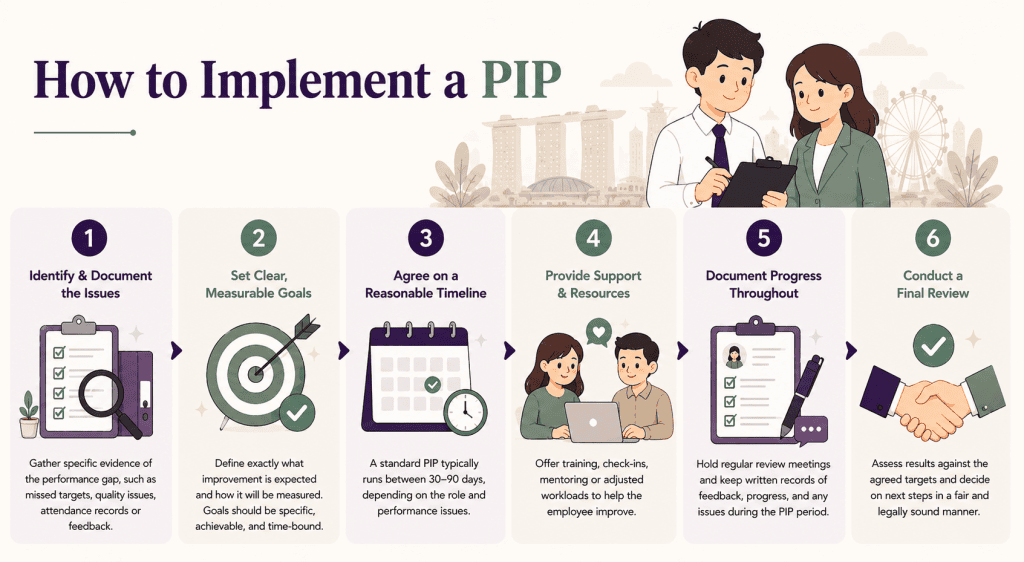
Step 1: Identify and Document the Performance Issues
Before initiating a PIP, gather specific evidence of the performance gap. This may include missed targets, quality issues, attendance records, or feedback from supervisors. Vague concerns are difficult to address and difficult to defend in a dispute.
Step 2: Set Clear, Measurable Goals
Define exactly what improvement is expected and how it will be measured. Goals should be specific, achievable, and time-bound. Avoid moving targets — if the standards shift during the PIP period, it undermines the entire process and may support an employee’s claim of bad faith.
Step 3: Agree on a Reasonable Timeline
A standard PIP typically runs between 30 and 90 days, depending on the nature of the role and the performance issues involved. The timeline should be realistic — long enough to allow meaningful improvement, but defined enough to maintain accountability.
Step 4: Provide Support and Resources
A fair PIP should include concrete support: additional training, more frequent check-ins, mentoring, or adjusted workloads where relevant. This is what separates a genuine improvement plan from a termination formality.
Step 5: Document Progress Throughout
Hold regular review meetings and keep written records of progress, feedback given, and any issues that arise during the PIP period. This documentation is critical if the matter escalates to a formal dispute.
Step 6: Conduct a Final Review
At the end of the PIP period, conduct a formal assessment. If the employee has met the agreed targets, the PIP should be formally closed and the improvement acknowledged in writing. If targets have not been met, the employer should follow a fair and legally sound process before taking further action.
Also Read: Can Employers Reject Annual Leave Requests in Singapore?
Fair PIP Checklist
| Element | What a Fair PIP Includes |
|---|---|
| Goals | Specific, measurable, and agreed upon by both parties |
| Timeline | Reasonable duration (typically 30–90 days) |
| Support | Training, mentoring, or resources provided |
| Documentation | Written records of meetings and progress |
| Review process | Regular check-ins with written feedback |
| Outcome | Clear criteria for success or failure |
PIP vs. Disciplinary Action: What Is the Difference?
| Key Difference | PIP | Disciplinary Action |
|---|---|---|
| Purpose | Address underperformance | Address misconduct or policy breaches |
| Trigger | Missed targets, quality issues | Rule violations, insubordination, dishonesty |
| Process | Goal-setting, support, review | Investigation, show-cause letter, hearing |
| Outcome | Improvement or managed exit | Warning, suspension, or dismissal |
| Legal basis | Best practice, not mandatory | Required under Employment Act for serious misconduct |
Employee Rights During a PIP in Singapore
Many employees who receive a PIP worry about what it means for their job security. Understanding your rights is essential.
1. You Have the Right to Clarity
An employer must be able to explain clearly what performance gap is being addressed. If the goals in your PIP are vague, unrealistic, or impossible to measure, this may indicate the PIP is not genuine.
2. You Have the Right to Support
A fair PIP should come with resources to help you succeed — not simply a countdown to dismissal. If no support is offered and the targets are unachievable within the timeline, document this carefully.
3. You Can Seek Legal Advice
Receiving a PIP does not mean you must handle it alone. If you believe the PIP is being used in bad faith or as a pretext for termination, consulting an employment lawyer early gives you more options and a stronger position.
4. Resigning During a PIP
You are legally entitled to resign during a PIP, subject to your notice period obligations under your employment contract. However, the decision to resign during a PIP has legal and practical consequences — particularly around whether you may be entitled to any severance, and how it affects any potential unfair dismissal claim. It is advisable to seek legal advice before resigning.
5. If You Fail Your PIP
Failing a PIP does not automatically mean termination is justified. The employer must still follow a fair process. If termination follows, you have the right to understand the reason and to challenge it through the Employment Claims Tribunal if you believe the dismissal was wrongful.
What Makes a PIP Unfair or Unreasonable?
A PIP may be considered unfair in the following circumstances:
- Goals are vague, contradictory, or changed mid-process
- The timeline is unreasonably short given the nature of the role
- No support or resources are provided
- The PIP follows a protected activity such as raising a grievance or whistleblowing
- The process appears designed to build a paper trail for a predetermined outcome
If any of these apply to your situation, you may have grounds to challenge the PIP or a subsequent termination.
Concerned About a PIP or Unfair Dismissal in Singapore? Speak With RBN Chambers
Whether you are an employer seeking to implement a legally sound Performance Improvement Plan (PIP), or an employee facing concerns about an unfair or poorly managed PIP process, obtaining early legal advice can help you understand your rights and obligations more clearly.
At RBN Chambers, our employment lawyers advise clients on a wide range of employment law matters in Singapore, including PIP disputes, wrongful dismissal claims, Employment Claims Tribunal proceedings, workplace investigations, and employment contract issues.
We work with both employers and employees to assess risks, review documentation, and provide practical legal solutions tailored to each situation.
If you are dealing with a sensitive workplace dispute or have questions about a PIP process, contact RBN Chambers to speak with our employment law team.
Frequently Asked Questions
Is a PIP mandatory before termination in Singapore?
No. Singapore law does not require employers to implement a PIP before terminating an employee. However, the absence of a fair process — including a PIP where performance is the stated reason for termination — may be relevant in an unfair dismissal claim.
Can I refuse to sign a PIP?
You can refuse to sign a PIP, but this does not nullify it. Refusing to sign may be noted by the employer. It is generally more effective to sign while noting your disagreement in writing, or to seek legal advice on how to respond formally.
What happens if I fail my PIP?
Failing a PIP does not automatically lead to dismissal. The employer must still follow a fair and documented process. If termination does follow, you have the right to be informed of the reason and to challenge it through the Employment Claims Tribunal if you believe the dismissal was wrongful.
Can I resign while on a PIP?
Yes, you may resign during a PIP subject to your contractual notice period. However, resignation during a PIP may affect your ability to bring an unfair dismissal claim and may have other legal or financial consequences. Seek legal advice before deciding.

Delivering Solutions not just Answers to your legal disputes
We provide solutions to all our clients regardless of the scale or complexity of the cases. Let us know how we can help.
Contact UsAny information of a legal nature in this blog is given in good faith and has been derived from resources believed to be reliable and accurate. The author of the information contained herein this blog does not give any warranty or accept any responsibility arising in any way, including by reason of negligence for any errors or omissions herein. Readers should seek independent legal advice.