

Legal Updates |
SIAC Rules 2025 Key Changes for Businesses

SIAC Rules are the arbitration rules of the Singapore International Arbitration Centre, and the current 7th Edition (SIAC Rules 2025) has applied to arbitrations commenced on or after 1 January 2025, replacing the 2016 6th Edition. SIAC developed this edition from its experience administering more than 3,000 cases across over 100 jurisdictions, and the changes focus on giving parties more tools to tailor the pace, cost and flexibility of their arbitration.
For businesses with existing SIAC arbitration clauses, or those negotiating dispute resolution clauses for the first time, these updates affect how disputes will actually play out if a contract goes wrong.
At RBN Chambers LLC, we set out below the changes that matter most, with reference to the specific rules involved.
Streamlined Procedure, Expedited Procedure and Ordinary Arbitration Compared
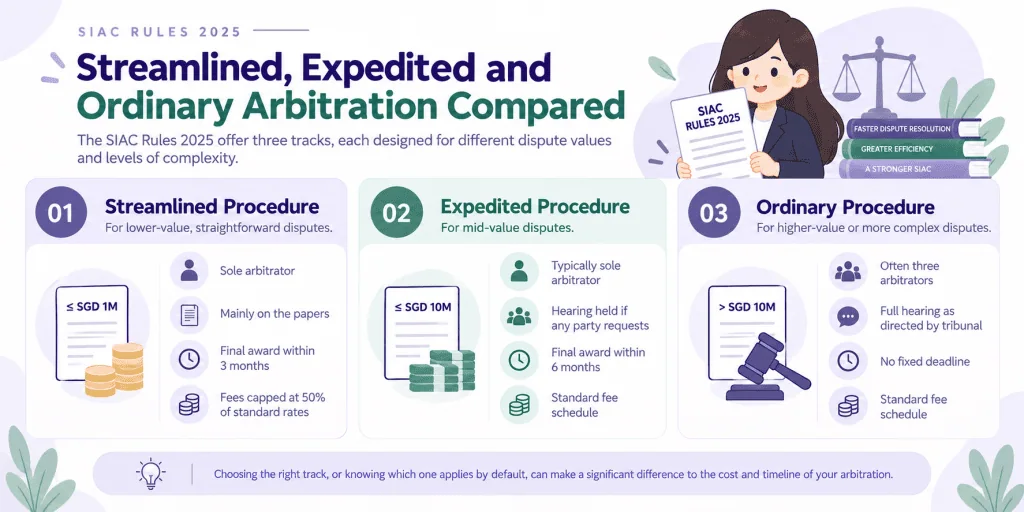
The SIAC Rules 2025 give parties three broad tracks depending on the size and complexity of a dispute, and choosing the right one or knowing which one applies by default affects both cost and timeline.
Streamlined Procedure
The Streamlined Procedure is new in this edition and applies where the amount in dispute does not exceed SGD 1 million, or where parties agree to use it regardless of value. A sole arbitrator is appointed and must be nominated within three days, proceedings are conducted mainly on the papers, and a final award is due within three months of the tribunal’s constitution.
SIAC’s and the arbitrator’s fees are also capped at 50% of the standard schedule. Because this procedure applies by default once the threshold is met, parties who would rather avoid it for a legally complex low-value claim need to apply to the President of the SIAC Court of Arbitration or agree in writing to exclude it.
Expedited Procedure
The Expedited Procedure sits above the Streamlined Procedure, and its monetary ceiling has been raised from SGD 6 million to SGD 10 million. A sole arbitrator is typical, and a final award is targeted within six months of constitution.
One notable refinement in this edition is that if any party requests an oral hearing, that hearing must be held removing earlier uncertainty about whether the tribunal could decide on the papers alone.
Ordinary Procedure
Disputes that exceed the Expedited Procedure threshold, or that parties don’t opt to fast-track, proceed under SIAC’s standard arbitration process, typically with a three-member tribunal for larger or more complex matters and no fixed award deadline beyond the tribunal’s own case management timetable.
| Feature | Streamlined Procedure | Expedited Procedure | Ordinary Procedure |
|---|---|---|---|
| Dispute value | Up to SGD 1 million (or by agreement) | Up to SGD 10 million | Above SGD 10 million, or by choice |
| Arbitrator(s) | Sole arbitrator | Typically sole arbitrator | Often three arbitrators |
| Hearing | Written submissions only, unless tribunal decides otherwise | Hearing held if any party requests one | Full hearing as directed by tribunal |
| Award timeline | 3 months from constitution | 6 months from constitution | No fixed deadline |
| Fee treatment | Capped at 50% of standard fees | Standard fee schedule | Standard fee schedule |
Enhanced Emergency Arbitration and Protective Preliminary Orders
Rule 12 and Schedule 1 strengthen how quickly a business can get urgent interim relief before a full tribunal is even in place.
Applying for an Emergency Arbitrator
- Parties may apply for an Emergency Arbitrator before filing a Notice of Arbitration, provided the Notice follows within seven days
- SIAC appoints the Emergency Arbitrator, who then oversees the interim relief application
Protective Preliminary Orders
- Parties may request a Protective Preliminary Order (PPO) on an ex parte basis, without first notifying the other side, where notice would undermine the relief sought
- The Emergency Arbitrator must decide the PPO application within 24 hours of appointment
- The applicant must serve case materials on the other party and file proof of service within 12 hours of receiving the order
- An order that isn’t served in time automatically expires within three days
This makes SIAC one of the few major arbitral institutions to expressly permit ex parte emergency relief, ahead of the ICC and LCIA on this point.
Also Read: Conditional Fee Arrangement for Legal Proceedings in Singapore
Mandatory Disclosure of Third-Party Funding
Rule 38 is entirely new to this edition and responds to the growing use of litigation funding in Singapore-seated arbitration.
- A party must disclose the existence of any third-party funding agreement, and the funder’s identity and contact details, in its Notice of Arbitration or Response, or as soon as practicable after signing a funding agreement
- A party cannot enter into a new funding agreement after the tribunal is constituted if doing so would create a conflict of interest with an arbitrator
- The tribunal may order further disclosure, including the funder’s interest in the outcome and any commitment to cover adverse costs
For businesses, this cuts both ways: it protects against undisclosed conflicts, but it also means funding arrangements are no longer confidential once arbitration is on foot.
Preliminary Determination and Early Dismissal Compared
The 2025 Rules give tribunals two distinct routes for resolving issues before a full award, and parties are generally better served understanding which one fits their situation rather than assuming they’re interchangeable.
Rule 46 codifies a general power to issue a binding preliminary determination on any issue, while Rule 47 is reserved for claims or defences that are manifestly without legal merit or manifestly outside the tribunal’s jurisdiction — a deliberately high bar.
Commentators following the rules since their release have generally suggested Rule 46 will see more use than Rule 47, precisely because it doesn’t require meeting that stricter threshold.
| Feature | Preliminary Determination (Rule 46) | Early Dismissal (Rule 47) |
|---|---|---|
| Threshold | Parties agree, or applicant shows time/cost savings, or tribunal finds circumstances warrant it | Claim or defence manifestly without legal merit, or manifestly outside jurisdiction |
| Scope | Any issue in the arbitration | Whole claims or defences only |
| Tribunal decision deadline | 90 days from application | 45 days from application (down from 60 days under the 2016 Rules) |
| Best suited to | Discrete, fact-agreed legal issues | Weak or jurisdictionally flawed claims |
Consolidation, Coordinated Proceedings and Joinder
Businesses dealing with multi-contract or multi-party disputes now have three separate mechanisms to manage related arbitrations, and it’s worth being clear on which applies where.
Consolidation
Consolidation under Rule 16 merges two or more arbitrations into a single proceeding, and is available where the arbitrations arise from compatible arbitration agreements and the same underlying legal relationship or transaction.
Coordinated Proceedings
Coordinated Proceedings under Rule 17 is new to this edition. Where the same tribunal is constituted in two or more arbitrations sharing a common question of law or fact, a party can apply to have the arbitrations run concurrently or sequentially, heard together, or with one suspended pending the outcome of another. Unlike consolidation, the arbitrations stay legally separate, with their own awards, unless the parties agree otherwise.
Joinder
Joinder under Rule 18 allows an additional party to be brought into an existing arbitration, typically where that party is bound by the same arbitration agreement.
SIAC Rules 2025 One Year On
SIAC’s newly published 2025 Annual Report gives the first full-year picture of how these changes have played out in practice, and the numbers suggest steady uptake rather than a slow start.
SIAC handled 886 new cases in 2025, its second-highest caseload on record and up from 625 in 2024, with a total sum in dispute of roughly US$14.53 billion (SGD 18.66 billion) — also a record. Parties came from 79 jurisdictions, up from 72 the year before, and 89% of cases were international.
On the new procedures specifically, 60 cases proceeded under the Streamlined Procedure and were concluded within the three-month target, 130 applications were made for the Expedited Procedure with 55 accepted (a 42% acceptance rate), and of 19 Emergency Arbitrator applications, 18 were accepted. SIAC also used the year to launch its Institute of Ethics in International Arbitration and a Restructuring and Insolvency Arbitration Protocol.
For businesses, this is a useful signal: the Streamlined Procedure’s three-month timeline is being met in practice, not just on paper, and the Expedited Procedure’s higher acceptance bar means it’s still being applied selectively rather than as a rubber stamp.
Reviewing Your Arbitration Clause After the SIAC Rules 2025
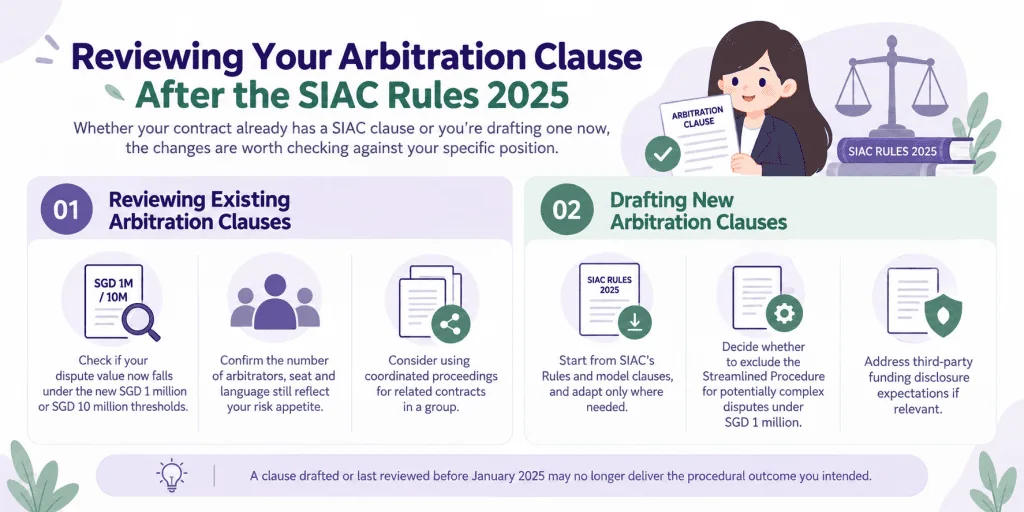
Whether a contract already has a SIAC clause or you’re drafting one now, the changes above are worth checking against your specific position.
Reviewing Existing Arbitration Clauses
- Check whether a likely dispute value would now fall under the Streamlined Procedure’s SGD 1 million threshold or the expanded SGD 10 million Expedited Procedure threshold
- Confirm the number of arbitrators, seat and language specified still reflect your risk appetite, since the Streamlined Procedure’s sole-arbitrator default overrides a multi-arbitrator clause unless excluded
- Consider whether related contracts in a group structure would benefit from the new coordinated proceedings option if a dispute arises across more than one agreement
Drafting New Arbitration Clauses
- Start from SIAC’s published Rules and model clauses, which can also be downloaded in full as a PDF, and adapt only where a specific commercial need requires it
- Decide upfront whether to exclude the Streamlined Procedure for disputes that could be legally complex despite falling under SGD 1 million
- Address third-party funding disclosure expectations explicitly if outside funding is a realistic possibility for either party
An arbitration clause that hasn’t been reviewed since before January 2025 may no longer produce the procedural outcome the parties originally intended, particularly on dispute value thresholds. At RBN Chambers, we regularly assist clients in reviewing SIAC clauses in existing contracts and in drafting new ones for commercial and cross-border agreements.
Also Read: Proposed Changes to the Maintenance of Parents Act 1995
Speak to RBN Chambers About Your SIAC Arbitration Clause
The SIAC Rules 2025 give businesses more procedural options than before, but that also means more decisions to get right at the drafting stage, and more ways an existing clause might now behave differently than intended.
Whether you’re negotiating a new cross-border contract or checking how a dispute would actually be handled under an agreement you already have, it’s worth having those clauses reviewed against the current rules rather than assuming the 2016 position still applies.
Ramesh Bharani Nagaratnam and the arbitration team at RBN Chambers LLC advise businesses on drafting, reviewing and enforcing SIAC arbitration clauses, and on managing disputes once they arise. Contact RBN Chambers to discuss your contracts or an active dispute.
Frequently Asked Questions
What is the claim limit for the SIAC Streamlined Procedure?
The Streamlined Procedure applies to disputes worth up to SGD 1 million, or to any value if the parties agree to use it.
When did the SIAC Rules 2025 take effect?
The 7th Edition took effect on 1 January 2025 and applies to arbitrations commenced on or after that date, unless the parties agree otherwise.
How is the Expedited Procedure different from the Streamlined Procedure?
The Expedited Procedure covers disputes up to SGD 10 million (raised from SGD 6 million), targets a six-month award rather than three months, and requires a hearing if any party asks for one.
Can I get emergency relief without notifying the other party first?
Yes. Protective Preliminary Orders under Schedule 1 allow an ex parte application, which the Emergency Arbitrator must decide within 24 hours.
Do I have to disclose third-party funding in a SIAC arbitration?
Yes. Rule 38 requires disclosure of the existence and identity of any third-party funder, and the tribunal can order further details to be disclosed.
What’s the difference between preliminary determination and early dismissal?
Preliminary determination (Rule 46) can resolve any issue where parties agree or the tribunal sees a benefit, within 90 days. Early dismissal (Rule 47) is reserved for claims or defences that are manifestly without merit or outside the tribunal’s jurisdiction, decided within 45 days.
Does the SIAC Rules 2025 apply to an arbitration clause I signed before 2025?
Generally yes, if the arbitration itself is commenced on or after 1 January 2025, since the rules attach to when the arbitration starts rather than when the contract was signed, which is one reason to review older clauses now.

Delivering Solutions not just Answers to your legal disputes
We provide solutions to all our clients regardless of the scale or complexity of the cases. Let us know how we can help.
Contact UsAny information of a legal nature in this blog is given in good faith and has been derived from resources believed to be reliable and accurate. The author of the information contained herein this blog does not give any warranty or accept any responsibility arising in any way, including by reason of negligence for any errors or omissions herein. Readers should seek independent legal advice.