

Business |
Alternative Dispute Resolution (ADR) Methods in Singapore

When a business dispute arises, litigation is no longer the default first step. Singapore’s courts now actively expect parties to consider settling matters amicably, the Rules of Court 2021 place disputing parties under a duty to consider an amicable resolution, such as mediation, before and even during a court action.
This shift, combined with the cost and time pressure of a full trial, has made Alternative Dispute Resolution (ADR) the preferred starting point for businesses in Singapore.
Alternative Dispute Resolution (ADR) refers to any method of resolving a dispute outside of the courtroom, typically with the help of a neutral third party. It is usually faster, more private, and less adversarial than litigation, which makes it especially useful for businesses that want to preserve a commercial relationship or keep the details of a dispute confidential.
Alternative Dispute Resolution
Singapore recognises five main forms of Alternative Dispute Resolution, each suited to a different kind of dispute:
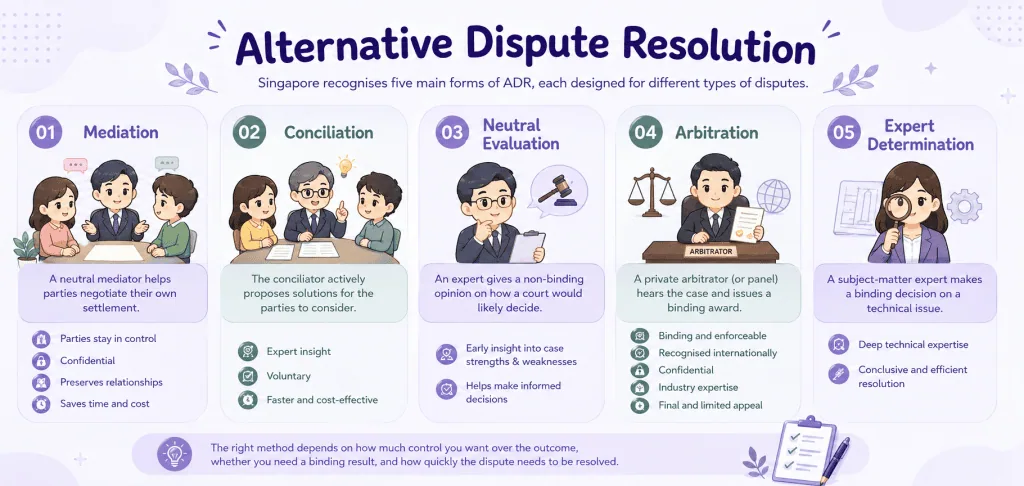
- Mediation — a neutral mediator helps parties negotiate their own settlement
- Conciliation — similar to mediation, but the conciliator actively proposes solutions
- Neutral Evaluation — an expert gives a non-binding opinion on how a court would likely decide the case
- Arbitration — a private arbitrator (or panel) hears the case and issues a binding award
- Expert Determination — a subject-matter expert is appointed to make a binding decision on a technical issue
| Method | Decision Maker | Binding Status | Typical Duration |
|---|---|---|---|
| Mediation | The parties themselves | Not binding until recorded in a signed settlement | Days to a few weeks |
| Conciliation | The parties, guided by the conciliator’s proposals | Not binding unless the proposal is accepted in writing | Weeks |
| Neutral Evaluation | The parties, informed by the evaluator’s opinion | Non-binding | A few weeks |
| Arbitration | The arbitrator(s) | Binding award, enforceable like a judgment | Around 12 to 24 months |
| Expert Determination | The appointed expert | Binding, per the parties’ agreement | Weeks to a few months |
The right method depends on how much control you want over the outcome, whether you need a binding result, and how quickly the dispute needs to be resolved. Each is explained in more detail below.
1. Mediation
Mediation is a consensual process in which parties agree to resolve their dispute amicably, facilitated by a neutral third party called the mediator. The mediator does not decide the outcome — their role is to guide discussions between the parties and help them reach common ground.
Mediation is administered in Singapore by institutions such as the Singapore Mediation Centre (SMC) and, for cross-border commercial matters, the Singapore International Mediation Centre (SIMC). Most commercial mediations are completed within one to three days once scheduled.
Benefits of mediation:
- Flexibility — parties control whether and how the dispute is resolved
- Confidentiality — discussions cannot be used in later litigation if the dispute isn’t resolved
- Preserves relationships — the collaborative process helps parties stay on workable terms
- Cost and time savings — sessions are typically measured in days, not months
2. Conciliation
Conciliation is similar to mediation, but the conciliator typically plays a more active role by proposing solutions for the parties to consider, rather than only facilitating discussion.
Benefits of conciliation:
- Expert insight — conciliators are usually experienced in the relevant industry or subject matter
- Voluntary — parties retain the right to accept or decline any proposed solution
- Speed — generally faster than litigation, with lower legal costs
3. Neutral Evaluation
In neutral evaluation, an experienced legal professional or subject-matter expert gives an early, non-binding assessment of the dispute and how a court is likely to decide it.
Benefits of neutral evaluation:
- Early insight — parties understand the strengths and weaknesses of their case before litigating
- Better decision-making — the assessment helps parties choose the most appropriate next step
4. Arbitration
Arbitration is available where parties have agreed — usually in a contract, before any dispute arises — to refer disputes to arbitration. An arbitrator or panel is appointed to hear both sides and issue a decision, known as an award.
Singapore is one of the world’s leading arbitration seats, home to the Singapore International Arbitration Centre (SIAC). The SIAC’s own study found its arbitrations take just under 14 months on average to conclude, and its 7th edition rules (in force since 1 January 2025) now actively encourage tribunals to raise mediation as an option throughout the arbitration process — a sign of how closely the two mechanisms now work together in Singapore.
Benefits of arbitration:
- Binding — the award is enforceable in the same way as a court judgment
- Internationally enforceable — SIAC awards are recognised in over 170 New York Convention countries
- Confidential — the entire proceeding is private
- Expertise — arbitrators are often specialists in the relevant industry
- Finality — very limited grounds exist to appeal an award
5. Expert Determination
In expert determination, an expert in the specific subject matter of the dispute — for example, a valuation, technical, or construction issue — is appointed to make a binding decision.
Benefits of expert determination:
- Deep expertise — the decision-maker has a thorough grasp of the technical issues in dispute
- Finality — provides a conclusive resolution without a full hearing process
Also Read: How to Sue Someone in Singapore? 8 Steps (2026)
ADR in the Singapore Courts and the SICC
ADR is no longer treated as separate from the court system in Singapore — it’s built into it. Under the Rules of Court 2021, parties in the State Courts and the General Division of the High Court are expected to make a genuine offer of amicable resolution before commencing an action, and courts can take a party’s efforts (or lack of them) into account when awarding legal costs.
For international commercial disputes, the Singapore International Commercial Court (SICC) has gone a step further with its Litigation-Mediation-Litigation Protocol, developed with SIMC, which lets parties pause SICC proceedings to attempt a structured mediation before returning to litigation if needed.
This reflects a broader Singapore approach: litigation, arbitration and mediation are treated as complementary tools rather than competing ones.
ADR for Employment Disputes in Singapore
Employment disputes follow their own ADR track. Salary and wrongful dismissal claims must first go through mediation at the Tripartite Alliance for Dispute Management (TADM) before they can be filed at the Employment Claims Tribunals (ECT).
This isn’t a formality, MOM’s Employment Standards Report 2024 shows the large majority of TADM cases are resolved through mediation without ever reaching the ECT.
This mediation-first approach is also expanding. The Workplace Fairness (Dispute Resolution) Bill, passed in November 2025, will require mandatory mediation before a workplace discrimination claim can be brought to the ECT or the General Division of the High Court, once it takes effect.
Businesses should expect mediation to remain the compulsory first step for an even wider range of workplace disputes going forward.
If your business is navigating a dispute with an employee, our Employment Disputes team can advise on how the TADM process affects your options.
Is ADR Legally Binding and Enforceable in Singapore
Whether an ADR outcome is binding depends entirely on the method used:
- Arbitration and expert determination produce binding decisions by default — an arbitral award is enforceable in the same way as a court judgment, and in over 170 countries under the New York Convention.
- Mediation and conciliation are not binding on their own. A settlement only becomes enforceable once it is signed by the parties. Under the Mediation Act 2017, a mediated settlement reached in Singapore can be recorded as an order of court, making it directly enforceable. For international commercial disputes, the Singapore Convention on Mediation Act 2020 goes further, allowing a mediated settlement to be enforced directly in any signatory country without treating it as an ordinary contract.
- Neutral evaluation is purely advisory, its value lies in helping parties decide their next step, not in producing an enforceable outcome.
This is one of the reasons businesses increasingly combine methods, for example, the SIAC-SIMC Arb-Med-Arb Protocol lets parties start arbitration, pause for mediation, and record any settlement as a consent arbitral award, combining mediation’s cost-effectiveness with an arbitral award’s enforceability.
Also Read: Litigation vs Arbitration: What’s Better for Resolving Disputes?
Choosing the Right ADR Method for Your Business
There is no single “best” ADR method, the right choice depends on whether you want a binding outcome, how much control you want over the result, whether the dispute crosses borders, and how important confidentiality is to your business.
A dispute over an ongoing supplier relationship may call for mediation to preserve the relationship, while a cross-border contract dispute may be better suited to arbitration for its enforceability.
Getting this choice wrong early on can add months and significant legal cost to resolving a dispute. This is where experienced guidance makes the difference, not just in choosing the right process, but in drafting the dispute resolution clauses that determine which options are even available to you when a dispute arises.
Speak With RBN Chambers About Your Dispute
Every dispute carries its own commercial pressures, and the “right” resolution method is rarely obvious from the outside.
At RBN Chambers, Ramesh Bharani Nagaratnam and the team regularly advise Singapore businesses on whether mediation, arbitration, or another route gives them the fastest and most cost-effective path to a resolution, and represent clients through that process from start to finish.
If you’re currently in a dispute, or want to build stronger dispute resolution clauses into your contracts before one arises, contact RBN Chambers today to discuss your options.
Frequently Asked Questions
What is Alternative Dispute Resolution (ADR)?
ADR refers to any method of resolving a dispute without going to trial, usually with the help of a neutral third party. In Singapore, the main forms are mediation, conciliation, neutral evaluation, arbitration and expert determination.
Is Alternative Dispute Resolution binding in Singapore?
It depends on the method. Arbitration and expert determination produce binding decisions. Mediation and conciliation are only binding once a signed settlement is reached, which can then be recorded as a court order under the Mediation Act 2017.
How does ADR compare to litigation in terms of cost and time?
Mediation and conciliation are typically the fastest and least expensive, often resolved within days or weeks. Arbitration takes longer, SIAC’s own data shows an average of just under 14 months but is usually still faster and more predictable than litigation, which can take well over a year depending on complexity.
Can Alternative Dispute Resolution be used for international business disputes?
Yes. Arbitration awards from institutions like SIAC are enforceable in over 170 countries under the New York Convention, and the Singapore Convention on Mediation Act 2020 allows international mediated settlements to be enforced directly across signatory states.
Is mediation compulsory for employment disputes in Singapore?
Yes, for salary and wrongful dismissal claims — mediation at TADM is compulsory before a claim can proceed to the Employment Claims Tribunals. Mandatory mediation is also being extended to workplace discrimination disputes under the Workplace Fairness (Dispute Resolution) Bill.
Delivering Solutions not just Answers to your legal disputes
We provide solutions to all our clients regardless of the scale or complexity of the cases. Let us know how we can help.
Contact UsAny information of a legal nature in this blog is given in good faith and has been derived from resources believed to be reliable and accurate. The author of the information contained herein this blog does not give any warranty or accept any responsibility arising in any way, including by reason of negligence for any errors or omissions herein. Readers should seek independent legal advice.