

Business |
Debt Recovery in Singapore: A Complete Guide

Your customer signed a contract, the invoice is overdue, and a WhatsApp reply says “will pay next week” but nothing arrives. If this sounds familiar, you’re not alone.
In Singapore, unpaid debts can start with a simple delay and quickly become a real cash flow problem, especially when there’s no clear payment date or the debtor stops responding altogether.
Debt recovery in Singapore covers a range of approaches, from informal reminders and negotiation to formal legal action and court enforcement, and knowing which route fits your situation can save significant time and cost.
What Debt Recovery Means
Debt recovery refers to the process of collecting money owed by an individual or business that has failed to pay within the agreed terms.
In Singapore, this can be pursued informally through direct communication, semi-formally through mediation, or formally through the Small Claims Tribunal, civil litigation, or, in more serious cases, bankruptcy or winding up proceedings against a debtor who ignores a statutory demand.
A statutory demand is a notice sent to a debtor (who may be an individual or a company) which states the amount of the debt as of the date of the demand. It informs the debtor of the basis of the demand, the time in which the demand is to be complied with, and that if the demand is not complied with, bankruptcy or insolvency proceedings may be commenced against them.” (SG Courts: Serve a statutory demand on a debtor (from 1 April 2022))
The right approach depends on the size of the debt, whether it’s disputed, the relationship with the debtor, and how quickly payment is needed. Businesses with recurring non-payment issues often benefit from having a structured recovery process in place, rather than deciding on an ad hoc basis each time an invoice goes unpaid.
Assessing the Debtor Before You Proceed
Before spending time or money on recovery, it’s worth checking whether the debtor actually has the means to pay. Pursuing a debtor with no assets and no income can result in a judgment that’s never actually collected, which is a common source of frustration for creditors.
A lawyer can help assess the debtor’s financial position, including whether they own property, have a business with visible assets, or hold a stable job.
This assessment shapes the recovery strategy, a debtor who’s genuinely unable to pay may be better handled through a negotiated payment plan, while a debtor who’s simply avoiding payment despite having the means may warrant a firmer legal approach from the outset.
Methods of Debt Recovery in Singapore
Informal Reminders and Negotiation
Most debt recovery begins before any legal step is taken. This usually includes reminder emails, phone calls, WhatsApp messages, and checking whether the debt is actually due under the contract or invoice terms. If there’s a clear agreement, those terms matter. If the debt is disputed, it may take longer to resolve.
At this stage, it’s often useful to review documents such as the signed contract, purchase order, delivery records, and unpaid invoices, since this confirms the legal basis for the claim and avoids wasting time on demands that aren’t properly supported.
Letter of Demand
A letter of demand is usually the first formal step in debt recovery. It states the amount owed, the basis of the debt, and a firm deadline for payment, and is often prepared and sent within 1 to 3 working days once the relevant documents are in order.
For many creditors, this is the turning point. A properly drafted demand letter signals that the matter is now serious and may lead to legal action if ignored.
A common response window given in a letter of demand is 7 to 14 days, though there is no prescribed legal rule. The deadline will depend on the facts, the size of the debt, and how urgent the matter is. If you need assistance, this is where drafting a letter of demand can be useful.
Mediation
Mediation can be a practical middle step when the debtor acknowledges the debt but needs time to pay, or when both sides want to avoid litigation costs. In Singapore, mediation may happen privately, through a lawyer-led discussion, or through a court-linked process depending on the case.
Typical mediation timelines range from 2 to 8 weeks from the point the parties agree to mediate. It’s often useful where the relationship matters, such as ongoing supplier, landlord, or service agreements — but if the debtor is simply stalling, mediation may not lead to payment and shouldn’t cause unnecessary delay.
Legal Action Through the Courts
If informal steps and mediation don’t work, court proceedings may be the next option. The proper forum depends on the amount claimed and the nature of the dispute. Singapore’s court process is administered through the State Courts, with small claims governed by the Small Claims Tribunals Act where applicable.
Before filing, creditors should check whether the claim falls within the Small Claims Tribunal’s jurisdiction or whether a civil suit by writ of summons is needed. For debts owed by companies that ignore a formal demand, a statutory demand may also be used as a precursor to winding up proceedings.
Also Read: How to Recover Unpaid Invoices in Singapore (Step by step)
How Long Debt Recovery Takes in Singapore
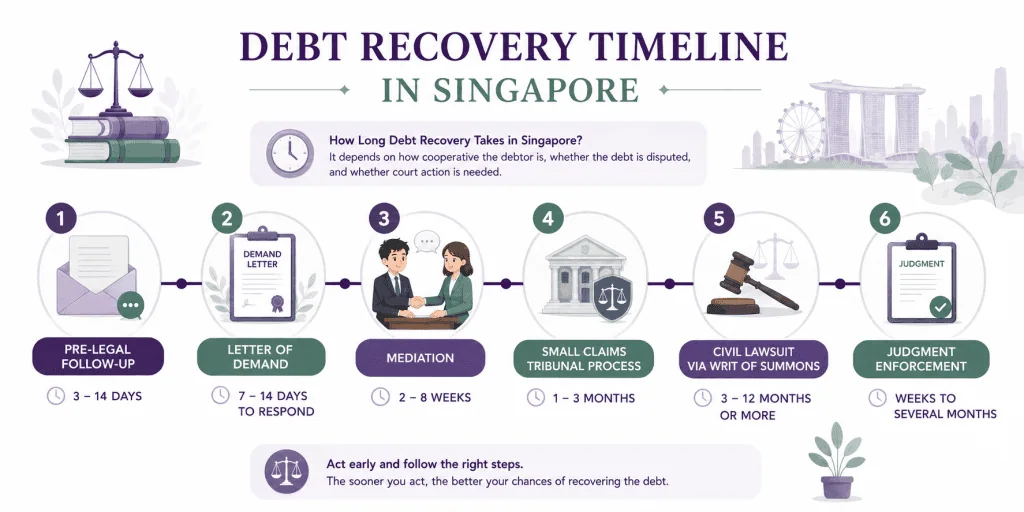
The time needed to recover a debt in Singapore usually depends on three things: how cooperative the debtor is, whether the debt is disputed, and whether court action is needed. If the debtor pays after a letter of demand, recovery may take only a few weeks.
If the matter becomes a civil lawsuit, the process may take several months or longer. If enforcement is required after judgment, additional time is needed to trace assets or take enforcement steps.
Below is a practical summary of the usual timeline.
| Recovery Stage | Average Timeline | Key Action Required |
|---|---|---|
| Pre-legal follow-up | 3 to 14 days | Send reminders, check invoice terms, and confirm the debt in writing |
| Letter of demand | 7 to 14 days to respond | Issue a formal demand with a clear payment deadline |
| Mediation | 2 to 8 weeks | Negotiate settlement or payment terms before litigation |
| Small Claims Tribunal process | 1 to 3 months | File a claim if the debt falls within the Tribunal’s scope |
| Civil lawsuit via writ of summons | 3 to 12 months or more | Start court proceedings in the State Courts or High Court, depending on the claim |
| Judgment enforcement | Weeks to several months | Enforce the court order if payment is still not made |
Small Claims Court Timeline
If the debt qualifies as a small claim, the Small Claims Tribunal process is usually faster than ordinary civil litigation, with a timeline from filing to hearing and resolution of around 1 to 3 months, depending on the schedule and whether the parties settle early. This route is designed for simpler disputes within the Tribunal’s monetary limits and isn’t suitable for every debt claim.
Civil Lawsuit Timeline
A civil lawsuit timeline in Singapore commonly ranges from 3 to 12 months or more. Simple matters may settle early, while more complex claims — especially where liability or quantum is disputed — can take longer. If the defendant doesn’t respond, the claimant may seek judgment in default, which can shorten the process.
Enforcing a Judgment
Getting a judgment or court order doesn’t always mean immediate payment. If the debtor still refuses to pay, the creditor may need to take enforcement action, often called judgment enforcement.
Available enforcement methods depend on the facts of the case and may include options such as a Writ of Seizure and Sale, garnishee proceedings, or examination of judgment debtor proceedings.
The right step depends on whether the debtor has money in a bank account, assets that can be seized, or income that can be traced. The judgment enforcement timeline can take weeks to several months after judgment is obtained, especially if assets must be identified first.
Also Read: 5 Common Types of Legal Disputes in Singapore (2026 Guide)
Costs of Debt Recovery in Singapore
Legal costs for debt recovery vary depending on the complexity of the case and how far it progresses. A letter of demand is typically inexpensive, while a Small Claims Tribunal filing carries only modest lodging fees. Costs rise significantly for a contested civil suit, particularly if the matter goes to trial.
Some lawyers offer a flat or capped fee for straightforward matters, quoted before any paid work begins, which gives creditors clarity on cost before committing. If the creditor wins, courts often award partial recovery of legal costs from the debtor, though this is rarely a full reimbursement and depends on the debtor actually having the means to pay.
When to Hire a Debt Recovery Lawyer
Many creditors start with a letter of demand on their own, but legal representation becomes more important in certain situations.
- The debtor disputes the claim: Once liability or the amount owed is contested, a lawyer helps build and present a stronger case
- Repeated demands are ignored: A lawyer’s letter carries more weight and signals the matter is now serious
- The amount makes litigation or enforcement likely: Larger claims often justify legal representation from the outset
- Assessing recovery potential: A lawyer can evaluate whether a debtor is worth pursuing, helping avoid spending on a case with little chance of actual recovery
For businesses dealing with recurring non-payment, having a lawyer involved from the letter of demand stage, rather than only after a dispute escalates, often leads to faster resolution, since a properly drafted demand carries more weight and can be used as evidence if the matter proceeds to court.
Let RBN Chambers Handle Your Debt Recovery
Debt recovery in Singapore rarely follows a single fixed path — the right approach, and how long it takes, depends on the debtor’s solvency, whether the claim is disputed, and how quickly evidence and documentation are in order.
RBN Chambers assists businesses with commercial dispute resolution and corporate legal services, including assessing a debtor’s solvency, drafting an effective letter of demand, and pursuing court action or enforcement when informal efforts fail. Contact us here!
Frequently Asked Questions
How long does a debtor have to respond to a letter of demand in Singapore?
There’s no fixed statutory response period, but many letters of demand give the debtor 7 to 14 days to pay or respond.
What is the time limit to bring a debt recovery claim in Singapore?
Under the Limitation Act 1959, contract claims must be brought within 6 years from the date on which the cause of action accrued. For a debt recovery claim, this would be the date on which the debt became due and payable.
Can I go straight to a civil lawsuit instead of the Small Claims Tribunal?
If your claim exceeds the Small Claims Tribunal’s monetary limit, or involves complexities the Tribunal doesn’t handle, you can file directly in the State Courts or High Court by writ of summons.
How long does a full civil lawsuit take to recover a debt?
A civil lawsuit timeline in Singapore commonly takes 3 to 12 months or more, depending on whether the claim is contested and how quickly the court process moves.
What happens if the debtor still doesn’t pay after a judgment?
The creditor can pursue enforcement, such as a Writ of Seizure and Sale, garnishee proceedings, or, in more serious cases, bankruptcy or winding up proceedings.
Delivering Solutions not just Answers to your legal disputes
We provide solutions to all our clients regardless of the scale or complexity of the cases. Let us know how we can help.
Contact UsAny information of a legal nature in this blog is given in good faith and has been derived from resources believed to be reliable and accurate. The author of the information contained herein this blog does not give any warranty or accept any responsibility arising in any way, including by reason of negligence for any errors or omissions herein. Readers should seek independent legal advice.