

General |
5 Common Types of Legal Disputes in Singapore (2026 Guide)

Legal disputes in Singapore can arise in many forms, from business disagreements and financial conflicts to family-related matters. Understanding the nature of a dispute is often the first step towards protecting your rights and finding an effective resolution.
Whether you are an individual, business owner, creditor, or beneficiary of an estate, legal disputes can have significant financial and personal consequences. This guide outlines five of the most common types of legal disputes in Singapore and explores the available methods for resolving them.
What Is a Legal Dispute?
A legal dispute arises when two or more parties disagree over their legal rights, obligations, or interests. Such disputes may involve individuals, companies, financial institutions, or family members.
Legal disputes can stem from various circumstances, including breach of contract, professional negligence, debt recovery issues, inheritance disagreements, and shareholder conflicts. Depending on the facts of the case, disputes may be resolved through negotiation, mediation, arbitration, or litigation before the Singapore courts.
Civil vs. Criminal Disputes: What Is the Difference?
Before examining the specific categories, it helps to understand the fundamental distinction between civil and criminal disputes.
- A civil dispute involves a conflict between two or more private parties — individuals or organisations — over legal rights and obligations. The goal is typically compensation or a court order to remedy the harm caused. Examples include contract breaches, negligence claims, and estate disagreements.
- A criminal dispute, by contrast, is brought by the State against an individual or entity accused of violating the Penal Code or other criminal statutes. The consequences involve punishment rather than compensation, and the burden of proof is higher.
Also Read: Tort Claims in Singapore: What to Do When Someone’s Negligence Harms You
5 Common Types of Legal Disputes
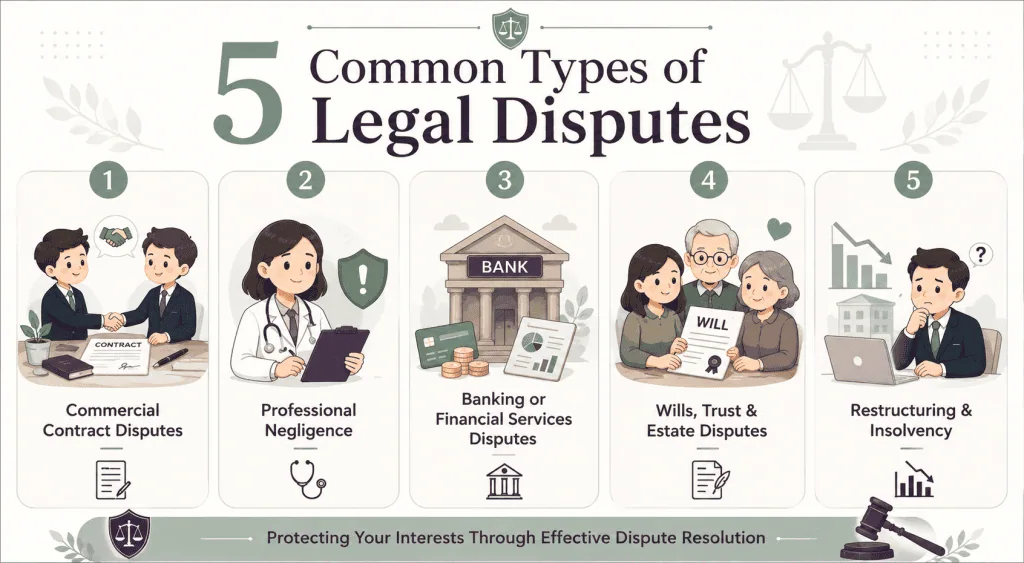
1. Commercial Contract Disputes
Contracts are the foundation of most commercial relationships, creating legal obligations between contracting parties and ensuring proper redress if things go wrong. Due to the complexity of doing business today, disputes over commercial contracts are inevitable — arising between customers, suppliers, shareholders, landlords, tenants, and many others.
Common examples include disputes over sale of goods and services, warranty and indemnity claims, mergers and acquisitions, misrepresentation, breaches of fiduciary duties, and economic torts such as conspiracy.
2. Professional Negligence
When a professional — such as a doctor, accountant, architect, or financial advisor — fails to exercise the required standard of skill and care, the affected party may have a claim for professional negligence. It must be shown that this failure directly caused the client to suffer reasonably foreseeable loss.
For complex matters such as medical negligence, expert opinion is typically required to assess the standard of care received. The general time limit for such claims is three years from the date the negligent act occurred or from when the claimant became aware of the problem.
3. Banking or Financial Services Disputes
Banking or Financial disputes are technical and complex in nature, potentially involving several jurisdictions and could have far reaching consequences on one’s reputation and/or regulatory obligations. Therefore, it can be overwhelming for an individual or an organisation to manage any such disputes against banks or other investment bodies.
Whether you are an investor who had suffered losses from an investment, a business in dispute with your lender or an investment professional facing allegations of negligence, our Commercial Litigation Lawyers can assist.
4. Wills, Trust and Estate Disputes
Disputes over Wills, Trusts and Estates occur at times of losing a loved one, emotional vulnerability and distress. Such disputes are unpleasant as they involve close family and loved ones. It is demanding to bring or defend such claims.
Disputes over Wills, Trusts, and Estates are never similar; the circumstances surrounding such disputes vary. This demands a tailored and suitable response that will balance sensitivity with pragmatism. Whether it is making or defending a dispute against a Will or estate, our Litigation Lawyers can assist.
5. Restructuring & Insolvency
Insolvency is a situation where a business is in financial difficulty and unable to repay its debts as they become due. Such a situation may lead to insolvency proceedings where legal action is taken against the insolvent entity to liquidate its assets to pay off outstanding debts to creditors.
Prior to commencing insolvency proceedings, the insolvent company may be involved in a restructuring arrangement with creditors to work out alternative ways to repay the outstanding debt. Insolvency proceedings will be commenced if the restructuring arrangement is not viable.
How Are Legal Disputes Resolved in Singapore?
Not all disputes need to proceed to trial. Singapore courts and professional bodies actively encourage alternative dispute resolution (ADR) before litigation is commenced.
1. Mediation
is a voluntary, confidential process where a neutral third party helps disputing parties reach a mutually acceptable settlement. It is generally faster and more cost-effective than going to court, and is particularly suited to disputes where preserving the relationship between parties remains important.
2. Arbitration
is a private process where an independent arbitrator hears both sides and issues a legally binding award. It is commonly used in commercial and international disputes, often where the contract contains an arbitration clause. Proceedings are confidential and the outcome is enforceable across jurisdictions.
3. Litigation
involves bringing the dispute before a Singapore court, where a judge determines the outcome based on the law and evidence presented. It is the appropriate route where a binding judicial decision is required, or where interim relief such as an injunction is needed.
| Method | Description | Best For |
|---|---|---|
| Mediation | A neutral mediator facilitates negotiation between parties | Family, employment, commercial disputes where relationship preservation matters |
| Arbitration | A private arbitrator hears the case and issues a binding award | Complex commercial and international disputes |
| Litigation | Dispute is heard and decided by a Singapore court | Matters requiring judicial determination or injunctive relief |
Understanding which method is appropriate for your dispute — and at what stage — is one of the first strategic decisions a qualified lawyer will help you make.
Key Elements to Prove a Legal Dispute
Not every disagreement amounts to a legal dispute that can be pursued in court. To bring a successful claim, certain key elements must generally be established:
- A legal obligation must exist. There must be a duty, contract, or legal relationship between the parties — for example, a signed agreement, a professional engagement, or a fiduciary relationship.
- A breach must have occurred. It must be shown that one party failed to meet their legal obligation, whether through an act or omission. A bad outcome or poor service alone is not sufficient — the failure must fall below the standard required by law.
- The breach must have caused loss. There must be a direct link between the breach and the loss suffered. The loss must also be reasonably foreseeable, not too remote from the breach itself.
- The loss must be quantifiable. Courts require that damages be proven with evidence. This may include financial records, expert assessments, or documentation of costs incurred as a result of the breach.
The strength of a claim depends heavily on the quality of evidence available. Engaging a lawyer early allows you to assess whether these elements are present and what supporting documentation will be needed to build a credible case.
Also Read: Litigation vs Arbitration in Singapore: What’s Better for Resolving Disputes?
When Should You Seek Legal Advice?
Legal disputes are subject to limitation periods — deadlines set by law within which a claim must be filed. For most civil claims in Singapore, this is six years from the date the cause of action arose. For professional negligence, including medical negligence, the period is generally three years. Missing these deadlines can result in losing the right to pursue a claim entirely, regardless of its merits.
Beyond limitation periods, seeking early legal advice matters for several other reasons:
Evidence is best preserved early.
Documents, correspondence, and witness recollections are most reliable closer to the event. Delays can result in lost or destroyed evidence that is critical to your case.
Early advice opens more options.
A lawyer consulted at the outset can explore negotiation, mediation, or other forms of ADR before positions become entrenched — often leading to faster and less costly resolutions.
Directors and businesses face particular urgency.
In insolvency situations, directors who delay seeking advice risk personal exposure to claims for wrongful trading, misfeasance, or transactions entered into at an undervalue.
If you are involved in or anticipating a dispute, do not wait until the situation escalates. Timely legal advice allows you to understand your rights, protect your position, and make informed decisions about how to proceed.
Speak to a Legal Disputes Lawyer at RBN Chambers
Legal disputes in Singapore can take many forms — from commercial contract disagreements to professional negligence, banking disputes, estate conflicts, and insolvency matters.
While no two disputes are alike, the principles that determine a successful outcome remain consistent: understanding your legal position early, preserving evidence, and engaging the right legal representation.
Whether your dispute is best resolved through mediation, arbitration, or litigation, having experienced legal counsel by your side ensures that your rights are protected and your interests are advanced at every stage of the process.
Disputes are disruptive. Resolving them efficiently — and on the right terms — requires experienced legal counsel with a clear strategy.
At RBN Chambers LLC, litigation and dispute resolution are at the heart of what we do. Our lawyers provide expert tactical advice, comprehensive case management, and assertive representation across all stages of a dispute — from pre-action correspondence through to trial.
If you are facing a legal conflict, contact us today to discuss your matter in confidence.
Frequently Asked Questions
Can disputes be resolved without going to court?
Yes. Many disputes in Singapore are resolved through mediation or arbitration, which are faster and less costly than litigation. Courts also encourage parties to attempt ADR before proceeding to trial.
Are legal disputes in Singapore confidential?
Court proceedings in Singapore are generally open to the public, meaning they are not confidential by default. However, disputes resolved through arbitration are private and confidential. Mediation proceedings are also confidential. If privacy is a concern, discussing the appropriate dispute resolution method with your lawyer early is advisable.
Can I recover my legal costs if I win a dispute?
In Singapore court proceedings, the winning party may be awarded costs, but this does not mean full reimbursement of all legal fees incurred. Courts have discretion over the amount awarded, and the recovery is often partial. In arbitration and mediation, cost outcomes depend on the terms agreed between the parties or the arbitrator’s award.
Delivering Solutions not just Answers to your legal disputes
We provide solutions to all our clients regardless of the scale or complexity of the cases. Let us know how we can help.
Contact UsAny information of a legal nature in this blog is given in good faith and has been derived from resources believed to be reliable and accurate. The author of the information contained herein this blog does not give any warranty or accept any responsibility arising in any way, including by reason of negligence for any errors or omissions herein. Readers should seek independent legal advice.