

Employment |
Workplace Injury Compensation Singapore: Limits & Claims

A fall from a ladder or a hand caught in machinery can leave an employee unable to work for months. In Singapore, most injured employees do not need to sue to be paid, because the Work Injury Compensation Act 2019 (WICA) provides a no-fault route to medical leave wages, medical expenses and lump sum compensation.
Limits rose for accidents from 1 November 2025, yet many online guides still show the old figures. This guide explains who can claim, what you can recover, how the process works and when a common law claim may be worth considering.
What Is Workplace Injury Compensation in Singapore
Workplace injury compensation is the money payable to an employee hurt or made ill by work, or to the family of an employee who dies from a work-related accident. In Singapore, it is paid mainly under WICA, which the Ministry of Manpower (MOM) administers and which grew out of the former Workmen’s Compensation Act.
You do not need to prove anyone was at fault. You need to show that the accident arose out of and in the course of your employment, and the amount follows a statutory formula rather than a judge’s assessment.
Workplace Injury Compensation Act Singapore Coverage
Who Is Covered?
WICA covers any local or foreign employee under a contract of service or apprenticeship, regardless of salary, age or citizenship. It excludes independent contractors, the self-employed, domestic workers and uniformed personnel such as the SAF, police and SCDF.
Whether a worker is truly an employee can itself be disputed, and the Employment Act has its own coverage rules, explained in our guide to who is covered under the Employment Act.
You can still claim after leaving the employer, after your work pass is cancelled, or if you were injured on an overseas assignment or while working from home under an approved arrangement. Since 1 January 2025, platform workers are also covered through insurance their platform operators must provide.
Which Accidents and Illnesses Qualify?
WICA covers accidents arising out of and in the course of employment, listed occupational diseases and illnesses caused by exposure to biological or chemical agents at work. MOM treats company transport between home and work, work travel without a personal detour, overseas assignments, and a heart attack or stroke caused by a work triggering event as covered.
Commuting by private car or public transport, personal detours, intoxication, deliberate self-injury and household chores while working from home are not. Each case turns on its facts.
Also Read: Constructive Dismissal in Singapore: Legal Rights & Claims Guide
Work Injury Benefits Under WICA
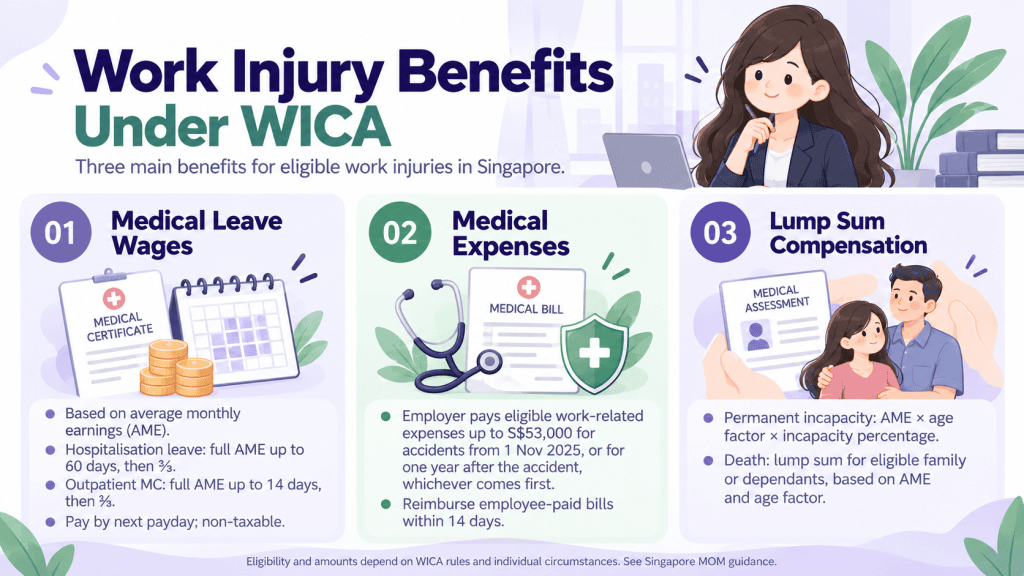
WICA provides three main work injury benefits.
1. Medical Leave Wages
Medical leave wages replace your pay for working days covered by an MC, hospitalisation leave or light duty from a Singapore-registered doctor or dentist, for up to one year from the accident. They are based on your average monthly earnings (AME) over the 12 months before the accident, which generally include overtime and bonuses but exclude transport allowances. Hospitalisation leave pays full AME for up to 60 days, then two-thirds. Outpatient MC pays full AME for 14 days, then two-thirds from the 15th day. Your employer must pay by the next payday, and the payments are not taxable.
2. Medical Expenses
Your employer must pay work-related medical expenses up to S$53,000 for accidents from 1 November 2025, or for one year from the accident, whichever comes first. This covers consultations, ward charges, treatment, medication, medical reports, ambulance transport, artificial limbs and dental charges. Physiotherapy, occupational therapy and Traditional Chinese Medicine count only if prescribed and billed by a Singapore-registered doctor or dentist. Employers must reimburse bills you paid within 14 days.
3. Lump Sum Compensation for Permanent Incapacity or Death
For permanent incapacity, the lump sum is your AME multiplied by an age factor and your percentage of permanent incapacity, assessed by a doctor once your condition stabilises.
Because most injuries stabilise within six months, compensation may be based on your incapacity at that point, known as current incapacity. If an injury causes death, the family or dependants receive a lump sum based on AME and the same age factor. MOM’s guide to compensation types explains the formulas.
How Much Workplace Injury Compensation Can You Claim in 2026
These limits apply to accidents from 1 November 2025. Older articles quoting S$45,000 for medical expenses, S$225,000 for death or S$289,000 for permanent incapacity reflect accidents before that date.
| Category | Minimum (SGD) | Maximum (SGD) |
|---|---|---|
| Death | 91,000 | 269,000 |
| Permanent incapacity (before applying % of incapacity) | 116,000 | 346,000 |
| Medical expenses | Actual expenses | 53,000 or one year from the accident, whichever comes first |
For permanent incapacity, the figure is multiplied by your percentage of incapacity, and a 100% award attracts an extra 25%. Use MOM’s calculator to estimate your own amount.
Workplace Injury Claim Process in Singapore
For accidents from 1 September 2020, the claim is treated as made once your employer is notified. MOM says most cases conclude within eight months, though some need longer for the injury to stabilise.
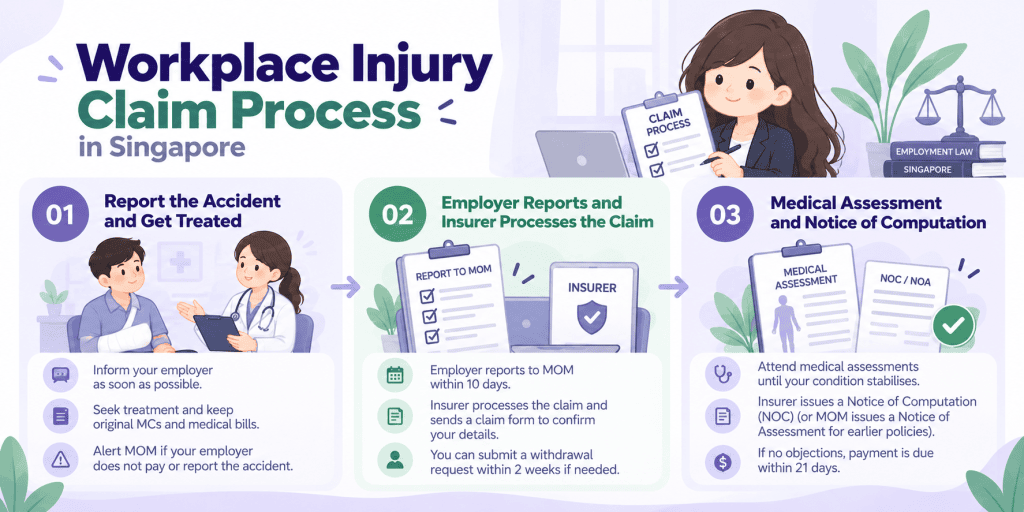
Report the Accident and Get Treated
Tell your employer as soon as the injury happens, because delay lets the employer dispute whether it is work-related.
- Seek treatment and inform your employer or supervisor as soon as possible.
- Hand over original MCs and medical bills, and keep photocopies.
- Alert MOM if your employer does not pay or does not report the accident.
Employer Reports and Insurer Processes the Claim
Your employer has strict reporting duties once you are hospitalised or given any medical leave or light duty.
- Non-fatal accidents must be reported to MOM within 10 days of the employer being notified.
- The designated insurer processes the report as your claim and sends a claim processing form to confirm your AME and injury details.
- You can submit a withdrawal request within two weeks if you do not want to proceed under WICA.
Medical Assessment and Notice of Computation
Compensation for permanent incapacity depends on a medical assessment and a formal notice.
- Attend every appointment, or your claim may be suspended.
- Once you stabilise, the doctor assesses your percentage of permanent incapacity.
- For policies from 1 January 2021, the insurer issues a notice of computation (NOC), while MOM issues a notice of assessment (NOA) for earlier policies.
- If no one objects, payment is due within 21 days, and objections to an NOC must be filed within 14 days.
Workplace Injury Rehabilitation and Return to Work
Workplace injury rehabilitation is part of recovery, and WICA medical expenses extend to treatment that helps you return to work sooner, such as case management, functional capacity evaluation and worksite assessment, alongside prescribed physiotherapy and occupational therapy.
If your doctor certifies light duties, you must return for them or take leave, and your employer must top up any shortfall between your wages and your AME entitlement. If no suitable light duties exist, tell your doctor. Once you return to full work, later medical leave is no longer claimable.
Workplace Injury Compensation Under WICA vs Common Law
You can claim under WICA or sue under common law, but not both for the same injury. The two routes differ sharply in proof, cost and risk, as the table shows.
| Feature | WICA claim | Common law suit |
|---|---|---|
| Who decides | MOM or the designated insurer | State Courts or High Court |
| Proof of fault | Not required | You must prove your employer or a third party was at fault |
| Lawyer | Optional | Needed, at your own cost |
| Compensation | Formula with fixed limits | No cap, but you must prove your damages |
| Main risk | Capped payout | You may recover nothing and pay costs |
Deadlines for Switching Routes
You have up to one year from the accident to decide, and withdrawing a WICA claim is time-sensitive.
- Any time before the NOC or NOA is issued.
- Within 14 days of service if there are no objections, or 28 days if there are.
- Not after the compensation is accepted and paid, because the case is then resolved.
Also Read: Singapore Labour Law for Foreign Workers: Legal Guide
Employer Duties for Workplace Injury Compensation
Employers must insure all employees doing manual work, regardless of salary, and non-manual employees earning S$2,600 or less a month, whether local or foreign, through a designated insurer. Failing to do so carries a fine of up to S$10,000, jail of up to 12 months, or both, and employers must still pay valid claims by uninsured staff.
After an accident, employers must report to MOM within 10 days, pay medical leave wages by the next payday, settle medical expenses even while awaiting insurer reimbursement, and not send foreign workers home against their wishes during an outstanding claim. Employers who doubt a claim can dispute it in writing with evidence. Failing to pay compensation can lead to a fine of up to S$15,000, jail of up to 12 months, or both.
How RBN Chambers Can Help With Workplace Injury Compensation Disputes
Most WICA claims proceed without conflict, but disputes arise when an employer contests whether the injury is work-related, an insurer and employee disagree on the percentage of permanent incapacity, payments are delayed, or an employee must decide whether to abandon WICA and sue. Each decision carries strict deadlines.
RBN Chambers’ employment disputes lawyers advise on disputes under the Work Injury Compensation Act, including compensation for injury, the degree of permanent incapacity, salary and medical expenses, for both employees and employers.
Get Legal Advice on Your Workplace Injury Compensation Claim
If you have been injured at work, or your business is facing a workplace injury claim, take advice before you object to an assessment, withdraw a WICA claim or commence a lawsuit, because those steps are difficult to reverse. Ramesh Bharani Nagaratnam, managing director of RBN Chambers and an experienced litigation and arbitration lawyer, can advise you on your options.
Visit our employment disputes page to see how RBN Chambers can assist, or contact us to arrange a consultation.
Frequently Asked Questions
Can I claim workplace injury compensation if the accident was my fault?
Generally yes, because WICA is a no-fault scheme. The injury must arise out of and in the course of employment, and claims are excluded in cases such as intoxication or deliberate self-injury.
How long do I have to claim workplace injury compensation?
For accidents from 1 September 2020, the claim is treated as made once your employer is notified, so report promptly. Medical leave wages and expenses are payable for up to one year from the accident, which is also your window to choose between WICA and common law.
What if my employer refuses to report my injury?
You can report it to MOM directly, and MOM can act against non-compliant employers. The designated insurer also provides a hotline for claim updates.
Can I switch from a WICA claim to a common law claim?
Yes, but only within the deadlines above, and never after the compensation is accepted and paid.
Is workplace injury compensation taxable?
Medical leave wages are compensation rather than income, so they are not taxable and attract no CPF contributions.
Do I need a lawyer to claim?
Not for a WICA claim, but you need one for a common law suit. Advice also helps where liability, the percentage of permanent incapacity or your choice of route is disputed.

Delivering Solutions not just Answers to your legal disputes
We provide solutions to all our clients regardless of the scale or complexity of the cases. Let us know how we can help.
Contact UsAny information of a legal nature in this blog is given in good faith and has been derived from resources believed to be reliable and accurate. The author of the information contained herein this blog does not give any warranty or accept any responsibility arising in any way, including by reason of negligence for any errors or omissions herein. Readers should seek independent legal advice.