

Employment |
Constructive Dismissal in Singapore: Legal Rights & Claims Guide

Resigning does not always mean leaving by choice. When an employer stops paying salary, strips away a role or lets harassment continue unchecked, quitting can feel like the only way out, yet the law may still treat that resignation as a dismissal.
This guide explains how constructive dismissal works under Singapore law, what an employee must prove, how to claim through TADM and the Employment Claims Tribunals, and how employers can reduce their risk.
What is Constructive Dismissal?
Constructive dismissal in Singapore happens when an employee resigns because of the employer’s conduct, and the law treats the resignation as a dismissal by the employer. Although the employee gives the notice, the focus is on who caused the employment to end.
It is a high threshold. Being unhappy, stressed or overlooked is not enough, and not every unfair act by an employer qualifies. The employee must show that the employer’s conduct left them with no real choice but to leave.
Constructive Dismissal Meaning Under Singapore Law
Singapore does not have a standalone constructive dismissal statute. Instead, the concept is captured by how the Employment Act 1968 defines dismissal, and it is supported by general contract law principles.
- Under section 2(1) of the Employment Act 1968, dismissal means the employer terminating the contract of service, with or without notice. It also includes a resignation where the employee shows, on a balance of probabilities, that they did not resign voluntarily but were forced to by the employer’s conduct or omissions, including a course of conduct. This is what the law treats as constructive dismissal.
- Section 14(2) of the Act then allows an employee who considers they were dismissed without just cause or excuse to file a wrongful dismissal claim. Since 1 April 2019, these claims must first go through mediation at TADM before they can be heard by the ECT. The ECT is required to apply the Tripartite Guidelines on Wrongful Dismissal, issued under the Employment Claims Act, and the MOM wrongful dismissal guidance explains how these rules work in practice.
Contract law supplies the underlying test. If an employer commits a serious breach of a fundamental term of the employment contract, the employee may treat the contract as ended, and the law treats the employer as having ended it. The employee carries the burden of proving that the breach went to the root of the contract and that they resigned because of it. The courts have not definitively settled whether a general implied term of mutual trust and confidence applies in Singapore, so claims are strongest when tied to specific contract terms or identifiable conduct.
Also Read: Singapore Labour Law for Foreign Workers: Legal Guide
Examples of Constructive Dismissal
Each case turns on its facts, but the following conduct commonly gives rise to claims.
Non-Payment or Late Payment of Salary
Failing to pay salary, or paying it persistently late, breaches a core term of the contract and the Employment Act. It is one of the clearest routes to a claim.
Demotion or Unilateral Change of Duties
Substantially changing a role, reporting line or responsibilities without consent can strike at the root of the contract, particularly where the change amounts to a demotion in substance, such as removing a senior employee from day-to-day operations. Whether a change is serious enough depends on how far it departs from what the employee agreed to.
Salary or Benefits Reduction
Arbitrary pay cuts or the removal of contractual benefits, especially when aimed at one employee, may amount to a repudiatory breach. Reductions made for genuine business reasons and after consultation are treated differently.
Workplace Harassment and a Hostile Environment
Persistent bullying, humiliation or discrimination, combined with management ignoring complaints, can support a claim. The Workplace Fairness Act 2025 is not yet in force and is expected to commence by end-2027, adding statutory protection against discrimination and retaliation.
Bad-Faith Discipline or Ignored Grievances
Disproportionate or pre-judged disciplinary action, or a pattern of ignoring serious complaints, may be relied on, particularly when viewed together as a course of conduct.
Constructive Dismissal vs Resignation
The difference lies in why the employee left and who caused the contract to end.
| Feature | Voluntary Resignation | Constructive Dismissal |
|---|---|---|
| Reason for leaving | Personal choice, such as a new job | The employer’s conduct left no real choice |
| Trigger | Nothing linked to the employer’s behaviour | A serious breach, such as non-payment, demotion or harassment |
| Legal treatment | Ordinary resignation with no claim | Treated as a dismissal under the Employment Act |
| Who must prove it | Not applicable | The employee, on a balance of probabilities |
| Where to claim | Not applicable | TADM mediation, then the ECT |
Timing also matters. An employee who stays on for a long time after the breach without protest risks being seen as having accepted it, while resigning too quickly can weaken the argument that the conduct was intolerable.
Also Read: Garden Leave in Singapore: Rights, Pay & Legal Guide
How to Prove Constructive Dismissal in Singapore
The employee bears the burden of proof, so the evidence needs to cover three points.
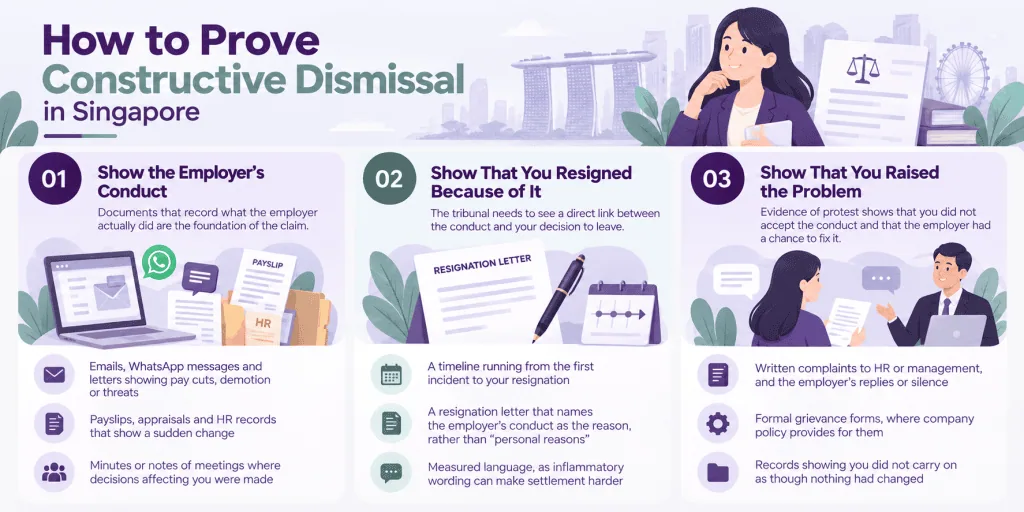
Show the Employer’s Conduct
Documents that record what the employer actually did are the foundation of the claim.
- Emails, WhatsApp messages and letters showing pay cuts, demotion or threats
- Payslips, appraisals and HR records that show a sudden change
- Minutes or notes of meetings where decisions affecting you were made
Show That You Resigned Because of It
The tribunal needs to see a direct link between the conduct and your decision to leave.
- A timeline running from the first incident to your resignation
- A resignation letter that names the employer’s conduct as the reason, rather than “personal reasons”
- Measured language, as inflammatory wording can make settlement harder
Show That You Raised the Problem
Evidence of protest shows that you did not accept the conduct and that the employer had a chance to fix it.
- Written complaints to HR or management, and the employer’s replies or silence
- Formal grievance forms, where company policy provides for them
- Records showing you did not carry on as though nothing had changed
Constructive Dismissal Claim Process at TADM and the ECT
Constructive dismissal claims follow the same two-stage route as other wrongful dismissal claims, and the deadlines are short. The Singapore Courts explain which claims the ECT can hear in their guidance on eligible employment claims.
File a Mediation Request at TADM
The first step is a mediation request, which must be made quickly.
- File within one month of your last day of employment, which is the end of your notice period if you serve notice
- Managers and executives may need at least six months’ service to file, so check your eligibility
Attend TADM Mediation
A mediator helps both sides look for a settlement.
- Outcomes can include compensation or agreed exit terms
- A settlement agreement can be registered within four weeks so that it is enforceable as a court order
File a Claim at the ECT
If mediation fails, the dispute moves to the tribunal.
- TADM issues a claim referral certificate, and you must file at the ECT within four weeks of its issue
- Parties attend a case management conference, followed by a hearing before a tribunal magistrate if the dispute is not resolved
- Lawyers cannot represent parties at the ECT, so employees present their own case
Receive the Outcome
The ECT decides whether the resignation amounted to a dismissal without just cause or excuse.
- If it did, the ECT may order compensation or reinstatement
- If it did not, the claim is dismissed and no remedy is granted
Constructive Dismissal Compensation
Reinstatement, with pay for lost income, is available but rare in practice, so most successful claims end in compensation. Under the ECT framework, loss of income is generally assessed at up to three months’ gross pay and harm at up to two months’ gross pay, within an overall limit of S$20,000 per claim, or S$30,000 where the claim went through union-assisted mediation or the Tripartite Mediation Framework. A separate salary claim, such as unpaid wages, has its own limit. You can read more in our guide to wrongful dismissal in Singapore.
Claimants whose losses exceed the cap can abandon the excess to stay within the ECT, or pursue a civil claim instead. In the civil courts, damages are usually measured by pay for the contractual notice period unless the employee proves further loss.
How Employers Can Avoid Constructive Dismissal Claims
Risk is easiest to manage before a dispute starts, and a fair process with clear records also helps show that the employer acted reasonably.
- Put material changes to pay, role or reporting lines in writing, and consult the employee first
- Investigate complaints promptly and impartially
- Use a documented performance improvement plan before acting on underperformance
- Review employment contract terms so they match actual practice
- Train managers to handle grievances and harassment complaints properly
When to Get Legal Advice on Constructive Dismissal
The deadlines are short and the legal test is demanding, so it is worth speaking to an employment lawyer before you resign or before you respond to a claim. Early advice helps you assess whether your facts meet the threshold, decide when and how to resign, and preserve the right evidence.
A lawyer cannot appear for you at the ECT, but can guide your preparation for TADM mediation, negotiate a settlement and act in the civil courts where a claim exceeds the ECT limit. Employers benefit equally from advice on terminations, restructuring and responding to a claim.
Speak to Our Employment Lawyers at RBN Chambers
Whether you are an employee who felt forced out or an employer facing a constructive dismissal allegation, the right strategy depends on the facts and the timelines. The employment disputes team at RBN Chambers, led by Ramesh Bharani Nagaratnam, advises employees and employers on wrongful dismissal, constructive dismissal and related workplace disputes.
Contact RBN Chambers to arrange a consultation and get clear advice on your options before the one-month deadline runs out.
Frequently Asked Questions
Can I claim constructive dismissal if I resigned because of stress?
Stress on its own is usually not enough. You need to show that the employer’s conduct or omissions, such as unpaid salary, a demotion or ignored harassment complaints, forced you to resign. Medical records and written complaints can help show the link.
How long do I have to file a constructive dismissal claim in Singapore?
File a mediation request with TADM within one month of your last day of employment. If mediation fails, you have four weeks from the date of the claim referral certificate to file at the ECT.
Do I need to serve my notice period if I resign for constructive dismissal?
It depends on the facts, and leaving without notice carries risk. If the tribunal or court decides the employer’s conduct did not justify it, the employer may claim salary in lieu of notice. Resigning with notice does not generally rule out a claim, but get advice before you decide.
Can a lawyer represent me at the ECT?
No. The Singapore Courts do not allow lawyers to represent parties at the ECT, so you present your own case. A lawyer can still advise you beforehand, help you prepare your evidence and strategy, negotiate a settlement and act for you in the civil courts if your claim goes beyond the ECT.

Delivering Solutions not just Answers to your legal disputes
We provide solutions to all our clients regardless of the scale or complexity of the cases. Let us know how we can help.
Contact UsAny information of a legal nature in this blog is given in good faith and has been derived from resources believed to be reliable and accurate. The author of the information contained herein this blog does not give any warranty or accept any responsibility arising in any way, including by reason of negligence for any errors or omissions herein. Readers should seek independent legal advice.