

Employment |
Garden Leave in Singapore: Rights, Pay & Legal Guide

When an employee resigns, or is told their role is ending, it’s common for the employer to ask them to stay away from the office for some or all of the notice period, while still drawing a full salary. This arrangement, known as garden leave, feels straightforward on the surface but raises real questions for both sides: is it actually enforceable, what happens if the contract is silent on it, and does the employee still get their full pay and bonus.
This guide walks through how garden leave works under Singapore law, what a properly drafted clause should contain, and the circumstances in which a garden leave arrangement can be challenged or enforced in court.
What Is Garden Leave?
Garden leave describes a period, usually falling within an employee’s notice period, during which the employer requires the employee to stay away from the workplace, stop performing their usual duties, and lose access to company systems and clients, while the employment relationship itself continues unbroken. The employee is not terminated and is not free to walk away from their obligations; they remain bound by their contract, and the employer remains bound to keep paying them.
Singapore does not have a standalone garden leave statute. It sits outside the Employment Act 1968 and is instead governed by whatever the employment contract says, read against general principles of contract law. That makes the wording of the garden leave clause, rather than any fixed statutory formula, the main thing that determines what an employer can and cannot do.
Garden Leave Singapore Law and the Employment Act
Garden leave is not expressly addressed in the Employment Act 1968, and the Ministry of Manpower does not treat it as a right an employer automatically has. Rather, MOM’s position is that an employer may place an employee on garden leave where the employment agreement provides for it, or where the employee continues to be paid in full and no separate legal obstacle applies. In other words, garden leave is a matter of contract, not statute.
The Requirement for an Express Garden Leave Clause
For a garden leave arrangement to be on solid legal footing, it should be supported by an express clause in the employment contract that spells out the employer’s right to invoke it, the circumstances in which it can be used, and what happens to pay and benefits during the period.
Without this, an employer imposing garden leave is on shakier ground, because it is effectively asking the employee to accept a restriction that the contract never actually promised.
What Happens Without a Garden Leave Clause
Where the contract is silent, the key legal question becomes whether the employee has a “right to work” that the employer would be breaching by sending them home. English case law, which Singapore courts often look to for guidance given how little local case law exists on garden leave specifically, suggests this depends heavily on the nature of the role.
Employees whose skills need regular exercise to stay sharp, who are paid substantially by commission, or who hold senior, specialised positions are more likely to be found to have a right to work, meaning an employer who excludes them from the office without contractual authority risks being in repudiatory breach.
Also Read: Collection of Personal Data by Employer: Does It Infringe the PDPA?
Garden Leave vs Resignation
The mechanics of garden leave apply in largely the same way whether the employee resigns or the employer initiates the termination, but the practical dynamics differ. When an employee resigns, garden leave gives the employer a tool to manage the exit on its own terms, protecting client relationships and sensitive information while the employee serves out notice they were always going to have to serve.
| Aspect | Garden Leave | Resignation |
|---|---|---|
| What it is | An arrangement where the employee stays away from work but remains employed and paid | The employee’s own decision to end the employment relationship |
| Who initiates it | The employer, usually during an existing notice period | The employee |
| Employment status | Continues unchanged until the last day of employment | Continues until the notice period ends or payment in lieu is made |
| Pay and benefits | Full salary, CPF, and contractual benefits continue throughout | Salary continues as normal until the last day of employment |
| Notice period | Not a separate notice period — it runs within the existing one | Employee must serve the notice period stated in the contract, or pay in lieu |
| Primary purpose | Protects the employer’s interests (clients, confidential information) while notice is served | Formally begins the exit process and triggers the notice period |
Garden Leave Notice Period and Duration
Garden leave typically runs for the same length as the employee’s contractual notice period, since it is usually structured as a way of managing that period rather than a separate period of its own. Where a contract does not specify a notice period at all, the default scale under Section 10 of the Employment Act applies:
- Less than 26 weeks of service: 1 day’s notice
- 26 weeks to less than 2 years of service: 1 week’s notice
- 2 years to less than 5 years of service: 2 weeks’ notice
- 5 years or more of service: 4 weeks’ notice
In practice, most Singapore employment contracts specify a longer notice period than these defaults, commonly one to three months, and garden leave clauses for senior or client-facing roles can extend to as long as six months.
Garden Leave Pay
Because the employee remains employed throughout garden leave, they are generally entitled to their full salary, CPF contributions, and contractual benefits for the entire period, exactly as if they were still working. This is one of the clearest and most consistently applied rules in this area: garden leave is paid leave, not a way for an employer to reduce its wage obligations while keeping an employee under contract.
Garden Leave Agreement Key Terms
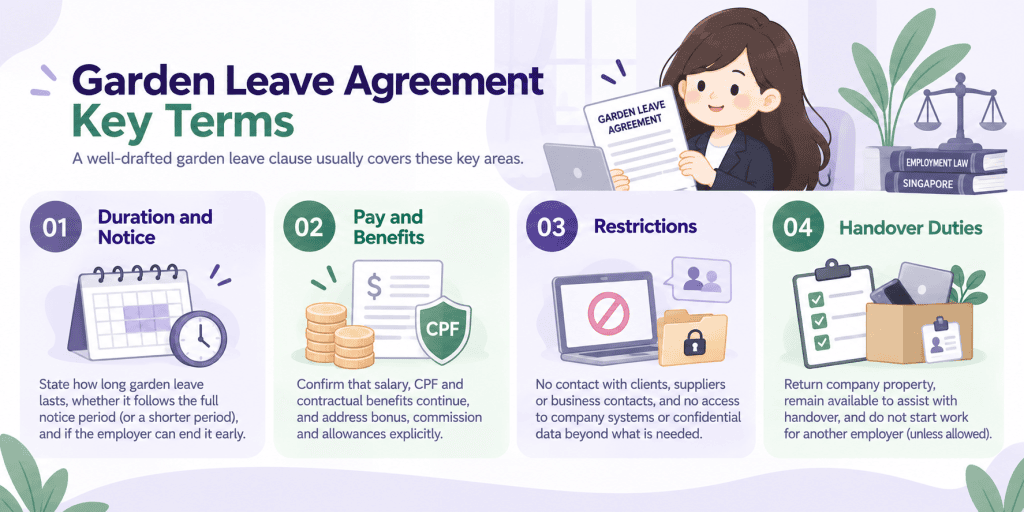
A garden leave clause that is well drafted tends to cover the same handful of areas consistently, which also happen to be the areas most likely to be disputed if left vague.
Duration and Notice
The clause should state clearly how long garden leave can last, whether it is tied automatically to the full notice period or can be shorter, and whether the employer has discretion to end it early and recall the employee to work.
Pay and Benefits
The clause should confirm that salary, CPF, and contractual benefits continue as normal, and should address bonus, commission, and any allowances explicitly rather than leaving them to be read into the general remuneration clause.
Restrictions and Handover Duties
Most garden leave clauses also set out what the employee must and must not do during the period. Common terms include:
- No contact with clients, suppliers, or business contacts without prior approval
- No access to company systems, email, or confidential data beyond what is needed for handover
- Return of company property, including devices, access cards, and documents
- Continued availability to assist with handover and answer queries from a successor
- No commencement of work for another employer, unless the contract allows it or the employer consents
Employee Obligations During Garden Leave
Even though the employee is not physically working, garden leave does not switch off every obligation under the contract. The duty of good faith and fidelity is generally accepted to continue during garden leave, though its scope narrows to reflect the fact that the employee is no longer actively advancing the employer’s business.
| Party | Rights | Obligations |
|---|---|---|
| Employer | May restrict access to premises, systems, and clients; may require return of property | Must continue paying salary, CPF, and contractual benefits for the full period |
| Employee | Entitled to full pay and benefits; retains employment status and any accrued entitlements | Must maintain confidentiality, avoid competing activity, and remain available for handover |
Why Employers Use Garden Leave
Garden leave is not a legal requirement anywhere in Singapore employment law; employers choose to use it because it addresses a handful of specific, recurring risks around an employee’s exit.
Protecting Confidential Information and Trade Secrets
Keeping a departing employee away from systems and files for the notice period reduces the window in which they could access, copy, or misuse commercially sensitive information before leaving.
Preventing Client Poaching
Cutting off contact with clients during the notice period makes it harder for a departing employee to quietly shift relationships toward a new employer before their exit is finalised.
Ensuring a Smooth Handover
Garden leave gives the business breathing room to brief a successor and transition responsibilities in a controlled way, rather than losing institutional knowledge the moment the employee stops attending.
Garden Leave and Restrictive Covenants
Garden leave and restrictive covenants such as non-compete clauses both aim to protect an employer’s business interests during a departure, but they work through different mechanisms and are treated somewhat differently by the courts.
| Feature | Garden Leave | Restrictive Covenants |
|---|---|---|
| Employment status | Employee remains employed throughout | Applies after employment has ended |
| Payment requirement | Employer must continue paying full salary and benefits | No ongoing payment obligation to the former employee |
| Typical duration | Length of the notice period, commonly 1 to 6 months | Can extend well beyond the notice period, often 6 to 12 months |
| Primary legal focus | Contractual right to require absence while paid | Restraint of trade doctrine and reasonableness of the restriction |
Enforceability and Legal Disputes in Singapore
Singapore courts have limited case law specifically on garden leave, so disputes are usually analysed through the same lens as restrictive covenants, with English authority filling the gaps. The main risk points:
- Legitimate interest test — the restriction must protect a genuine interest (confidential information, client relationships) and go no further than necessary
- Employer must keep paying — enforcing garden leave through the courts generally requires an undertaking to continue full pay
- Non-payment risks repudiatory breach — imposing garden leave without contractual authority, or stopping pay, can release the employee from notice and post-termination restrictions
- TADM route — unpaid salary or benefits disputes can go to the Tripartite Alliance for Dispute Management before escalating to litigation
- Duration and bonus wording — an excessive duration or vague bonus clause is the most common source of later disputes
- No clause at all — relying on an implied right rather than an express clause leaves the employer exposed if challenged
Reviewing garden leave and restrictive covenant clauses before they’re needed is generally the more cost-effective path.
Also Read: Employment Disputes Singapore: Types, Process & How to Handle
Speak With RBN Chambers About Your Garden Leave Clause
Whether you are an employer trying to draft a garden leave clause that will actually hold up, or an employee who has been told to stay home and isn’t sure what you’re entitled to, the details of the wording matter far more than most people expect. A clause that seems clear at signing can turn out to be silent on exactly the point that ends up in dispute.
The employment law team at RBN Chambers advises both employers and employees on garden leave, notice period, and restrictive covenant issues, from reviewing and drafting contracts to resolving disputes when a garden leave arrangement is contested. Reach out to discuss your situation before a disagreement escalates.
Frequently Asked Questions
Can I start a new job while on garden leave in Singapore?
Generally no. Since your employment contract is still active during garden leave, starting a new job would usually breach your existing contract, unless your current employer gives written consent or your contract expressly allows it.
Do I get my full bonus if I am on garden leave?
It depends on how the bonus clause in your employment contract is worded. Clauses tied to being in “active employment” can be read differently from those tied to being “in service,” and this distinction can determine whether your bonus is affected during garden leave.
What happens if my contract doesn’t have a garden leave clause?
Your employer may not have a clear right to exclude you from the office, and doing so without contractual authority could potentially amount to a repudiatory breach of your employment contract, depending on the nature of your role.
Is garden leave the same as being suspended?
No. Suspension is usually a disciplinary measure tied to an ongoing investigation or misconduct issue, while garden leave is a standard part of managing a resignation or termination notice period, and does not imply any wrongdoing on the employee’s part.
How long can garden leave last in Singapore?
Garden leave usually matches the length of the contractual notice period, commonly one to six months depending on seniority. Courts expect the duration to be reasonable relative to the interest being protected, so an unusually long period can be challenged.
Can my employer stop paying me during garden leave?
No, not under normal circumstances. Since you remain employed throughout garden leave, your employer is generally required to continue your full salary, CPF contributions, and contractual benefits for the entire period.

Delivering Solutions not just Answers to your legal disputes
We provide solutions to all our clients regardless of the scale or complexity of the cases. Let us know how we can help.
Contact UsAny information of a legal nature in this blog is given in good faith and has been derived from resources believed to be reliable and accurate. The author of the information contained herein this blog does not give any warranty or accept any responsibility arising in any way, including by reason of negligence for any errors or omissions herein. Readers should seek independent legal advice.