

Employment |
Employment Disputes Singapore: Types, Process & How to Handle

Workplace conflict is stressful for everyone involved, whether you’re an employee unsure if you’ve been treated fairly or an employer trying to handle a dismissal the right way. According to the Ministry of Manpower’s (MOM) Employment Standards Report 2025, the overall rate of employment claims and appeals rose from 3.12 to 3.44 per 1,000 employees in 2025, driven mainly by business reorganisation and restructuring rather than a decline in employment standards.
For both employees and employers, understanding your rights and obligations is the first step to resolving a dispute quickly, whether that’s through mediation or, where needed, legal representation. This guide covers the most common employment disputes in Singapore, the legal remedies available, and when it makes sense to bring in a lawyer.
Common Types of Employment Disputes in Singapore
An employment dispute arises from disagreements between an employer and an employee over contractual terms, workplace treatment, termination, or post-employment obligations. Left unresolved, these disputes can affect careers, reputations, and business operations alike.
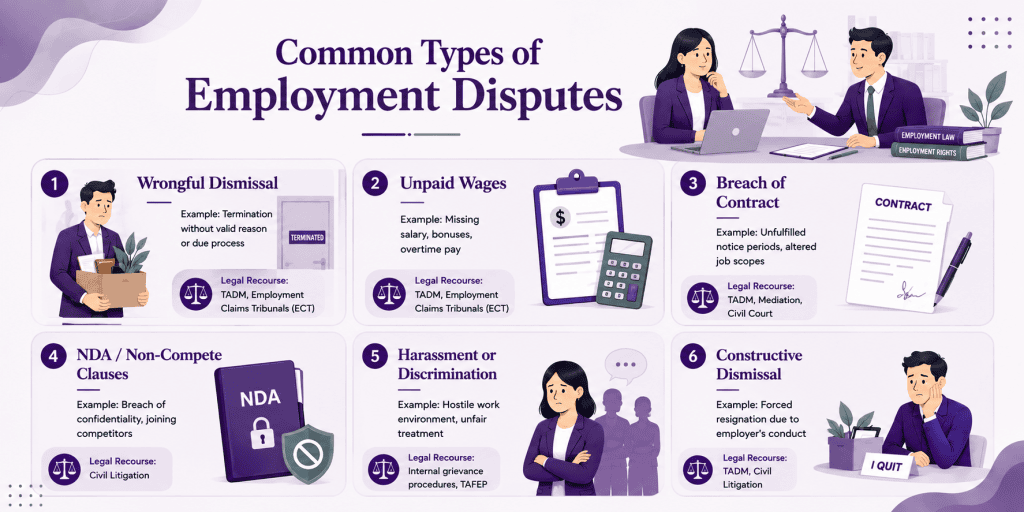
| Type of Dispute | Examples | Legal Recourse |
|---|---|---|
| Wrongful Dismissal | Termination without valid reason or due process | TADM, Employment Claims Tribunals (ECT) |
| Unpaid Wages | Missing salary, bonuses, overtime pay | TADM, ECT |
| Breach of Contract | Unfulfilled notice periods, altered job scopes | TADM, Mediation, Civil Court |
| NDA / Non-Compete Clauses | Breach of confidentiality, joining competitors | Civil Litigation |
| Harassment or Discrimination | Hostile work environment, unfair treatment | Internal grievance procedures, TAFEP |
| Constructive Dismissal | Forced resignation due to employer’s conduct | TADM, Civil Litigation |
1. Wrongful Dismissal
Under Section 14 of the Employment Act 1968 (Cap. 91), an employee may claim wrongful dismissal if they believe they were terminated without just cause or excuse. An employer is not generally required to give a reason for termination, though it is encouraged to do so to help the employee understand the decision. The position is different for misconduct: where the grounds for dismissal are misconduct, the employer must substantiate the allegation and give the employee a fair opportunity to be heard first.
Employees must first seek mediation through the Tripartite Alliance for Dispute Management (TADM). If mediation does not resolve the matter, an eligible claim can then be filed with the Employment Claims Tribunals (ECT). It is not automatically referred.
According to MOM’s 2025 report, wrongful dismissal claims rose to 0.57 per 1,000 employees, up from 0.46 in 2024 and 0.32 in 2023. Around two in three cases (67%) were resolved amicably at TADM, with the remaining third referred to the ECT.
For a full breakdown of compensation caps, recent tribunal rulings, and the grounds that count as wrongful dismissal, see our dedicated guide to wrongful dismissal in Singapore.
2. Unpaid Salaries or Wages
Claims related to unpaid compensation may involve:
- Basic salary
- Overtime pay
- Commissions and bonuses
- Leave encashment
Salary claims rose to 2.84 per 1,000 employees in 2025, up from 2.63 in 2024. The good news for employees is that recovery rates remain high: 88% of salary claims lodged in 2025 were resolved through TADM mediation, and more than nine in ten claimants who pursued a claim through TADM and the ECT fully recovered what they were owed, totalling $22 million recovered in 2025.
Employees should act promptly, since filing deadlines are tighter than most people expect. Former employees generally have six months from their last day of employment to file, while current employees have up to one year from when the dispute arose.
3. Breach of Employment Contract
Disputes here typically arise from:
- Employers altering job scope without the employee’s consent
- Employees resigning without proper notice
- Conflicts over restrictive covenants written into the contract
The appropriate route for resolving these disputes depends on the nature of the claim. Specified salary-related claims may proceed through mediation at TADM and, if unresolved, the ECT. Other contractual disputes may require negotiation, private mediation or proceedings in the civil courts. TADM and the ECT do not have general jurisdiction over every breach of an employment contract.
4. NDAs and Non-Compete Clauses
Disputes tend to emerge when an employee discloses confidential information or a former employee joins a direct competitor. Unlike most disputes on this list, these are generally not TADM or ECT matters.
An NDA protects confidential information, so disputes over it focus on the information covered and the obligations governing its use or disclosure. A non-compete clause restricts a former employee from working for a competitor. Singapore courts assess the enforceability of non-compete clauses based on their scope, duration, geography, and whether they protect a legitimate business interest, rather than simply restricting competition.
These disputes are generally matters for civil litigation rather than the TADM or ECT framework. Mediation is not ruled out, however, as parties may still choose to negotiate privately or engage a private mediator.
5. Harassment and Discrimination
Harassment and discrimination are often grouped together, but they are separate issues governed by different frameworks.
Harassment is covered by statute. The Protection from Harassment Act 2014 (POHA) provides a legal framework for harassment, including harassment at work.
Discrimination is an area of Singapore employment law that’s changed significantly since this guide was last updated. Singapore has historically relied on the Tripartite Guidelines on Fair Employment Practices (TGFEP), enforced through TAFEP, rather than standalone legislation on discrimination.
That’s changing: the Workplace Fairness Act (WFA) was passed in January 2025, with a companion Workplace Fairness (Dispute Resolution) Bill passed in November 2025. Once it takes effect, expected by end-2027, it will make it illegal to base hiring, appraisal, training, promotion, or dismissal decisions on protected characteristics such as age, nationality, sex, race, religion, disability, or caregiving responsibilities.
Until then, the TGFEP continues to apply to discrimination matters, and complaints can still be raised with TAFEP. The most recent MOM data shows 6.0% of employees reported experiencing workplace discrimination in 2023, down from 8.2% the year before, a downward trend, though the WFA is intended to give complainants a formal statutory claims process that the current guidelines don’t provide.
6. Constructive Dismissal
Constructive dismissal occurs when an employee resigns because of hostile or unfair working conditions, such as:
- Drastic pay cuts
- Unlawful demotions
- Persistent bullying or a hostile work environment the employer failed to address
If proven, a resignation under these circumstances is treated as a wrongful dismissal, and follows the same TADM and ECT process as a formal termination.
Also Read: Can Employers Reject Annual Leave Requests in Singapore?
Strategic Steps Before Filing a Claim
Government portals will tell you where to file a claim. What they generally won’t tell you is how to strengthen your position before you get there. A few steps make a real difference to how a claim, or a settlement negotiation, plays out.
Evidence checklist before you file:
- Your employment contract and any letters of appointment or variation
- Payslips and CPF contribution records for the relevant period
- Written correspondence with your employer about the dispute (emails, messages, memos)
- Any warning letters, performance reviews, or termination letters
- A dated, written account of key events while they’re still fresh
For employers, the equivalent discipline applies in reverse: document performance issues as they happen, keep a clear paper trail for any disciplinary process, and be aware that an employer does not always have to state a reason for termination, but where one is given, it must be accurate and supported by evidence.
Before filing, it’s also worth honestly assessing whether mediation or a negotiated settlement serves you better than pushing a claim to the ECT. Mediation is faster and preserves the relationship where that matters, such as in ongoing contractual disputes.
The ECT becomes the more realistic option once one party is unwilling to negotiate in good faith, or where the dispute involves a clear-cut breach that’s unlikely to resolve informally.
Should You Bring a Lawyer?
This is one of the more common questions employees and employers ask, and the answer surprises people. Lawyers are not permitted to represent parties at TADM mediation or at ECT hearings.
Under the Employment Claims Act, only the employee, the employer (or an authorised company representative), and the mediator or tribunal magistrate can take part. This keeps the process accessible and low-cost, with ECT filing fees of S$30 per claim where the claim is S$10,000 or less, and S$60 per claim where the claim exceeds S$10,000.
That doesn’t mean legal advice has no place in the process. A lawyer can’t sit beside you at TADM mediation specifically, though lawyers can attend other forms of mediation, such as private mediation. Engaging one beforehand to assess the strength of your case, review your contract, and help you prepare your evidence often makes the difference between a favourable settlement and a drawn-out dispute.
This is particularly worth doing where the claim exceeds the ECT’s limits (S$20,000 per claim, or S$30,000 with union assistance), where a non-compete or NDA dispute may need to go to the civil courts instead, or where the facts are genuinely contested and you’re not confident presenting your own case.
The Employment Dispute Resolution Process
Most statutory employment disputes in Singapore follow the same general path.
- Internal resolution. Where possible, raise the issue with HR or through your company’s internal grievance process first.
- e-Negotiation with TADM. A faster, guided online process where both parties attempt to resolve the claim directly.
- TADM mediation. If e-Negotiation doesn’t resolve it, a mediator is assigned. Only the employee, employer, and mediator take part, no lawyers or third parties.
- Employment Claims Tribunals (ECT). If mediation fails, TADM issues a claim referral certificate, and the claim can be filed with the ECT within four weeks.
- Civil courts. For disputes outside the ECT’s scope, such as high-value contractual claims or non-compete disputes, the matter proceeds to the ordinary courts instead.
Also Read: Know Your Employee Rights in Singapore
Getting the Right Support for Your Employment Dispute at RBN Chambers
Employment disputes rarely resolve themselves cleanly, and the process, while designed to be accessible, still rewards preparation. Whether you’re an employee weighing whether to file a claim or an employer trying to manage a dispute before it escalates, understanding where you stand legally makes the next step clearer.
Whether you’re facing a potential wrongful dismissal, navigating a complex employment dispute, or seeking to enforce your contractual rights, RBN Chambers‘ employment disputes team, led by Ramesh Bharani Nagaratnam offers clear, practical guidance tailored to your situation. Contact us to discuss your case.
Frequently Asked Questions
How long do I have to file a salary claim in Singapore?
Former employees generally have six months from their last day of employment to file. Current employees have up to one year from when the salary dispute arose. Salary claims generally cover amounts arising within the year before filing. Wrongful dismissal claims have a shorter window, generally within one month after the last day of employment.
Can I bring a lawyer to a TADM mediation session?
No. Under the Employment Claims Act, only the employee, the employer (or an authorised representative), and the mediator can take part in TADM mediation. The same applies at ECT hearings, lawyers are not permitted to represent parties there either. You can still consult a lawyer before filing to prepare your case.
What is the maximum claim limit at the Employment Claims Tribunal?
The ECT can hear salary-related and wrongful dismissal claims of up to S$20,000 per claim, or S$30,000 if you’re a union member who went through the Tripartite Mediation Framework. If your claim exceeds this, you can still file at the ECT by abandoning the amount above the limit, or pursue the full amount through the civil courts instead.
Delivering Solutions not just Answers to your legal disputes
We provide solutions to all our clients regardless of the scale or complexity of the cases. Let us know how we can help.
Contact UsAny information of a legal nature in this blog is given in good faith and has been derived from resources believed to be reliable and accurate. The author of the information contained herein this blog does not give any warranty or accept any responsibility arising in any way, including by reason of negligence for any errors or omissions herein. Readers should seek independent legal advice.