

Business |
Contract Disputes in Singapore: Guide to Your Legal Options

You delivered the goods, provided the service, or signed the deal — and now the other party delays payment, changes the terms, or goes silent. What looked like a straightforward transaction has turned into a contract dispute.
This guide walks through what counts as a contract dispute in Singapore, the common causes, and the legal remedies available, from a simple Letter of Demand to full civil litigation.
If your situation needs more than general information, it also covers what to expect when you consult a contract dispute lawyer.
What Is a Contract Dispute
A contract dispute happens when one or more parties disagree over the terms or performance of a contractual agreement. It can involve a client who won’t pay, a supplier who delivered late, or two parties who simply read the same clause differently.
Singapore’s contract law is largely based on English common law, and Singapore courts closely follow English legal principles when interpreting agreements. This means the general rules around breach, remedies, and interpretation will feel familiar if you’ve dealt with contract law in other common law jurisdictions.
Common Causes of Contract Disputes
Most contract disputes in Singapore trace back to one of a few recurring issues.
- Non-payment or delayed payment: One party fails to pay for goods or services rendered.
- Substandard performance: Delivered goods or services do not meet agreed-upon standards.
- Ambiguous terms: Unclear contract clauses leading to differing interpretations.
- Breach of specific clauses: Violations of exclusivity, confidentiality, or termination provisions.
Understanding your legal rights early can make a world of difference when navigating these conflicts. Let’s explore the key issues surrounding contract disputes and your options for resolution.
In Singapore, contract law is largely based on the English common law of contract. The legal rules developed by the Singapore courts closely mirror those under English jurisprudence.
Also Read: Contract Termination Disputes in Singapore: A Legal Guide
Common Scenarios That Give Rise to Contract Disputes
Contractual disputes are not limited to large commercial transactions—they can arise in everyday dealings across industries.
| Scenario | Typical Consequences |
|---|---|
| Client fails to pay after goods or services are delivered | The supplier suffers cash flow issues while chasing debts |
| Disagreement over service quality | The customer refuses to pay, claiming the work was substandard. |
| Delays in delivering products or services | The buyer wants to cancel the contract or demand compensation. |
| Contract terms are unclear or poorly drafted | Both parties have different interpretations, leading to conflict. |
| Breach of exclusivity clauses | One party accuses the other of violating an exclusivity agreement. |
| Termination of contract without proper notice | One party faces unanticipated financial losses |
In Singapore, many of these situations fall under standard contractual obligations and can escalate without clear resolution strategies.
Legal Remedies for Contract Disputes in Singapore
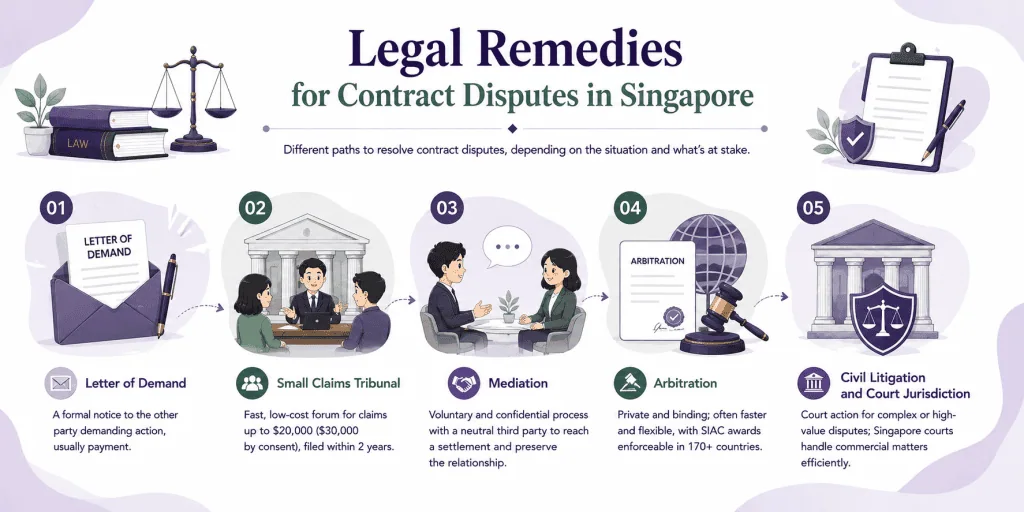
If you’re stuck in a contract dispute, you have several paths to resolution. Some are faster and cheaper than others, and the right one usually depends on how much is at stake and how the other party is responding.
Letter of Demand
A Letter of Demand (LOD) is a formal notice sent to the other party, setting out the breach and demanding action, usually payment, within a set timeframe. It’s typically the first step before anything more formal, and it often resolves the matter on its own.
Small Claims Tribunal
The Small Claims Tribunal (SCT) handles claims up to $20,000, or $30,000 if both parties sign a Memorandum of Consent. It’s a fast, low-cost, self-represented forum — lawyers generally aren’t involved in the hearing itself. One detail worth knowing: SCT claims must be filed within 2 years of the dispute arising, which is shorter than the general limitation period for contract claims.
Mediation
Mediation is a voluntary, confidential process guided by a neutral third party. Institutions like the Singapore Mediation Centre (SMC) help both sides reach a settlement while preserving the business relationship, which matters if you plan to keep working with the other party.
Arbitration
Arbitration works well for commercial disputes, especially cross-border ones. It’s private and binding, and it’s often faster and more flexible than going to court. Singapore is a leading arbitral seat, and awards from the Singapore International Arbitration Centre (SIAC) are enforceable in over 170 countries under the New York Convention.
Civil Litigation and Court Jurisdiction
If other methods don’t resolve things, court action may be necessary, particularly for complex or high-value disputes. Singapore courts are known for handling commercial matters efficiently. Which court hears your case depends on the claim value.
| Court | Claim Value |
|---|---|
| Small Claims Tribunal | Up to $20,000 (or $30,000 by consent) |
| Magistrate’s Court | Up to $60,000 |
| District Court | $60,000 to $250,000 |
| General Division of the High Court | Above $250,000 |
Mediation vs Litigation Which Option Fits Your Dispute
Both routes can resolve a contract dispute, but they trade off differently on cost, time, and privacy.
| Factor | Mediation | Litigation |
|---|---|---|
| Cost | Generally lower, shared between parties | Higher, especially for complex or drawn-out cases |
| Time | Often resolved in weeks | Can take months to years, depending on complexity |
| Privacy | Confidential | Public court record, with limited exceptions |
| Outcome | Non-binding unless formalised into a settlement agreement | Binding court judgment, enforceable and appealable |
| Relationship impact | Designed to preserve the business relationship | Adversarial, often ends the relationship |
Also Read: Alternate Dispute Resolutions Methods
Why Early Legal Advice Matters in Contract Disputes
It’s common for people to delay seeking legal advice, hoping the problem resolves on its own. However, waiting too long can cause bigger issues, such as:
- Losing critical evidence: Emails, messages, and documents critical to your case can be deleted or become harder to track down.
- Missing legal deadlines: Under Singapore law, there are strict limitation periods (e.g., six years for most contract claims under the Limitation Act 1959).
- Costlier outcomes: Early legal advice can often help settle disputes quickly, avoiding expensive court action.
Getting professional guidance early doesn’t mean rushing into a lawsuit. In fact, it often helps you resolve the matter quietly and cost-effectively, protecting your business or personal interests.
What Happens When You Consult a Contract Dispute Lawyer
If your dispute is beyond what an LOD or the SCT can resolve, the next step is usually a consultation with a lawyer. Here’s roughly what that looks like.
You’ll walk through the facts of your dispute, and bring along the contract itself, any correspondence (emails, messages, invoices), and records of payments or deliveries. The lawyer will assess the strength of your position and outline the realistic options, whether that’s a Letter of Demand, mediation, or preparing for litigation.
Facing a Contract Dispute? Talk to Our Contract Dispute Lawyers
RBN Chambers regularly advises clients on contract disputes across a wide range of industries and transaction types, from straightforward non-payment issues to complex cross-border commercial disagreements.
Our lawyer, Ramesh Bharani Nagaratnam, leads on dispute resolution matters, representing clients in negotiations, mediations, arbitrations, and court proceedings, alongside contract review work aimed at preventing disputes before they start.
Contact RBN Chambers for a confidential consultation, or read more about our civil litigation and commercial law practice areas.
Frequently Asked Questions about Contract Disputes
What counts as a breach of contract in Singapore?
A breach occurs when a party fails to meet their agreed obligations, whether through action, inaction, or deviation from agreed terms. For example, delivering goods late, providing poor services, or refusing payment.
How long do I have to file a contract dispute claim?
In Singapore, most contract claims must be filed within six years from the date of the breach, as outlined in the Limitation Act 1959.
Do I always have to go to court for contract disputes?
No. Many disputes are resolved through Letters of Demand, mediation, or arbitration without needing formal court proceedings.
What happens if I ignore a contract dispute
Delaying action can weaken your legal position, cause financial losses, and even cause your right to claim to expire.
Can RBN Chambers help if my dispute involves an overseas party?
Yes. RBN Chambers has strong experience in all kinds of contractual disputes and can tailor a legal solution to resolve your dispute.
Delivering Solutions not just Answers to your legal disputes
We provide solutions to all our clients regardless of the scale or complexity of the cases. Let us know how we can help.
Contact UsAny information of a legal nature in this blog is given in good faith and has been derived from resources believed to be reliable and accurate. The author of the information contained herein this blog does not give any warranty or accept any responsibility arising in any way, including by reason of negligence for any errors or omissions herein. Readers should seek independent legal advice.