

General |
Letter of Demand Singapore: How to Send or Respond

Receiving a Letter of Demand in Singapore can feel alarming, but it is not a court judgment and does not mean you are being sued yet.
Whether you are trying to recover a debt, respond to a dispute, or simply understand a letter that landed in your inbox, knowing how a Letter of Demand works is the first step to resolving the matter on your terms.
This guide covers what a Letter of Demand should contain, how to write and respond to one, and why ignoring it can lead to costlier legal action.
What is a Letter of Demand?
A Letter of Demand is a formal letter, usually issued by a lawyer on behalf of a client, setting out a demand for the recipient to comply with, most commonly payment of a debt or the fulfilment of a contractual obligation. It puts the recipient on notice that legal action may follow if the demand is not met within a stated deadline.
A Letter of Demand is not itself a court document and does not start legal proceedings. If the matter remains unresolved, the next formal step is typically filing a Originating Claim, which officially commences a civil suit.
Under the Rules of Court, parties to a business or contractual dispute are generally expected to consider amicable resolution, such as sending a Letter of Demand, before escalating to litigation, so a well-drafted letter also strengthens your position if the matter does reach court.
When Should You Send a Letter of Demand
Letter of Demand is typically sent once informal reminders, calls, or negotiation have failed to resolve the issue, and before deciding whether to escalate to litigation. It is commonly used in situations such as:
- An unpaid debt, loan, or overdue invoice
- Breach of a contract, including a partnership or joint-venture agreement
- Non-payment of compensation or sums owed under an employment agreement
- Defamatory statements that need to be retracted or stopped
- A tenancy or lease dispute involving unpaid rent or damage
Before sending one, it is worth checking the facts, the supporting documents, and the amount owed carefully, since a Letter of Demand that overstates a claim or contains threatening language can weaken, rather than strengthen, your position.
What Should a Letter of Demand Include
There is no prescribed legal format for a Letter of Demand in Singapore, but an effective one reads as a clear, accurate summary of the dispute rather than a vague threat. At minimum, it should set out:
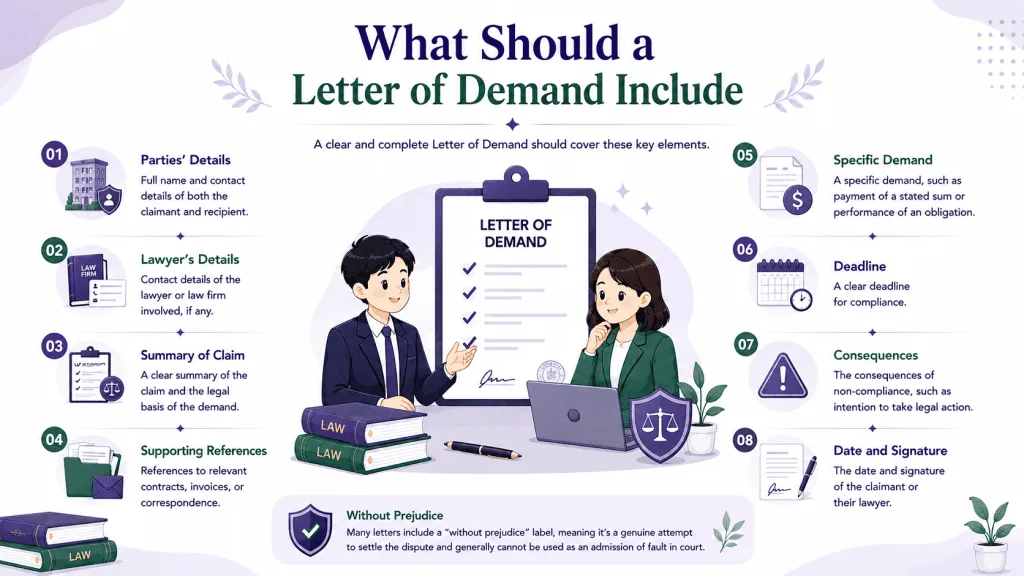
- Full name and contact details of both the claimant and the recipient
- Contact details of the lawyer or law firm involved, if one is engaged
- A clear summary of the claim, including the legal basis of the demand
- References to the relevant contract, invoices, or correspondence
- A specific demand, such as payment of a stated sum or performance of an obligation
- A clear deadline for compliance
- The consequences of non-compliance, such as the intention to commence legal action
- The date and signature of the claimant or their lawyer
Many letters also carry a “without prejudice” label, meaning the letter is written as a genuine attempt to settle the dispute and generally cannot be used as an admission of fault if the matter later goes to court. This protection is not automatic just because the words appear on the letter, so it is worth having a lawyer confirm it is used correctly.
Also Read: Tort Claims in Singapore: What to Do When Someone’s Negligence Harms You
Self-Prepared Letter of Demand vs Lawyer-Issued Letter
There is no legal requirement to engage a lawyer to send a Letter of Demand, but the source of the letter often affects how seriously it is taken.
| Aspect | Self-Prepared Letter | Lawyer-Issued Letter |
|---|---|---|
| Legal requirement | None, anyone can send one | Not required, but common practice |
| Perceived weight | Often read as a personal request | Signals genuine intent to pursue litigation |
| Legal accuracy | Higher risk of overstating or misstating the claim | Basis, figures, and language checked against the law |
| Typical cost | Free | Generally from around $150, more for complex matters |
| Best suited for | Very small, straightforward, low-value disputes | Debt, commercial, employment, and contractual disputes |
How Much Does a Letter of Demand Cost in Singapore
Costs vary depending on the complexity of the dispute, the amount involved, and how much drafting and fact-checking is required. Straightforward letters, such as a request for the return of a deposit, tend to sit at the lower end, while letters involving disputed facts, larger sums, or multiple parties cost more because of the additional review involved.
As a general guide, simple letters commonly start from around $150, with more involved matters running into several hundred dollars or more. Because pricing depends on the specifics of the claim, it’s best to speak with a lawyer directly for an accurate quote.
How to Write a Letter of Demand
A Letter of Demand works best when it reads as a firm, factual account rather than an angry one. A few habits make a real difference to how persuasive and enforceable the letter turns out to be:
- Set out what happened in order, so the reader can follow the dispute without needing extra context.
- State exactly what you want, whether that’s a specific dollar amount, the return of an item, or a specific act, and give a clear deadline for it.
- Reference and attach supporting documents, such as the contract, invoices, receipts, or prior correspondence, so the demand is backed by evidence rather than assertion.
- Keep the tone professional and factual. Avoid threats, insults, or language that goes beyond what you’re legally entitled to demand, since this can undermine your credibility if the matter reaches court.
- Decide whether to mark the letter “without prejudice” and understand that this label alone doesn’t guarantee protection; it needs to be used in the right context.
- Send it in a way that gives you proof of delivery, such as registered post or email with a read receipt, and keep a copy for your records.
Example of a Letter of Demand
The format below illustrates how a simple commercial Letter of Demand for an unpaid invoice might be structured. It is a general example only and should be adapted, or drafted from scratch, based on your actual facts.
| 15 July 2026 Harborview Trading Pte Ltd 21 Jurong Gateway Road #04-15 JEM Tower Singapore 608549 Attn: The Directors Dear Sir/Madam, RE: OUTSTANDING PAYMENT UNDER INVOICE NO. INV-0472 — S$8,400.00 We act for Meridian Design Studio, owned by Ms Wei Ling Chua (“our Client”), in the above matter. Our Client provided design and consultancy services to your company under the service agreement dated 3 March 2026. Invoice No. INV-0472, in the sum of S$8,400.00, was issued on 30 April 2026 and fell due on 30 May 2026. Despite reminders sent on 10 June 2026 and 25 June 2026, this sum remains unpaid to date. We are instructed to demand that your company remit the full sum of S$8,400.00 to our Client within fourteen (14) days from the date of this letter. Should payment not be received within this period, we are instructed to commence legal proceedings against your company to recover the said sum, together with interest and legal costs, without further notice to you. This letter is written without prejudice save as to costs. Yours faithfully, Messrs Teo Wong & Co Solicitors for the Claimant |
How to Respond to a Letter of Demand
Getting a Letter of Demand is stressful, but it is a starting point for resolving the matter, not a final decision against you. A measured response generally follows a few steps.
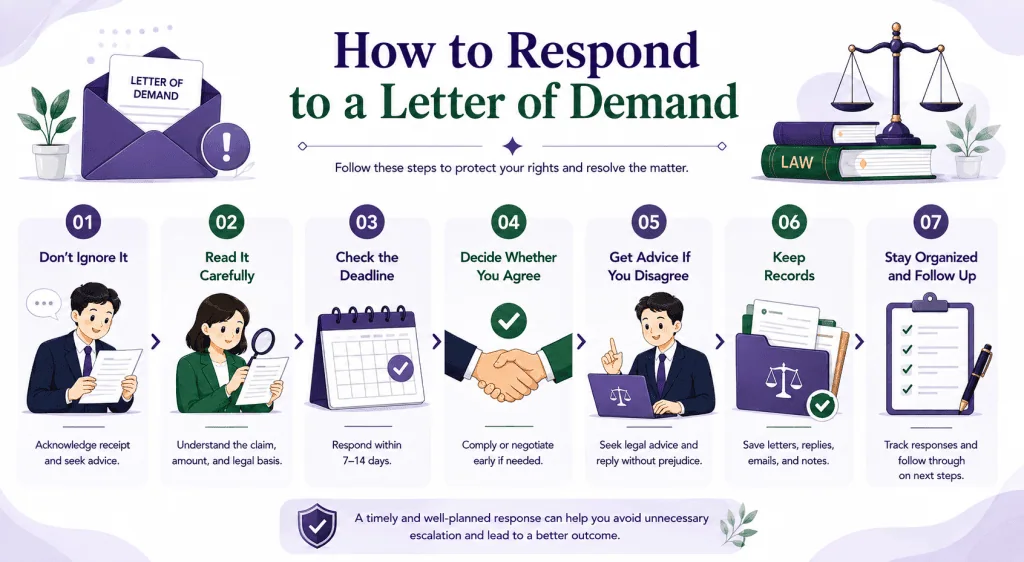
Don’t Ignore It
Silence is often read as a refusal to engage, which can prompt the other side to escalate sooner than necessary. Even a short acknowledgement, confirming you’ve received the letter and are looking into it, shows good faith and buys you time to get proper advice before committing to a position.
Read It Carefully
Go through the letter line by line to understand exactly what is being claimed, the amount involved, and the legal basis given. If any part of the claim, the figures, or the deadline is unclear, you can write back to the sender or their lawyer to ask for clarification or supporting documents before deciding how to respond.
Check the Deadline
Most letters give 7 to 14 days to respond, though there’s no fixed rule and the actual window depends on the facts and how urgent the matter is. Missing the deadline without any response at all is one of the more common triggers for the other side to move straight to filing a claim.
Decide Whether You Agree
If you don’t dispute the claim, you may choose to comply within the deadline, or reach out to negotiate a payment plan or revised terms if you’re not able to pay or perform immediately. Responding early, even to negotiate, generally puts you in a stronger position than waiting until the deadline has passed.
Get Advice If You Disagree
If you dispute the claim, in whole or in part, it’s worth getting legal advice before replying rather than responding on your own. A lawyer can help you reply on a “without prejudice” basis, which keeps room to negotiate a settlement without your reply being treated as an admission if the matter later ends up in court.
Keep Records
Save the original letter, proof of when it was received, and copies of every reply, email, or call note that follows. These records matter if the dispute isn’t resolved and either side needs to show the court what was said and when.
Also Read: How to Recover Unpaid Invoices in Singapore (Step by step)
Can You Ignore a Letter of Demand in Singapore
You are not legally compelled to respond to a Letter of Demand, but ignoring one carries real risk. If the recipient does not respond or resolve the matter, the sender may proceed to file a claim, either at the Small Claims Tribunals for claims up to $20,000 (or $30,000 with a signed Memorandum of Consent), or in the State Courts or High Court for larger or more complex disputes.
If court papers are then also ignored, the claimant can apply for a default judgment, meaning the court may rule in their favour simply because no defence was filed. At that point, the options for negotiating on your own terms narrow considerably, and the amount owed can grow to include legal costs.
Get Help With Your Letter of Demand From RBN Chambers
A Letter of Demand is often the difference between resolving a dispute quickly and being drawn into a lengthy court process, but only if it is accurate, properly targeted, and backed by a genuine willingness to follow through. Whether you need to send one to recover a debt or have just received one and are unsure how to respond, getting advice early gives you more options and a stronger negotiating position.
RBN Chambers , led by Ramesh Bharani Nagaratnam, advises individuals and businesses on drafting and responding to Letters of Demand, debt recovery, and the civil litigation that can follow. If you have received a Letter of Demand or need one sent, contact RBN Chambers today for advice tailored to your situation.
Frequently Asked Questions
Can I ignore a Letter of Demand in Singapore?
You are not legally required to respond, but doing so is risky. Ignoring Letter of Demand can lead to a court claim, and if you then also ignore the court papers, the other party can apply for a default judgment against you without your side being heard.
How much does a lawyer charge for a Letter of Demand in Singapore?
Fees vary with the complexity of the claim. Simple letters commonly start from around $150, with more complex or high-value matters costing more. It is best to get a firm quote based on your specific situation.
Do I need a lawyer to send a Letter of Demand?
No, there is no legal requirement to use a lawyer. However, a letter issued by a lawyer, on a law firm’s letterhead, is generally taken more seriously and signals a clearer intent to follow through with legal action if the demand isn’t met.
What does “without prejudice” mean on a Letter of Demand?
It signals that the letter is a genuine attempt to settle the dispute and is generally intended to be inadmissible as evidence of an admission if the matter proceeds to court. The label alone does not guarantee this protection, so it should be used correctly.
Is there a sample or template I can use for a Letter of Demand?
There is no official government template, since the law does not prescribe a fixed format. The example above shows a typical structure, but the wording and legal basis should be adapted to your specific facts, which is generally worth having a lawyer draft or review rather than relying on a generic template.

Delivering Solutions not just Answers to your legal disputes
We provide solutions to all our clients regardless of the scale or complexity of the cases. Let us know how we can help.
Contact UsAny information of a legal nature in this blog is given in good faith and has been derived from resources believed to be reliable and accurate. The author of the information contained herein this blog does not give any warranty or accept any responsibility arising in any way, including by reason of negligence for any errors or omissions herein. Readers should seek independent legal advice.