

General |
Limitation Act in Singapore: Key Time Limits & Deadlines

Most people only think about limitation periods when it’s almost too late. You discover a breach, a debt, or an injury years after the fact, and suddenly the question isn’t whether you have a case — it’s whether you’re still allowed to bring it to court at all.
In Singapore, the Limitation Act 1959 answers that question. It sets out fixed deadlines, known as limitation periods, within which a claimant must commence legal proceedings for different categories of civil claims.
Once that window closes, the right to sue is generally lost for good, regardless of how strong the underlying claim might be. This guide breaks down the key deadlines under the Limitation Act, how they’re calculated, and the narrow exceptions that can extend them.
What is the Limitation Act?
The Limitation Act sets out time limits for various categories of civil disputes within which a claimant must initiate legal action or risk losing the chance to bring their claim to court. These time limits are in place to ensure swift action by a claimant and prevent stale claims from being litigated in court wherein damages may be harder to assess due to the delay.
It is essential to be aware of these time-bars or time limits so as not to lose your fundamental right to legally protect your interests.
When Does the Limitation Period Start?
One of the most common questions is when the limitation clock begins to run.
In most cases, the limitation period starts when the cause of action accrues, that is, when the legal right to bring a claim first arises. The exact starting point depends on the nature of the dispute.
For example:
- For a breach of contract, time generally begins from the date the contract was breached.
- For negligence claims, it usually begins when the negligent act caused damage.
- For personal injury claims, the limitation period may begin from the date of injury or the date the claimant first became aware of the injury and its connection to the defendant’s conduct.
Because determining the correct commencement date can be legally complex, obtaining legal advice early is highly recommended.
Also Read: Tort Claims in Singapore: What to Do When Someone’s Negligence Harms You
Limitation Periods for Common Claims
The applicable limitation period varies depending on the type of legal action. Below is a general overview of some of the most common claims.
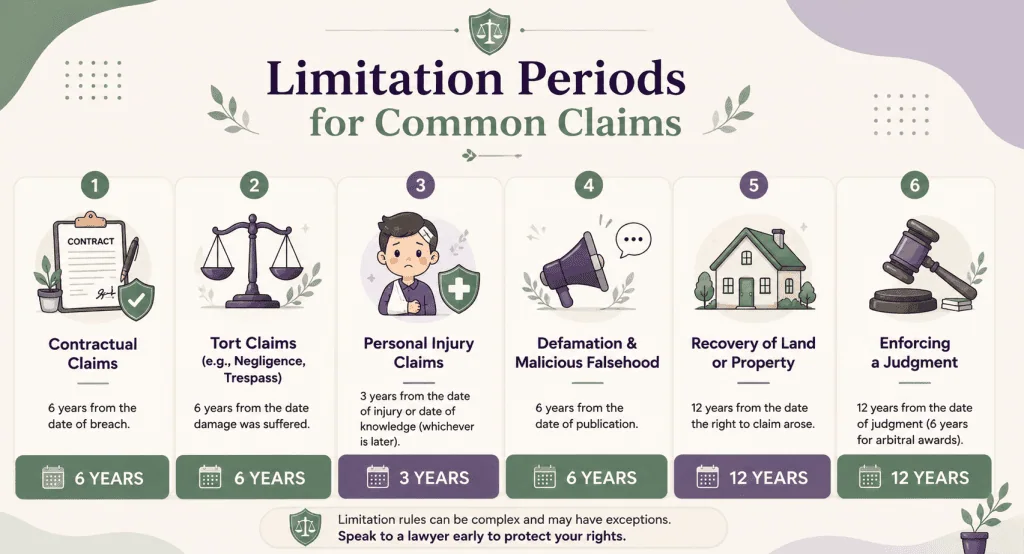
- Contractual claims: Under Section 6 of the Limitation Act, a claimant generally has 6 years from the date of breach to bring proceedings for breach of contract.
- Tort claims (e.g., negligence, trespass): Also governed by Section 6, the general limitation period is 6 years from the date the damage was suffered, subject to the special rules for latent damage and personal injury below.
- Personal injury claims: Where a claim for negligence, nuisance, or breach of duty includes damages for personal injury, Section 24A sets a 3-year limitation period, running from either the date of the injury or the date the claimant first had the knowledge needed to bring the claim, whichever is later.
- Defamation and malicious falsehood: Claims must generally be brought within 6 years of the date of publication.
- Recovery of land or property: A claimant has 12 years from the date the right to claim arose.
- Enforcing a judgment: A judgment creditor has 12 years from the date of the judgment to enforce it (arbitral awards have their own 6-year period).
| Type of Claim | Limitation Period |
|---|---|
| Contractual claims | 6 years |
| Tort claims (negligence, trespass) | 6 years |
| Personal injury claims | 3 years |
| Latent property damage (negligence/nuisance) | 6 years from damage, or 3 years from knowledge, subject to a 15-year long-stop |
| Defamation and malicious falsehood | 6 years |
| Recovery of land or property | 12 years |
| Enforcing a court judgment | 12 years |
| Small Claims Tribunal (SCT) claims | 2 years |
These are general limitation periods only. Certain claims may be subject to different statutory deadlines or exceptions depending on the applicable legislation and factual circumstances.
Also Read: Defamation, Slander & Libel Laws in Singapore
Small Claims Tribunal Time Limit
If your dispute falls within the jurisdiction of the Small Claims Tribunal (SCT), different deadlines may apply.
Generally, claims must be filed within 2 years from the date the cause of action arose. Certain exceptions may apply in limited circumstances, but missing the applicable deadline may prevent the Tribunal from hearing your claim.
If you are unsure whether your dispute should be brought before the Small Claims Tribunal or the courts, it is advisable to seek legal advice as early as possible.
Latent Damage Claims
Some of the most legally complex limitation issues arise in construction defect and professional negligence cases, where damage, a crack in a wall, a structural defect, a defective design — may not surface until years after the underlying act or omission.
Sections 24A and 24B of the Limitation Act address this specifically for negligence, nuisance, and breach of duty claims not involving personal injury:
- Under Section 24A, a claim must be brought within 6 years of the date the damage occurred, or 3 years from the date the claimant had both knowledge of the damage and the right to sue, whichever expires later.
- Section 24B imposes an overriding “long-stop” limit of 15 years from the date of the act or omission complained of — this applies even if the damage was only discovered after the 15 years had run, except where the claim involves fraud, in which case the long-stop doesn’t apply (Section 29).
Singapore courts have grappled with exactly what counts as “knowledge” under Section 24A, recent case law has clarified that a claimant only needs a reasonable, rather than complete or certain, understanding that the damage is attributable to the defendant’s conduct before the clock starts running on the 3-year limb.
These cases are highly fact-sensitive, so anyone who suspects a latent defect should get legal advice as soon as it’s discovered rather than waiting for it to fully develop.
Can a Limitation Period Be Extended or Paused?
The Limitation Act allows the clock to be paused or postponed in narrow circumstances:
Disability
If the claimant was a minor or lacked mental capacity when the cause of action accrued, the limitation period doesn’t begin until the disability ends.
Fraud or mistake
Where the claim is based on the defendant’s fraud, the right of action was fraudulently concealed, or the claim seeks relief from a mistake, time doesn’t start running until the claimant discovered (or with reasonable diligence could have discovered) the fraud or mistake.
Singapore courts have held that this exception is applied narrowly, for example, fraudulent concealment by one defendant in a multi-party claim doesn’t automatically postpone time against co-defendants who weren’t involved in the concealment.
These exceptions are technical and frequently litigated in their own right, so they shouldn’t be relied on without legal advice specific to the facts.
Know Your Deadline, Protect Your Claim at RBN Chambers
Limitation periods can be deceptively complex, the deadline that applies to your situation often depends on exactly when your cause of action accrued, what knowledge you had and when, and whether any of the narrow extensions apply.
A claim that looks straightforward can quietly become time-barred while you’re still gathering evidence or weighing your options, and once that window closes, even a strong case on the merits can no longer be brought to court.
The safest move is to get clarity before the clock runs out, not after. Our litigation team at RBN Chambers can assess your situation, pinpoint exactly when your limitation period started and when it expires, and advise on the best way forward, whether that means filing promptly, exploring an extension, or pursuing your claim through the right forum.
Frequently Asked Questions
What is the statute of limitations in Singapore?
The statute of limitations refers to the legal time limit within which a civil claim must be commenced. In Singapore, these limitation periods are primarily governed by the Limitation Act 1959.
Can a limitation period be extended?
Generally no, except in specific circumstances such as fraud, concealment, mistake, or disability (where the claimant was a minor or lacked mental capacity when the claim arose).
What is the time limit for a Small Claims Tribunal claim?
2 years from the date the cause of action accrued, for claims that arose on or after 1 November 2018.
Does the limitation period apply to criminal cases?
No. The Limitation Act applies to civil actions only; criminal prosecutions are governed by separate rules under the Penal Code and Criminal Procedure Code.
What happens if I miss the limitation period?
The claim generally becomes time-barred and the court will not allow it to proceed on the merits, provided the defendant raises the limitation defence — so it’s important to act well before the deadline.

Delivering Solutions not just Answers to your legal disputes
We provide solutions to all our clients regardless of the scale or complexity of the cases. Let us know how we can help.
Contact UsAny information of a legal nature in this blog is given in good faith and has been derived from resources believed to be reliable and accurate. The author of the information contained herein this blog does not give any warranty or accept any responsibility arising in any way, including by reason of negligence for any errors or omissions herein. Readers should seek independent legal advice.