

Business |
Non-Disclosure Agreement (NDA) in Singapore: Legal Guide

Protecting confidential business information is essential when companies share sensitive information with employees, investors, suppliers, business partners or potential buyers. A non-disclosure agreement (NDA) provides a contractual framework for controlling how that information can be used and disclosed.
However, an NDA is only as effective as its drafting. An overly broad confidentiality clause, unclear definition of confidential information, or inappropriate restriction may create difficulties when enforcement becomes necessary. Singapore courts have considered these issues in recent cases involving confidentiality obligations, particularly in employment disputes.
This guide explains what a non-disclosure agreement is, what it should contain, whether NDAs are legally binding in Singapore, and what businesses should consider when dealing with an NDA breach.
What Is a Non-Disclosure Agreement?
A non-disclosure agreement is a contract under which one or more parties agree to protect confidential information from unauthorised use or disclosure.
Confidential information may include business plans, customer data, pricing, financial information, software, technical information, product designs, trade secrets and other commercially sensitive material.
NDAs are commonly used during:
- Employment and consultancy arrangements
- Business negotiations and partnerships
- Investment and financing discussions
- Mergers and acquisitions
- Joint ventures
- Supplier and service-provider relationships
The agreement typically establishes what information is protected, how it may be used, who may receive it and what obligations continue after the relationship ends.
Are Non-Disclosure Agreements Legally Binding in Singapore?
Yes. A properly formed non-disclosure agreement can create legally enforceable contractual obligations in Singapore.
However, the fact that a document is labelled an “NDA” does not make every provision automatically enforceable. Courts may examine the actual wording, the nature of the information and the circumstances in which the information was disclosed.
Singapore courts have scrutinised confidentiality clauses that were drafted too broadly. In a 2024 High Court decision concerning an employee confidentiality clause, the court noted that an extremely wide definition that effectively covered all information could raise serious concerns about reasonableness and enforceability.
What Should a Non-Disclosure Agreement Include?
A well-drafted NDA should address the circumstances in which confidential information is being shared rather than relying solely on a generic confidentiality statement.
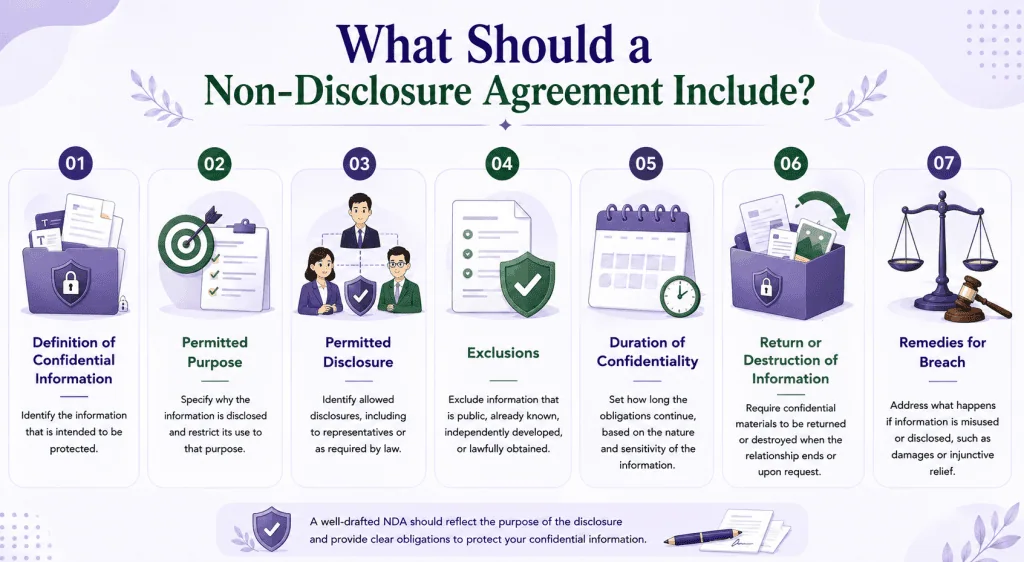
1. Definition of Confidential Information
The NDA should identify the information that is intended to be protected. This may include information provided in writing, electronically, verbally or in other forms. The definition should be sufficiently comprehensive without being so broad that it effectively treats all information concerning a business as confidential.
2. Permitted Purpose
The agreement should specify why information is being disclosed and restrict the recipient from using it outside that purpose. For example, information provided during acquisition due diligence should generally only be used for evaluating or completing the proposed transaction.
3. Permitted Disclosure
An NDA should identify circumstances in which disclosure is allowed, such as disclosure to employees, directors, professional advisers or representatives who need the information for the agreed purpose. It should also address disclosures required by law, court order or regulatory authorities.
4. Exclusions
Common exclusions cover information that:
- is already publicly available without a breach;
- was lawfully known before disclosure;
- is independently developed without using the confidential information; or
- is lawfully obtained from another source without a confidentiality obligation.
5. Duration of Confidentiality
The parties should determine how long confidentiality obligations will continue. Some commercial information may only require protection for a defined period. Other information, particularly genuine trade secrets, may require protection for as long as it remains confidential.
The appropriate duration should therefore depend on the nature and sensitivity of the information.
6. Return or Destruction of Information
An NDA may require confidential documents and other materials to be returned or destroyed when the business relationship ends or upon request. The clause should account for legitimate legal, regulatory and electronic backup requirements where appropriate.
7. Remedies for Breach
The NDA should address what happens if confidential information is misused or disclosed. Depending on the circumstances, a party may seek remedies such as damages or injunctive relief.
RBN Chambers notes that businesses dealing with confidentiality disputes may consider legal action, including an injunction to stop further disclosure or misuse.
Also Read: Frustration of Contract in Singapore: Comprehensive Guide
5 Tips for Drafting a Non-Disclosure Agreement in Singapore
A well-drafted non-disclosure agreement (NDA) should clearly explain what information is protected, how it may be used, and what happens if the obligations are breached. Consider these five key steps:
Clearly Define Confidential Information
Identify the types of information that require protection, such as trade secrets, customer data, financial records, business plans or technical information. Avoid using an unnecessarily broad definition that could make the clause difficult to enforce.
Explain the Permitted Use
State why the information is being disclosed and make clear that it may only be used for that agreed purpose. For example, information shared during due diligence should generally only be used to evaluate the proposed transaction.
Set Out Permitted Disclosures and Exceptions
Specify who may receive the information, such as employees, professional advisers or contractors who need it for the agreed purpose. The NDA should also address information that is already public, previously known, independently developed, or required to be disclosed by law.
Specify the Duration and Handling Requirements
State how long the confidentiality obligations will apply and what should happen to the information when the relationship or project ends. This may include returning or destroying documents and addressing how confidential information should be stored or protected.
Address Breach and Remedies
Explain what happens if confidential information is misused or disclosed without authorisation. Depending on the agreement and circumstances, this may include obligations to stop further disclosure, return or delete the information, and the right to seek appropriate legal remedies.
Unilateral vs Bilateral Non-Disclosure Agreement
The appropriate NDA depends on who will be disclosing confidential information.
| Type | Description | Typical Situation |
|---|---|---|
| Unilateral NDA | One party primarily discloses confidential information and the receiving party agrees to protect it. | Employer and employee |
| Bilateral NDA | Both parties disclose confidential information and owe confidentiality obligations to each other. | Joint venture or business negotiation |
A unilateral NDA may be sufficient where only one party is providing sensitive information. A bilateral NDA is generally more suitable where both parties expect to exchange commercially sensitive material.
NDA for Employees vs Business Partners
The contents of an NDA may also differ depending on the relationship.
- For employees, confidentiality obligations may form part of an employment agreement or a separate NDA. The drafting should distinguish genuine confidential information from the employee’s general skills and knowledge.
- For business partners, the NDA should be aligned with the commercial transaction and explain exactly what information may be disclosed, who can access it and for what purpose.
NDA and Personal Data Under the PDPA
A non-disclosure agreement does not replace obligations under Singapore’s Personal Data Protection Act 2012 (PDPA).
Where an NDA covers information containing personal data, the relevant organisation may also have obligations relating to the collection, use, disclosure and protection of that personal data. The PDPC states that the PDPA establishes Singapore’s general data protection framework governing the collection, use and disclosure of individuals’ personal data by organisations.
Businesses should therefore consider contractual confidentiality requirements separately from their statutory data protection obligations.
NDA vs Non-Compete Clause
An NDA and a non-compete clause are not the same. A non-disclosure agreement focuses on protecting confidential information from unauthorised disclosure or use. A non-compete clause seeks to restrict certain competitive activities.
This distinction matters because restrictive covenants may raise separate questions under Singapore’s restraint of trade principles. A confidentiality clause should not simply be used as a way to impose an unnecessarily broad restriction on an individual’s future activities.
What Happens If There Is a Breach of NDA?
A breach may occur when confidential information is disclosed to an unauthorised person, used for an unauthorised purpose, or otherwise handled contrary to the NDA.
Depending on the agreement and circumstances, the affected party may consider:
- Taking immediate steps to contain the disclosure.
- Issuing a formal demand to stop the unauthorised use or disclosure.
- Seeking an injunction where urgent protection is required.
- Pursuing damages or other available remedies.
- Considering whether a separate breach of confidence claim may also arise.
Speed can be important because the commercial value of confidential information may be substantially reduced once it becomes publicly available.
Common Non-Disclosure Agreement Mistakes
Businesses should be cautious about:
- Using an overly broad definition of confidential information
- Failing to state the permitted purpose
- Omitting reasonable exclusions
- Failing to regulate disclosure to employees or advisers
- Using an inappropriate confidentiality period
- Ignoring return or destruction obligations
- Assuming an NDA automatically makes every restriction enforceable
- Using confidentiality clauses to impose inappropriate non-compete restrictions
A recent 2024 Singapore High Court decision illustrates the risks of an excessively broad confidentiality clause, particularly where the provision is framed so widely that virtually all information relating to the company may fall within its scope.
Also Read: What to Include in a Singapore Partnership Agreement
Get Legal Advice on Your Non-Disclosure Agreement (NDA)
A non-disclosure agreement can provide important contractual protection when a Singapore business needs to share sensitive information. But an effective NDA requires more than a standard confidentiality clause.
The agreement should be tailored to the information being protected, the relationship between the parties, the permitted purpose, security requirements, ownership rights, duration and potential remedies. This is particularly important in employment disputes, M&A transactions, trade-secret matters and situations involving digital or AI systems.
RBN Chambers advises businesses on drafting and reviewing commercial agreements, including confidentiality and non-disclosure arrangements, as well as legal disputes involving confidential information.
For advice on your specific circumstances, contact RBN Chambers through to discuss your legal requirements.
Frequently Asked Questions
How long does a non-disclosure agreement last?
The duration depends on the agreement and the nature of the information. Some obligations may apply for a defined period, while trade-secret protection may need to continue while the information remains confidential.
Can I use a standard NDA template?
A template may provide a starting point, but it may not reflect the specific information, transaction, recipients, security requirements or legal issues involved. IPOS itself recommends tailoring NDA terms to the business’s circumstances.
Can an NDA prevent someone from competing with my business?
Not automatically. An NDA primarily concerns confidentiality and the use or disclosure of protected information. Restrictions on competition raise separate legal considerations and should be drafted and assessed separately.
Can an NDA cover information shared before it was signed?
The parties can agree on the scope of information covered by the agreement, but the wording should clearly address earlier disclosures. Where commercially sensitive information is expected to be shared, it is generally preferable to establish confidentiality protections before disclosure.

Delivering Solutions not just Answers to your legal disputes
We provide solutions to all our clients regardless of the scale or complexity of the cases. Let us know how we can help.
Contact UsAny information of a legal nature in this blog is given in good faith and has been derived from resources believed to be reliable and accurate. The author of the information contained herein this blog does not give any warranty or accept any responsibility arising in any way, including by reason of negligence for any errors or omissions herein. Readers should seek independent legal advice.