

Employment |
Know Your Employee Rights in Singapore

Employment disputes arise when the rights of employees are breached or contractual terms are not followed by either party.
To avoid such disputes, it’s essential to understand the laws governing employment in Singapore — and the Employment Act 1968 is the place to start. It sets the minimum standards that any employment arrangement must meet, and covers everyone employed in Singapore except seafarers, domestic workers, and civil servants.
Below, we set out the key rights under the Act, together with guidance from the Ministry of Manpower (MOM), including a few recent changes worth knowing about.
Workman vs Non-Workman
Not every employee gets the same statutory protections, and the workman/non-workman distinction is one of the most searched and misunderstood parts of the Act.
- A workman is someone doing manual labour, or holding a job listed in the First Schedule of the Act (cleaner, construction worker, machine operator, bus/train driver, and similar roles).
- A non-workman is any other employee who isn’t a manager or executive — for example, clerks, receptionists, and general administrative staff.
- Managers and executives are employees with decision-making or supervisory authority, and are treated differently again.
This classification decides who gets the protections in Part IV of the Act (below) — it isn’t just a technical label.
| Key Difference | Workman | Non-Workman |
|---|---|---|
| Definition | Manual labour, or a job in the First Schedule | Other employee, not a manager/executive |
| Part IV coverage (rest days, hours, overtime) | If earning ≤ S$4,500/month basic salary | If earning ≤ S$2,600/month basic salary |
| Examples | Construction worker, cleaner, machine operator, driver | Clerk, receptionist, general admin staff |
Working hours and overtime
Part IV of the Act regulates rest days, hours of work, and overtime, but only for the two groups above, within their salary caps. Managers and executives are not covered by Part IV at all, regardless of salary.
Working hours for common arrangements are capped at:
- 9 hours a day or 44 hours a week, for employees working 5 days or less weekly, or
- 8 hours a day or 44 hours a week, for employees working more than 5 days weekly
Employees can also work up to 48 hours a week (capped at 88 hours across 2 consecutive weeks) under other arrangements, or 44 hours over 3 consecutive weeks on shifts of up to 12 hours a day. Including overtime, capped at 72 hours a month, employees cannot work more than 12 hours a day, subject to certain MOM exceptions. Overtime pay must be at least 1.5 times the basic hourly rate.
For PMEs (professionals, managers, and executives), these hours are instead governed by the employment contract, not Part IV.
CPF Contributions: What Employees Are Entitled To
Unlike Part IV, CPF contributions apply based on citizenship, not job classification, but they’re one of the most consistently overlooked “employee rights” topics.
- Only Singapore Citizens and Permanent Residents are entitled to employer CPF contributions; foreign employees on work passes are not.
- For employees aged 55 and below, the current total contribution rate is 37% of wages — 17% from the employer, 20% from the employee — applied to wages up to the Ordinary Wage ceiling of S$8,000 a month (as of 1 January 2026).
- The rate steps down progressively for older employees, tapering across the 55–60, 60–65, 65–70, and above-70 age bands.
- The employee’s share is deducted directly from gross pay and must be shown on the itemised payslip; the employer’s share is paid on top.
Itemised Payslips and Key Employment Terms (KETs)
Since 1 April 2016, these two documents have been mandatory for every employee covered by the Act, including managers and executives, who miss out on Part IV but not on this.
- Employers must issue an itemised payslip within 3 working days of salary payment, showing basic salary, allowances, all deductions (including CPF), overtime, and net pay as separate items — not just a gross-to-net summary.
- Employers must issue written Key Employment Terms within 14 days of the start date, for any employee engaged for 14 days or more.
- Failing to issue compliant payslips or KETs is something MOM can act on, and may result in financial penalties for the employer.
If your payslip doesn’t break these items out, or you were never given written KETs, that’s already a compliance gap worth raising.
Also Read: MOM Compliance Checklist for Singapore Employers
Leave Entitlements in Singapore
Sick and Hospitalisation Leave
Under section 89 of the Act, employees who have worked for at least 3 months are entitled to paid sick and hospitalisation leave.
Full entitlement, 14 days of sick leave and 60 days of hospitalisation leave (inclusive of the 14 outpatient days) kicks in after 6 months of service. Employees between 3 and 6 months get a prorated entitlement, adding roughly 3 sick leave days and 15 hospitalisation days for each completed month.
Annual Leave
Under section 88A, employees who have completed a year of service are entitled to 7 days of annual leave, on top of rest days, sick leave, and public holidays, with one additional day for each further completed year.
Employees with less than a year of service get a prorated entitlement. Most employment contracts start at 14 days, with their own rules on forfeiture and encashment — note that employers are legally entitled to reject annual leave requests, subject to reasonable grounds.
Maternity and Paternity Leave
Working mothers employed for at least 3 months are entitled to 16 weeks of paid maternity leave for a Singaporean-born child, starting up to 4 weeks before confinement, under the maternity protection provisions in Part 9 of the Act.
For a non-citizen child, the entitlement is 12 weeks. Legally married or adoptive fathers of Singaporean children get 2 weeks of paid paternity leave, plus up to 4 weeks of shared parental leave if the mother qualifies for the 16-week entitlement.
Retirement and Re-Employment Age
As of 1 July 2026, the statutory retirement age rose from 63 to 64, and the re-employment age rose from 68 to 69. Employers should update internal policies and extend re-employment offers to eligible employees at least three months before they reach the retirement age.
Also Read: Employment Disputes: Common Types of Employment Issues in Singapore and How to Handle Them
Termination and Notice
Either party can terminate an employment contract under section 10(1) of the Act. Employees who resign must give notice in writing; employers cannot reject a resignation. Employers ending a contract must issue a termination letter.
The notice period is usually set out in the employment contract and, under section 10(2), must be the same for both parties. Where the contract is silent, section 10(3) sets the default notice period. If either party doesn’t want to serve notice, they must pay compensation in lieu — equivalent to the salary that would have been earned during that period.
Termination not supported by the contract or the Act may amount to wrongful dismissal.
Retrenchment Benefits
Section 45 of the Act states that employees with less than 2 years of continuous service are not entitled to any retrenchment benefit. It’s commonly assumed this means employees with 2 or more years automatically qualify for a benefit — but that’s not quite right.
An Employment Claims Tribunal recently confirmed this directly: Section 45 is framed entirely in the negative, and doesn’t create a positive entitlement to retrenchment benefits for anyone, including employees with 2+ years of service. Whether a retrenched employee gets a benefit and how much still depends on what the employment contract or a collective agreement says.
In practice, retrenchment benefits are commonly 2 weeks’ to 1 month’s salary per year of service, or the rate set in a collective agreement for unionised staff, but none of this is guaranteed by the Act itself. An employer may still choose to make an ex-gratia payment out of goodwill, though this isn’t legally required.
Employment Act Section Quick Reference
| Topic | Section | Note |
|---|---|---|
| Notice | Section 10 | Governs the notice period required to terminate the contract of service |
| Compensation in lieu of notice | Section 11 | Covers termination without notice, requiring payment of salary in lieu |
| Rest days, hours of work | Sections 36–41 | Part IV; sections 42–44 have been repealed |
| Retrenchment benefit | Section 45 | Confirms no entitlement below 2 years’ service; creates no positive entitlement above it |
| Maternity protection | Part 9 (sections 76–87A) | Covers benefit period, dismissal protection, childcare leave |
| Annual leave | Section 88A | 7 days after 1 year, +1 day per year thereafter |
| Sick and hospitalisation leave | Section 89 | Full entitlement after 6 months’ service |
What to Do If Your Employee Rights Are Breached
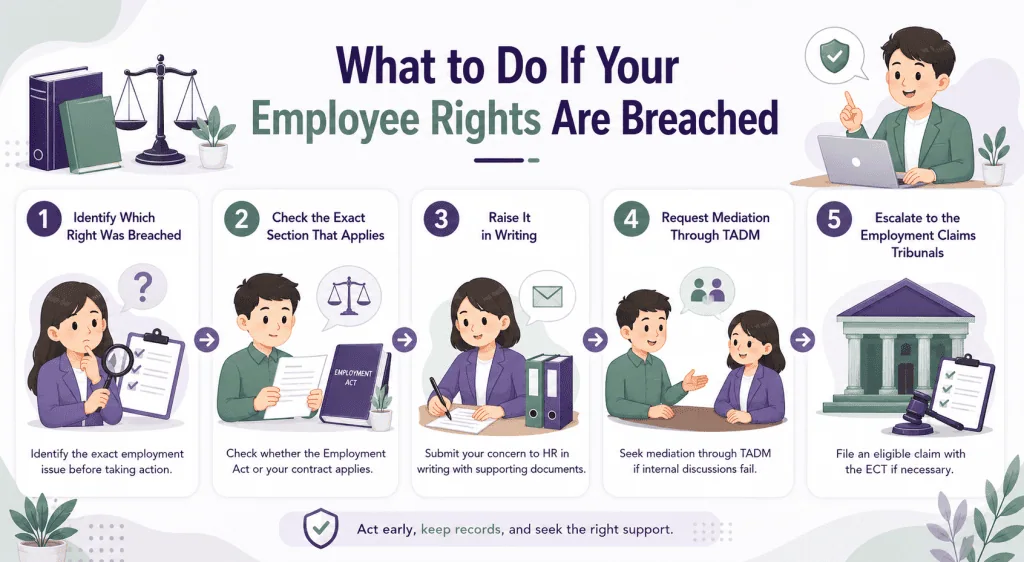
1. Identify Which Right Was Breached
Start by naming the issue precisely, unpaid overtime, denied leave, wrongful termination, or a retrenchment benefit dispute like the one covered above. It’s easy to describe a dispute in general terms “my employer isn’t treating me fairly” but the more specific you can be, the easier it is to match the issue to the right part of the Act and the right remedy.
2. Check the Exact Section That Applies
Before raising the issue, check whether it’s governed by a specific section of the Employment Act (as set out in the quick reference table above) or by a clause in your employment contract.
Some rights, like annual leave under section 88A or notice periods under section 10, are set by statute; others depend entirely on what your contract says. Knowing which one applies changes what you can reasonably ask for.
3. Raise It in Writing
Raise the matter in writing with your employer or HR, rather than relying on a verbal conversation. Include the relevant dates, amounts, and supporting documents, payslips, your employment contract, KETs, and any related correspondence. A written record also matters later if the dispute escalates, since it shows the issue was raised properly and isn’t a last-minute claim.
4. Request Mediation Through Tripartite Alliance for Dispute Management (TADM)
If the matter isn’t resolved internally, the next step for most salary, leave, and dismissal disputes is mediation through the Tripartite Alliance for Dispute Management (TADM). For eligible claims, this step is mandatory before the case can proceed further — TADM will bring both parties together with a neutral mediator to try to reach a settlement.
5. Escalate to the Employment Claims Tribunals
If TADM mediation doesn’t resolve the dispute, you can escalate to the Employment Claims Tribunals (ECT), which hears eligible salary and wrongful dismissal claims up to S$20,000 (or S$30,000 with union assistance). Parties represent themselves at the ECT, getting legal advice on your position beforehand still helps, even though a lawyer can’t appear at the hearing itself.
How RBN Chambers Can Help
An employment dispute rarely gets simpler by waiting — a denied leave request or an unclear termination letter can turn into a wrongful dismissal claim or a retrenchment benefit dispute if it isn’t addressed properly from the start.
RBN Chambers advises both employees and employers on the full range of employment matters, helps you understand exactly where you stand before you commit to a position, whatever side of the dispute you’re on.
If your employee rights have been breached, or you’re an employer facing a claim, contact RBN Chambers for a legal review before the dispute escalates.
Frequently Asked Questions
Can my employer put a term in my contract that gives me less than the Employment Act provides?
No. Under section 8 of the Act, any contract term that’s less favourable than the Act’s minimum standards is illegal, null and void to that extent — regardless of what you signed.
Do fixed-term or contract employees get the same rights as permanent staff?
Yes. Fixed-term and contract employees are entitled to the same statutory benefits under the Employment Act as open-ended, permanent employees, the difference is in how and when the contract ends, not in the underlying entitlements.
Can I refuse to work overtime?
If you’re covered by Part IV, your employer can require overtime up to the statutory caps (72 hours a month, and no more than 12 hours in a day inclusive of overtime), and you’re entitled to overtime pay for it. Beyond those caps, or without your consent where the contract doesn’t require it, you can refuse.
What’s the minimum notice period if my contract doesn’t specify one?
Under section 10(3), it depends on length of service: 1 day for less than 26 weeks, 1 week for 26 weeks to 2 years, 2 weeks for 2 to 5 years, and 4 weeks for 5 years or more. Most contracts specify a longer period, commonly 1–3 months, which takes precedence.
Are foreign domestic workers (FDWs) protected under the Employment Act?
No. FDWs are excluded from the Employment Act entirely — their terms are governed by their Work Permit conditions and the Employment of Foreign Manpower Act instead, not by the Act discussed in this guide.

Delivering Solutions not just Answers to your legal disputes
We provide solutions to all our clients regardless of the scale or complexity of the cases. Let us know how we can help.
Contact UsAny information of a legal nature in this blog is given in good faith and has been derived from resources believed to be reliable and accurate. The author of the information contained herein this blog does not give any warranty or accept any responsibility arising in any way, including by reason of negligence for any errors or omissions herein. Readers should seek independent legal advice.