

Employment |
Retrenchment in Singapore: Rights, Benefits and Legal Process

Retrenchment in Singapore raises urgent, practical questions the moment a role is declared redundant. Are you owed retrenchment pay, how much notice must you receive, and will the money be taxed? Employers planning a restructuring face the mirror image: what must be paid, who must be notified, and how to avoid a wrongful dismissal claim.
The law on retrenchment in Singapore works in three layers: the Employment Act, the employment contract, and the tripartite guidelines that MOM expects employers to follow. This guide explains how they work together and what to do if a retrenchment goes wrong.
What Is Retrenchment?
Retrenchment is the termination of an employee’s job because the role is redundant or the employer is reorganising its business, not because of the employee’s conduct or performance. It is a no-fault termination, so the legal questions centre on notice, payment and fairness rather than proof of misconduct.
MOM and NTUC have said that a role made redundant in Singapore is a retrenchment even if the work is moved overseas, and whether or not the employee applies for an overseas role. Employers cannot avoid retrenchment obligations by changing the label.
Also Read: Workplace Injury Compensation Singapore: Limits & Claims
Retrenchment Rate in Singapore
MOM’s labour market data show retrenchments rising through 2026. In the second quarter, 4,620 workers were retrenched, an incidence of 2.0 per 1,000 employees and the highest level since the fourth quarter of 2020. MOM attributed the rise mainly to business restructuring in outward-oriented sectors such as manufacturing, information and communications, and financial services.
The job search is also getting harder. Only 54.9 per cent of retrenched residents were re-employed within six months in the second quarter, down from 60.7 per cent in the first. In 2025, the retrenchment incidence for resident PMETs reached 10.1 per 1,000, and NTUC handled more than 3,900 retrenchment and termination cases involving PMEs, about 5 per cent more than in 2024. Overall levels remain well below the global financial crisis and COVID-19 periods, but packages and selection decisions are drawing closer scrutiny.
Is Retrenchment Benefit Mandatory in Singapore?
No statute sets a retrenchment payment. Section 45 of the Employment Act says an employee with less than two years of continuous service is not entitled to retrenchment benefit, but the Act does not fix an amount for anyone with longer service. The entitlement comes from the employment contract, staff handbook or collective agreement. If those documents promise a benefit, the employer is legally bound to pay it.
Where the documents are silent, the Tripartite Advisory on Managing Excess Manpower and Responsible Retrenchment fills the gap. MOM’s guidance on responsible retrenchment says employees with at least two years of service are eligible for retrenchment benefit. The prevailing norm is two weeks to one month of salary per year of service, and usually one month under a collective agreement. The advisory is not legislation, but MOM can curtail the work pass privileges of employers who ignore it. Employees with less than two years of service may receive an ex gratia payment out of goodwill.
How to Calculate Retrenchment Pay in Singapore
Start with the contract or collective agreement, because a stated formula overrides the benchmark. If there is none, use the advisory range: monthly salary multiplied by completed years of service, multiplied by the applicable fraction of a month. Partial years are often pro-rated, but this depends on the wording, so check the document.
For example, an employee earning S$4,000 a month with five years of service would receive about S$10,000 at two weeks per year (treated as half a month) or S$20,000 at one month per year. Contracts may define salary differently, so confirm whether allowances or fixed bonuses count.
Retrenchment Notice Period in Singapore
The notice period in your contract applies first. Where the contract states none, the Employment Act sets the minimum notice according to length of service.
| Length of service | Minimum notice where the contract is silent |
|---|---|
| Less than 26 weeks | 1 day |
| 26 weeks to less than 2 years | 1 week |
| 2 years to less than 5 years | 2 weeks |
| 5 years or more | 4 weeks |
Either party can end the employment by giving notice or paying salary in lieu of notice. Salary in lieu is a substitute for working the notice period and is separate from retrenchment benefit. A package that offers only notice pay, with no discussion of retrenchment benefit, deserves a closer look.
Is Retrenchment Pay Taxable in Singapore?
IRAS treats compensation for loss of employment as generally not taxable. Payments that reward past service or cover notice are taxable. IRAS looks at what each payment is actually for, and taxable retrenchment benefits are taxed in the year you become legally entitled to them, not the year they are paid.
| Payment | Legal status | Tax treatment |
|---|---|---|
| Retrenchment benefit as compensation for loss of employment | Binding if stated in contract or collective agreement; otherwise advisory | Generally not taxable |
| Salary in lieu of notice | Contract or Employment Act | Taxable |
| Ex gratia payment or gratuity for past services | Discretionary unless the contract says otherwise | Taxable |
Because the substance of each payment matters, a retrenchment agreement should state clearly what each sum is for. Employers must declare the taxable components correctly.
Retrenchment Process for Employers in Singapore
The advisory treats retrenchment as a last resort and expects a fair, documented process. The key stages are below.
Consider Alternatives First
- Redeployment, retraining, shorter work weeks, temporary layoffs or wage adjustments in line with tripartite norms.
- Records showing why these alternatives were not viable.
Select Employees Objectively
- Objective criteria such as skills, experience and performance, applied consistently.
- No discrimination on grounds such as age, nationality, gender, race or religion, and attention to maintaining a strong Singaporean core.
- “Last in, first out” is not required, but whatever method is used must be objective and documented. Unionised employers should consult the union on selection and benefits.
Notify Employees and MOM
- Notice to employees according to the termination terms in their contracts.
- A Mandatory Retrenchment Notification to MOM within five working days of informing each retrenched employee, for employers with at least 10 employees. Smaller employers are strongly encouraged to notify.
- The notification asks whether retrenchment benefits were paid and whether other assistance was given.
Pay and Support Affected Employees
- Wages due and retrenchment benefits paid by the employee’s last day of work.
- Job search support, for example through e2i or Workforce Singapore.
Wrongful Dismissal and Disguised Retrenchment
Under the Tripartite Guidelines on Wrongful Dismissal, dismissal with notice for genuine redundancy is not wrongful. It becomes wrongful if the stated reason is false (for example, citing redundancy and then hiring a replacement), if it is discriminatory, or if it is meant to deprive the employee of a benefit.
A disguised retrenchment happens when an employer terminates with ordinary notice or salary in lieu to avoid paying retrenchment benefit or notifying MOM. Managers and executives dismissed with notice can only bring a wrongful dismissal claim if they have served at least six months.
Workplace Fairness Act and Retrenchment
The Workplace Fairness Act, passed in two stages in 2025, is expected to take effect at the end of 2027. It will prohibit adverse employment decisions, including retrenchment, based on protected characteristics such as age, nationality, sex, marital status, pregnancy, caregiving responsibilities, race, religion, language ability, disability and mental health conditions.
Claims must go through mediation first, and the Employment Claims Tribunals will be able to hear discrimination claims up to S$250,000. Until then, the Tripartite Guidelines on Fair Employment Practices remain the standard.
Legal Recourse for Unfair Retrenchment in Singapore
Most disputes start with a reading of the contract and end in mediation. MOM’s guidance on managing employment disputes sets out the route.
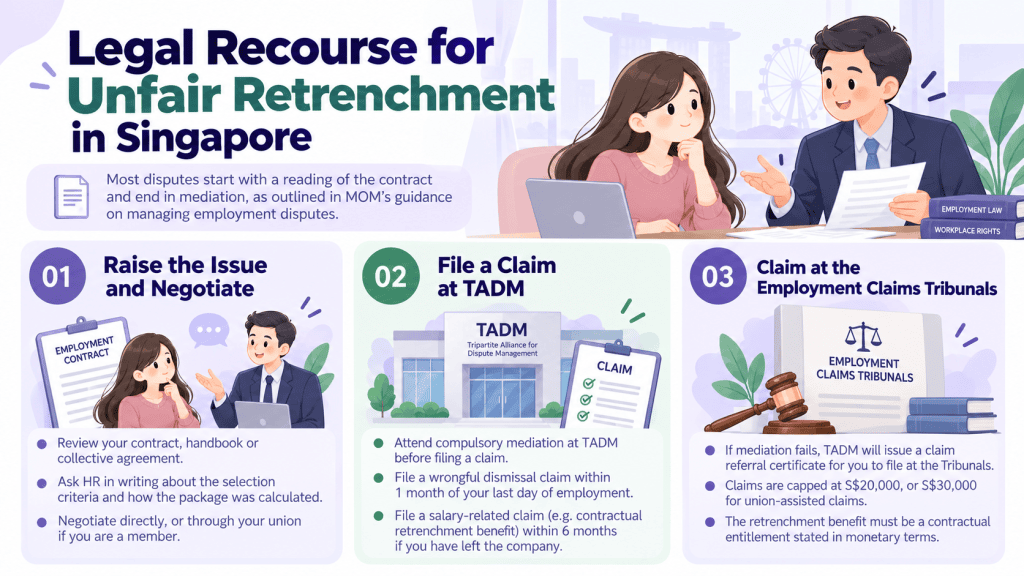
Raise the Issue and Negotiate
- Review the contract, handbook or collective agreement for any retrenchment benefit formula.
- Ask HR in writing how the selection criteria were applied and how the package was calculated.
- Negotiate directly, or through your union if you are a member.
File a Claim at TADM
- Mediation at the Tripartite Alliance for Dispute Management (TADM) is compulsory before any claim reaches the Employment Claims Tribunals.
- A wrongful dismissal claim must be filed within one month of your last day of employment.
- A salary-related claim, which can include a contractual retrenchment benefit, should be filed within six months of your last day of work if you have left the company.
Claim at the Employment Claims Tribunals
- If mediation fails, TADM issues a claim referral certificate that allows you to file at the Tribunals.
- Claims are capped at S$20,000, or S$30,000 for union-assisted claims.
- A retrenchment benefit claim here must be a contractual entitlement stated in monetary terms. Larger or more complex disputes may belong in the courts.
Also Read: Who Is Covered Under Employment Act Singapore? A Legal Guide
How a Lawyer Can Help With Retrenchment
Retrenchment sits where contract terms, statutory minimums, tripartite expectations and tax treatment meet, and a small drafting point can change what an employee is owed or what an employer is exposed to. A lawyer can review a retrenchment letter or release agreement before it is signed, check whether the benefit matches the contract, and assess whether the selection process or stated reason would withstand a wrongful dismissal claim.
For employers, early advice on alternatives, selection criteria, MOM notification and documentation reduces the risk of disputes later. For employees, advice is most valuable before signing a release, and well before the one-month and six-month claim deadlines run out.
Speak to RBN Chambers About Your Retrenchment
Whether you are an employer planning a restructuring or an employee facing a retrenchment package, the right advice at the start is far easier than a dispute later. Ramesh Bharani Nagaratnam and the RBN Chambers team advise on employment disputes, from reviewing retrenchment terms to representing clients in mediation, the Employment Claims Tribunals and the courts.
To discuss your situation, visit our employment law services page or contact RBN Chambers to arrange a consultation.
Frequently Asked Questions
Can I be retrenched if I have served less than two years?
Yes. Retrenchment does not depend on length of service, and you are still entitled to notice under your contract or the Employment Act. What changes is the benefit: the Employment Act says employees with less than two years of continuous service are not entitled to retrenchment benefit. An employer may still pay an ex gratia sum, and your contract may promise more.
What should I do if my package is lower than my colleagues’?
Compare your contract terms first, because length of service, seniority or contractual benefits can explain different amounts. If the gap appears linked to age, nationality, gender or another protected characteristic, ask HR in writing how the package was calculated and seek legal advice. Discriminatory treatment in retrenchment is contrary to the tripartite guidelines and, once in force, the Workplace Fairness Act.
Is my employer required to help me find a new job?
Not by statute. The Tripartite Advisory expects responsible employers to help affected employees, for example by working with e2i or Workforce Singapore, and the MOM notification asks whether non-monetary assistance was provided.
Can an employer retrench me and then hire someone else for the same role?
This is risky for the employer. Dismissal with notice for genuine redundancy is not wrongful, but citing redundancy while the role continues can be treated as a false reason and a wrongful dismissal. The facts matter, including whether the new role is genuinely different, so seek advice promptly.
How long do I have to make a claim?
Time limits are short. A wrongful dismissal claim must be filed at TADM within one month of your last day of employment. Salary-related claims, including a contractual retrenchment benefit, should be filed within six months of your last day of work if you have left the company.

Delivering Solutions not just Answers to your legal disputes
We provide solutions to all our clients regardless of the scale or complexity of the cases. Let us know how we can help.
Contact UsAny information of a legal nature in this blog is given in good faith and has been derived from resources believed to be reliable and accurate. The author of the information contained herein this blog does not give any warranty or accept any responsibility arising in any way, including by reason of negligence for any errors or omissions herein. Readers should seek independent legal advice.