

Business |
Due Diligence in Singapore: Legal Guide for Businesses

Due diligence in Singapore is more than a background check. It is a legal safeguard that protects a business before it commits to a merger, acquisition, investment, partnership, or senior hire.
Private companies here are not subject to continuous public disclosure, so much of what matters about a target, outstanding tax exposure, undisclosed debt, or a pending lawsuit, often only surfaces through a proper due diligence review.
This guide sets out what due diligence covers under Singapore law, the checks a thorough review should include, and when to bring in a lawyer.
What is Due Diligence?
Due diligence is the structured investigation a buyer, investor, or employer carries out to verify, among other things, facts, financial health, and legal risk before finalising a transaction or relationship.
Singapore does not have a single due diligence statute, so the depth of review depends on the situation. A share sale, an asset purchase, a joint venture, and an executive hire each call for a different investigation.
What stays constant is the goal: confirming that what is being bought, invested in, or relied on is what it has been represented to be. For transactions involving a company listed on the Singapore Exchange, the Singapore Code on Take-overs and Mergers and the SGX-ST Listing Rules add their own disclosure and timing requirements on top of ordinary due diligence.
Due Diligence Triggers for Singapore Businesses
A due diligence review is standard practice in several recurring situations.
- Mergers and acquisitions, before combining with or buying another company.
- Investments, when evaluating a stake in a new venture or startup.
- Commercial real estate, before a property purchase or long-term lease.
- Partnerships and joint ventures, before formalising a business alliance.
- Executive hiring, particularly for senior or fiduciary roles, to verify professional and legal history.
- Vendor and supplier onboarding, before signing a contract or paying a deposit.
Types of Corporate Due Diligence in Singapore
For a business transaction, due diligence usually runs across four workstreams.
Financial Due Diligence
This assesses whether the numbers a seller presents are accurate and sustainable. A reviewer will typically examine three to five years of income statements, balance sheets, and cash flow records, checking for gaps between reported profit and actual cash generation, contingent liabilities, and working capital needs.
Legal Due Diligence
This tests whether the target’s rights, obligations, and approvals will actually hold up. It covers the corporate structure and constitution, material contracts, an e-Litigation search for pending or past court proceedings, and whether existing licences and regulatory approvals are transferable to a new owner.
Operational Due Diligence
This looks at how the business actually runs day to day, its supply chain, technology systems, customer and supplier concentration, and organisational structure, to flag integration risk before a deal closes rather than after.
Intellectual Property Due Diligence
For technology, creative, or brand-driven businesses, this assesses whether ownership and registration of trademarks and patents are properly recorded through the Intellectual Property Office of Singapore’s register, along with any licensing arrangements or data security gaps.
Individual Due Diligence and Background Checks
Individual due diligence may be appropriate when a business is bringing on a senior hire, appointing a director, assessing a prospective business partner, or placing an individual in a regulated, fiduciary, financial or security-sensitive role. The scope should be relevant and proportionate to the role. This may include professional qualifications, employment history, directorships, conflicts of interest, role-relevant regulatory or disciplinary history, and publicly available information concerning material litigation or insolvency.
In regulated sectors, additional requirements may apply. For example, MAS AML/CFT notices impose customer-due-diligence duties on applicable financial institutions, including obligations to identify customers and, where appropriate, beneficial owners and persons acting on behalf of customers. The precise requirements depend on the entity’s regulatory status and the applicable MAS notice or other legislation.
Background checks involve personal data, so consent under the Personal Data Protection Act is generally required before running one, a blanket consent buried in a standard employment contract will not suffice. The PDPA does allow limited exceptions, such as the evaluative purpose exception, which can permit certain checks (like reference verification) without consent, but employers should not assume an exception applies without first assessing it against the Act’s specific conditions.
Also Read: Essential Shareholder Agreement Clauses in Singapore
Financial Due Diligence vs Legal Due Diligence
Financial and legal due diligence are often run in parallel but answer different questions, and it helps to know which professional handles which.
| Aspect | Financial due diligence | Legal due diligence |
|---|---|---|
| Core question | Are the numbers accurate and sustainable | Are the rights, obligations, and approvals enforceable |
| Typically led by | Accountants or financial advisers | Lawyers |
| Key documents | Financial statements, tax filings, cash flow records | Constitution, contracts, licences, litigation records, IP registrations |
| Common red flags | Reported profit inconsistent with cash flow, undisclosed liabilities | Non-transferable licences, pending litigation, defective share transfer |
| Feeds into | Valuation and pricing | Representations, warranties, and conditions in the SPA |
Singapore Due Diligence Checklist
A structured checklist keeps a review from missing something material. At minimum, a Singapore due diligence check should cover the following.
- Corporate records, an ACRA Business Profile confirming UEN, entity status, directors, shareholders, and filing history.
- Constitution and shareholder agreements, including any restrictions on share transfer or change of control.
- Material contracts, key customer, supplier, financing, and lease agreements, and whether they trigger consent or termination rights on a sale.
- Litigation history, an eLitigation search for pending or past court proceedings involving the target.
- Licences, permits and regulatory approvals, including whether they remain valid after the transaction and whether they require consent, notification, variation, reissue or a fresh application.
- Financial statements, at least three years of income statements, balance sheets, and cash flow records.
- Tax position, outstanding assessments or disputes with IRAS.
- Intellectual property, an IPOS register check confirming ownership of trademarks and patents.
- Employment matters, employment contracts, CPF compliance, and any pending employment claims.
- Data protection, whether the target meets its PDPA obligations, including appointing a Data Protection Officer, maintaining proper consent records, and complying with data breach notification requirements.
Much of this checklist can be verified against Singapore’s official registries rather than taking a seller’s word for it. ACRA’s BizFile portal provides a company’s Business Profile for S$5.50, showing its live status, directors, and shareholders. The Singapore Courts’ eLitigation portal and the IPOS register serve the same verification purpose for litigation history and registered intellectual property.
Regulatory Compliance for Due Diligence in Singapore
The depth of due diligence depends on the level of risk. Most private transactions require a standard review, while regulated businesses and higher-risk counterparties may need a more detailed investigation.
| Level | Applies to | What it involves |
|---|---|---|
| Standard due diligence | Most private M&A, investment, and partnership transactions | ACRA and litigation searches, financial and legal document review, personal data collected under the appropriate PDPA basis |
| More detailed due diligence | Banks, payment and financial institutions, corporate service providers, and higher-risk counterparties such as politically exposed persons or complex ownership structures | Verified beneficial ownership, source of funds and wealth checks, required AML/CFT compliance measures, and registration checks under the Corporate Service Providers Act 2024 |
Beyond these sector-specific obligations, any business handling personal data during due diligence, in a data room, a background check, or vendor onboarding, remains subject to the PDPA’s consent, notification, and data minimisation requirements throughout the process.
Due Diligence Process and Timeline in Singapore
A due diligence review generally moves through five stages, from scoping the transaction to using the findings to inform the final decision. For a small or straightforward business acquisition, the full process typically takes four to eight weeks.
Larger transactions, cross-border deals, or reviews involving regulated entities can take considerably longer, particularly where enhanced due diligence or regulatory approvals are involved.
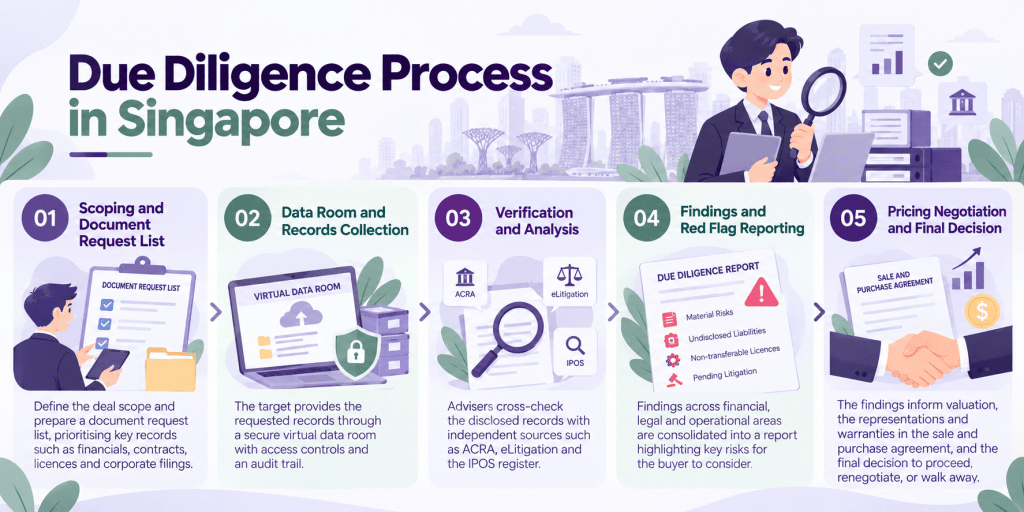
1. Scoping and Document Request List
The buyer’s team defines what the deal covers and drafts a document request list prioritised by urgency, usually financial records, material contracts, licences, and corporate filings first. Scope is set here, so gaps at this stage tend to surface as delays later.
2. Data Room and Records Collection
The target discloses the requested records, typically through a secure virtual data room with access controls and an audit trail. Missing, inconsistent or disorganised records may be a signal worth noting.
3. Verification and Analysis
Advisers cross-check what has been disclosed against independent sources, an ACRA Business Profile, an eLitigation search and the IPOS register, rather than relying solely on the seller’s own documents. This is where inconsistencies between reported figures and actual records tend to surface.
4. Findings and Red Flag Reporting
Financial, legal, and operational findings are consolidated into a report that flags material risks, undisclosed liabilities, non-transferable licences, or pending litigation among them, so the buyer’s team can weigh them before moving further.
5. Pricing Negotiation and Final Decision
The findings feed directly into valuation, the representations and warranties negotiated in the sale and purchase agreement, and ultimately the decision to proceed, renegotiate the price, or walk away from the deal.
Also Read: What to Include in a Singapore Partnership Agreement
Secure Your Transaction with RBN Chambers
Due diligence tools and public registries can confirm that a company exists, but they cannot tell you whether a contract is enforceable, a licence will survive a change of control, or a litigation history creates real exposure. That judgment call is where a lawyer earns their keep, translating what a review uncovers into terms that actually protect you in the sale and purchase agreement.
RBN Chambers advises Singapore businesses on legal due diligence for mergers, acquisitions, investments, and senior appointments, from scoping the initial document request through to negotiating the representations and warranties that follow.
Contact RBN Chambers to discuss the due diligence requirements for your next transaction.
Frequently Asked Questions
How long does due diligence take in Singapore?
For a small business acquisition, four to eight weeks is typical. Larger, cross-border, or regulated transactions take longer, especially where enhanced due diligence or regulatory sign-off is required.
What are the three main types of due diligence?
Financial, legal, and operational due diligence form the core of most reviews. Depending on the deal, tax and intellectual property due diligence are often added as a fourth and fifth workstream.
Is due diligence a legal requirement for Singapore M&As?
For most private company transactions, no single law compels a buyer to conduct due diligence. In practice, lenders, investors, and insurers routinely make it a condition of financing, and regulated entities carry separate statutory AML obligations that apply regardless of the transaction.
What are the ACRA compliance requirements to check in due diligence?
At minimum, confirm the target’s entity status is Live, not Struck Off or in liquidation, and review its filing history through a BizFile Business Profile, which shows directors, shareholders, and paid-up capital for S$5.50. While an ACRA Business Profile is a useful starting point, further ACRA documents and the target’s own corporate records may be needed to assess filing history, charges and corporate compliance.
Can I conduct due diligence on a private company without their consent?
Public record searches, an ACRA Business Profile, court records, or the IPOS register, do not require the company’s consent. A deeper review of financial statements, contracts, or staff personal data requires the target’s cooperation, usually under an NDA. Where employee or other personal data is shared for a prospective acquisition, the parties must comply with the PDPA. Individual consent may not be required where a relevant exception applies, but the information should be limited to what is necessary for the transaction

Delivering Solutions not just Answers to your legal disputes
We provide solutions to all our clients regardless of the scale or complexity of the cases. Let us know how we can help.
Contact UsAny information of a legal nature in this blog is given in good faith and has been derived from resources believed to be reliable and accurate. The author of the information contained herein this blog does not give any warranty or accept any responsibility arising in any way, including by reason of negligence for any errors or omissions herein. Readers should seek independent legal advice.