

Business |
Fiduciary Duties in Singapore & When to Consider Litigation

It is not uncommon to hear of company directors, or others placed in a position of power, who breach fiduciary duties by abusing their authority for personal gain. When that happens, the company can suffer real losses, and shareholders can watch their investments shrink as a result.
Breach of fiduciary duties can cause the company to suffer losses, and in these circumstances, legal action may be considered to seek remedies or damages from the fiduciary. This guide sets out who owes fiduciary duties in Singapore, how a breach is proven, and what a claim can recover.
Who is a fiduciary?
In essence, a fiduciary is a person or entity who has undertaken to act with loyalty in the interest of another person or entity, referred to as the principal. Discretionary power to act on the principal’s behalf is often present, but it is not enough on its own. What matters is the nature and scope of the responsibility assumed. It is important to note that a fiduciary is legally and ethically bound to act in the principal’s interest.
Fiduciaries are commonly associated with company directors, investment fund managers, trustees, estate administrators, doctors and lawyers. Whether a particular relationship gives rise to fiduciary duties, and the scope of those duties, depends on the circumstances. A person or entity placed in a position of trust and authority over someone else’s affairs may be a fiduciary, but trust, authority or a professional relationship does not automatically make every obligation fiduciary.
Core Fiduciary Duties in Singapore
Fiduciary duties are duties of loyalty. They mainly include acting in good faith, avoiding conflicts of interest and not profiting from the fiduciary position. The duty to act with skill and care is a separate duty and is distinct from fiduciary loyalty. A fiduciary may owe both, but a failure of care is not, by itself, a breach of fiduciary loyalty.
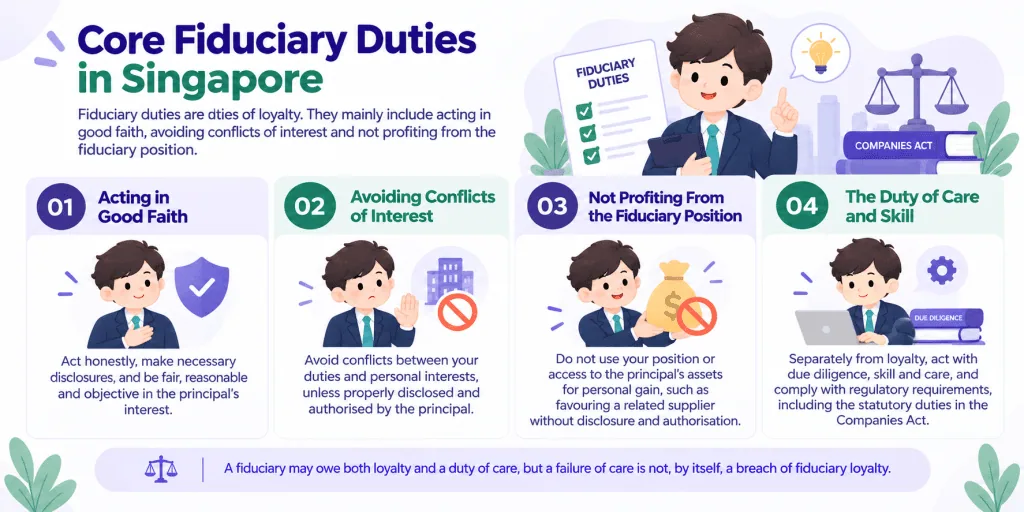
Acting in Good Faith
The fiduciary must always act honestly and with fidelity to the principal. The fiduciary must make disclosures required by the relationship, including material information needed for informed consent to a conflict of interest or personal benefit. Any disclosure must be truthful and clear, and the fiduciary must be fair, reasonable and objective when making decisions in the principal’s interest.
Avoiding Conflicts of Interest
As a relationship built on trust and empowerment, a fiduciary must avoid conflicts of interest between their duty to the principal and their own interests or other duties, unless the conflict is properly disclosed and authorised by the principal after informed consent. For example, a director should not without proper disclosure and any required authorisation, be working for a direct competitor of the company while still serving on its board.
Not Profiting From the Fiduciary Position
Fiduciaries have access to the principal’s assets and can exercise freedom to make decisions on the principal’s behalf, but they must never abuse that authority for personal benefit. A fiduciary must not, for instance, favour a supplier or business partner in which they hold a personal stake without proper disclosure and authorisation.
The Duty of Care and Skill, Distinct From Fiduciary Loyalty
Separately from fiduciary loyalty, a fiduciary may also owe a duty to act with due diligence, skill and care. This duty is distinct from the duties of loyalty above, and a breach of it is assessed differently (see the comparison with negligence below). As part of protecting the principal’s interest, the fiduciary must also ensure their actions comply with regulatory requirements, including the statutory duties laid down in the Companies Act.
Fiduciary Duties of Company Directors in Singapore
Company directors carry a heavier load than most fiduciaries because they owe two families of duty at once: fiduciary duties rooted in case law, and statutory duties set out directly in the Companies Act. A director who satisfies one set but breaches the other is still in breach.
Statutory Duties Under Section 157
Section 157 of the Companies Act requires every director to act honestly and use reasonable diligence in the discharge of their duties. This sits alongside, not instead of, the fiduciary duties owed under common law.
Under the Corporate and Accounting Laws (Amendment) Act 2025, which took effect on 6 May 2026, the maximum fine for breaching Section 157 quadrupled from S$5,000 to S$20,000, with an imprisonment term of up to 12 months also available. Passive or nominal status does not, by itself, excuse a director from their duties.
The Creditor Duty When a Company Is Insolvent
Where a company becomes insolvent or financially parlous, a director’s fiduciary duty does not disappear, but its weighting shifts. This creditor duty remains owed to the company, not directly to creditors. Critically, the court confirmed that even the shareholders of the company cannot authorise or ratify a breach of this duty, since it exists to protect a class of stakeholders the shareholders do not represent.
Breach of Fiduciary Duty vs Negligence
Claimants sometimes struggle to work out whether their situation is really a breach of fiduciary duty or a negligence claim, because the underlying facts can look similar on the surface. The two causes of action are judged differently and open up different remedies, so it helps to compare them side by side.
| Aspect | Breach of Fiduciary Duty | Negligence |
|---|---|---|
| Legal basis | Equity, arising from a relationship of trust and loyalty | Common law, arising from a duty of reasonable care |
| What must be proven | A fiduciary relationship existed, and its duties of loyalty, disclosure or no-profit were breached | A duty of care existed, the standard of care was breached, and loss was caused |
| Typical conduct | Self-dealing, secret profits, conflicts of interest, misuse of confidential information | Poor judgment, inadequate diligence or careless decision-making without disloyalty |
| Effect of consent | Fully informed consent from the principal in advance can cure what would otherwise be a breach | Consent is not a complete defence, though contributory negligence may reduce damages |
| Remedies available | Equitable compensation, account of profits, rescission, proprietary remedies, injunctions | Damages assessed to compensate the loss actually suffered |
Common Ways Fiduciary Duties Are Breached in Singapore
Breach of fiduciary duty can happen in several ways, and this list is not exhaustive:
- Choosing a third-party vendor based on personal preference rather than objective grounds
- Misusing assets belonging to the principal to generate personal profit
- Taking away a business opportunity that was intended for the principal
- Engaging in insider trading
- Misrepresenting or withholding essential information, such as a potential conflict of interest
- Disclosing the principal’s confidential information without authorisation
When Should You Consider Litigation
Litigation should be considered when the principal can prove that their interests have been compromised due to the negligence or disloyalty of the fiduciary. Suspecting a breach is not enough on its own, which is why the elements below need to be established before a claim is worth pursuing.
Elements to Prove a Breach of Fiduciary Duty
Suspicion alone is insufficient, but preventive relief may be available where there is a sufficiently established threatened breach. It is often difficult for a principal to gather this evidence alone, which is why hiring an experienced lawyer to piece together the missing information matters.
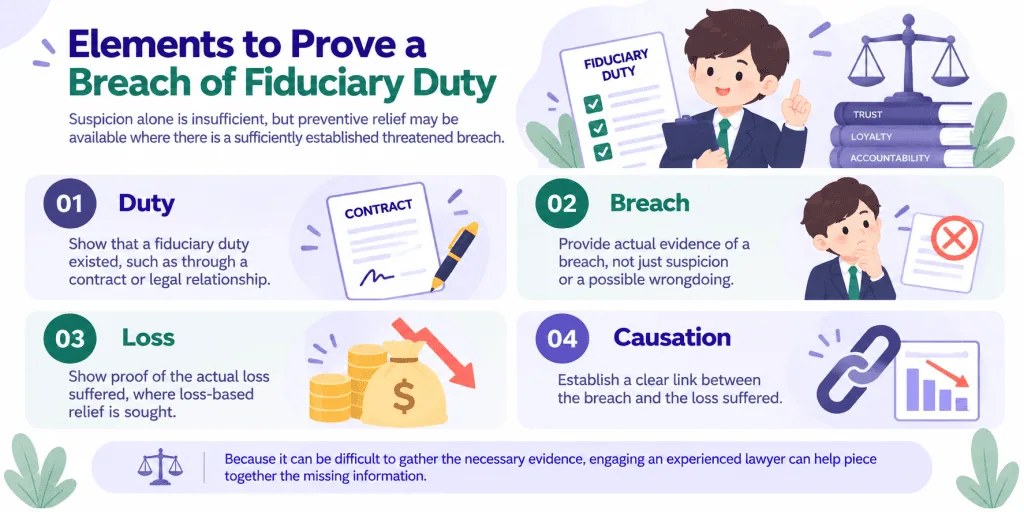
1. Duty
A lawyer must first demonstrate that a fiduciary duty existed. This can involve substantial investigation depending on the circumstances. If your fiduciary signed a written contract with you, for example, your lawyer must be able to show through that contract that the fiduciary was legally bound to you.
2. Breach
You must have actual evidence that a breach occurred, since suspicion alone is inadequate. If the company suffered a loss after a director diverted a business opportunity to their own company, for instance, your lawyer must show that the director’s conduct breached the duties they owed. Breach of fiduciary duty is not confined to a failure to disclose information. Directors ordinarily owe the relevant duties to the company, so the proper claimant is ordinarily the company. A shareholder does not automatically have a personal claim merely because the company’s loss reduced the value of their shares.
3. Loss, Where Loss-Based Relief Is Sought
Actual loss is relevant to loss-based relief, such as equitable compensation, and where it is claimed you must show proof of the loss suffered. It is not a universal prerequisite for relief for breach of fiduciary duty. An account of profits targets the fiduciary’s unauthorised gains and does not depend on corresponding loss to the principal.
4. Causation
Where loss-based relief is sought, there must be a demonstrable link between the breach and the loss suffered. Whether the loss was caused directly or indirectly by the fiduciary, your lawyer must be able to attribute it to their actions or negligence.
Limitation Period for Suing
Most civil claims in Singapore, including many breach of fiduciary duty claims, must be brought within 6 years of when the cause of action accrued, under Section 6 of the Limitation Act 1959. Section 22 does not automatically govern every claim simply because the defendant is a fiduciary. Whether it applies depends on the nature of the claim, the property involved and whether the defendant is a trustee for the purposes of the Act.
Section 22 applies, Section 22(2) applies the same 6-year period to most breach of trust claims, and to breach of fiduciary duty claims that fall within it. However, Section 22(1) removes the time limit entirely for two categories of claim: where the breach involved fraud or a fraudulent breach to which the fiduciary was party, or where the claim seeks to recover trust property still in the fiduciary’s possession or converted to their own use.
Weighing the Cost of Litigation
Litigation can be expensive and time-consuming. In some cases, your lawyer will advise against bringing a matter to court if the claim amount is smaller than the legal costs involved. It is also worth confirming whether the other party has sufficient assets to satisfy a judgment before you commit to proceedings.
Before pursuing litigation, it is typically worth exploring other options such as negotiation and mediation for a faster and more affordable resolution.
Director’s Indemnity and Insurance
Directors sometimes ask whether they can simply be indemnified against a fiduciary duty claim in advance. Under Section 172 of the Companies Act, any provision in a company’s constitution, a contract, or otherwise, that purports to indemnify a director against liability for their own negligence, default, breach of duty or breach of trust to the company is void. A company cannot contract its way out of a director’s accountability to it.
That said, the law does allow two practical forms of protection. Under Section 172A, a company may purchase and maintain directors’ and officers’ liability insurance to cover a director against such liability. Under Section 172B, a company may indemnify a director against liability incurred to third parties, and against defence costs where the director is acquitted or succeeds in the proceedings.
Remedies for Breach of Fiduciary Duty
If you are confident about proving your case, you could claim damages or equitable compensation. These are monetary relief for the loss suffered, which may be loss of money, income, property or other loss, depending on the specifics of the case. Recovery of property is a different form of relief. Other remedies and forms of relief available in Singapore include:
- Rescission of a contract that involves a breach of fiduciary duty
- An account of the ill-gotten profits payable by the fiduciary to the beneficiary
- Recovery of property, including through proprietary remedies such as transferring the title of an ill-gotten property from the fiduciary to the beneficiary
- Injunctions restraining an actual or threatened breach, and, where appropriate, orders requiring performance of an obligation
Get Legal Advice From RBN Chambers on a Fiduciary Duty Claim
Breach of fiduciary duty cases require substantial time and expertise to prove, from establishing that a duty existed through to tracing the loss it caused. Ramesh Bharani Nagaratnam and the RBN Chambers team regularly advise both principals pursuing a claim and directors defending one, and can help you assess whether litigation, mediation, or negotiation is the right path for your situation.
If your interests have been compromised and you are uncertain whether to proceed with litigation, contact RBN Chambers for a consultation with Ramesh Bharani Nagaratnam and the team.
Frequently Asked Questions
What is the time limit to sue for breach of fiduciary duty in Singapore?
Claims must generally be brought within six years from accrual of the cause of action, subject to the applicable rules and exceptions, under the Limitation Act. This time limit does not apply at all where the breach involved fraud, or where the claim seeks to recover trust property still in the fiduciary’s possession.
Can a director be personally liable for a breach?
Yes. A director who breaches their fiduciary or statutory duties can be personally liable to compensate the company for losses, to account for any profits made, and in serious cases can face criminal penalties under the Companies Act.
What is the difference between a breach of duty and a breach of contract?
A breach of fiduciary duty arises from a relationship of trust and is governed by equity, while a breach of contract arises from an agreed set of contractual terms and is governed by contract law. The two can overlap, but they require different elements to prove and can lead to different remedies.
Can a company indemnify a director against a fiduciary duty claim?
No, not against the company itself. Section 172 of the Companies Act voids any indemnity for a director’s own breach of duty to the company, though a company can purchase D&O insurance and indemnify a director against third-party claims.

Delivering Solutions not just Answers to your legal disputes
We provide solutions to all our clients regardless of the scale or complexity of the cases. Let us know how we can help.
Contact UsAny information of a legal nature in this blog is given in good faith and has been derived from resources believed to be reliable and accurate. The author of the information contained herein this blog does not give any warranty or accept any responsibility arising in any way, including by reason of negligence for any errors or omissions herein. Readers should seek independent legal advice.