

Employment |
Flexi Work Arrangement Singapore: Your Legal Rights

Can you ask your employer to let you work from home two days a week, start later, or move to part-time hours? And if you are the employer, do you have to say yes? In Singapore, you can ask, and employers do not have to approve every request. They do have to consider it properly.
Since 1 December 2024, the Tripartite Guidelines on Flexible Work Arrangement Requests have set out how that process should work. This guide explains how to make or handle a request, when a refusal is reasonable, and the legal issues that tend to appear once an arrangement is in place.
What Is a Flexi Work Arrangement in Singapore?
A flexi work arrangement (FWA) is an agreed variation from the standard way a job is done. Examples include working from home on certain days, starting and finishing at different times, or taking on a lighter workload. The Ministry of Manpower (MOM) and the Tripartite Alliance for Fair and Progressive Employment Practices (TAFEP) treat FWAs as arrangements that employer and employee agree on, not something either side can impose.
An FWA is not a statutory right. The Tripartite Guidelines on Flexible Work Arrangement Requests (TG-FWAR) do not require employers to offer FWAs or approve every request. They are tripartite guidelines, not an Act of Parliament. MOM still expects all employers to follow them and to have a process for properly considering formal requests, as explained on MOM’s TG-FWAR page.
Types of Flexi Work Arrangements in Singapore
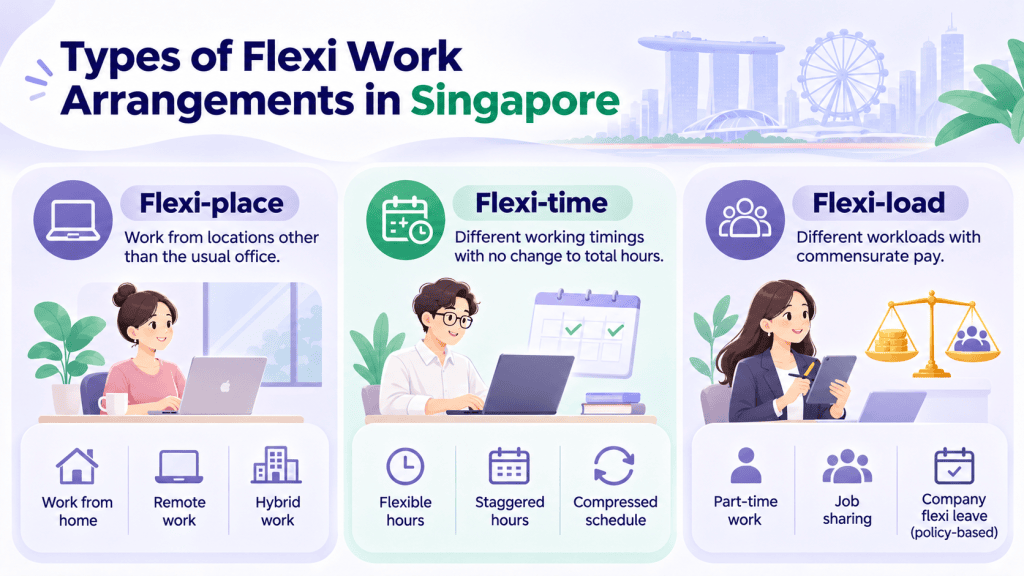
The Guidelines group FWAs into three categories. An employee can request one, combine several, or propose an arrangement that is not listed.
Flexi-place
Flexi-place covers working from locations other than the usual office, such as telecommuting, remote work options and work from home Singapore arrangements. Hybrid work arrangements, where the week is split between home and office, also fall here.
Flexi-time
Flexi-time covers different working timings with no change to total hours or workload. Examples include flexible work hours, staggered hours, flexi-shift and compressed work schedules. This is what most people mean by flextime in Singapore.
Flexi-load
Flexi-load covers different workloads with commensurate pay, such as part time flexi work and job sharing. Because pay follows workload, this category is the most likely to change contract terms. Labels such as “flexi leave” are usually company policy terms, so their legal effect depends on the contract and the policy.
Also Read: Retrenchment in Singapore: Rights, Benefits and Legal Process
How to Request a Flexi Work Arrangement in Singapore
Informal arrangements that work for both sides can continue. The TG-FWAR only covers formal requests, so a request has to meet the formal requirements to be covered.
Who can make a formal request
- Employees who have completed probation, as defined by their employer.
- Employers may, but do not have to, consider requests during probation.
- MOM states there is no limit on the number of requests an employee can make, although requests should be made responsibly.
What a formal request must contain
If the employer has its own process, such as a portal or template, the employee should follow it. If not, a written request should state:
- The date of the request.
- The FWA requested, including expected frequency and duration.
- The reason for the request.
- The start and end dates, if relevant.
A verbal request is a non-formal request. A request that leaves out these details is not covered by the Guidelines.
How the employer should respond
- Give a written decision within two months of receiving the request. This includes any clarification discussions.
- State the reasons in the written decision if the request is rejected.
- Discuss alternatives with the employee, which the Guidelines encourage.
When Can an Employer Reject a Flexi Work Arrangement Request?
Employers may reject a request, but the Guidelines say the decision should rest on reasonable business grounds and not personal bias against FWAs. Each request is assessed case by case. Where there are valid business grounds, an employer is not expected to approve the same FWA for every employee at once. The table below summarises the grounds the Guidelines treat as reasonable and unreasonable.
| Ground | Treated as | What it means |
|---|---|---|
| Cost | Reasonable | The FWA significantly increases the employer’s cost burden |
| Productivity or output | Reasonable | Output falls significantly, or the business cannot meet customer needs |
| Feasibility | Reasonable | The job role does not suit it, there is no capacity to adjust others’ work, or new hires would be needed |
| Management does not believe in FWAs | Not reasonable | A personal view, not a business outcome |
| Supervisor wants to see staff in the office despite good performance | Not reasonable | Not linked to performance |
| Tradition, or fear that others will also ask | Not reasonable | Custom alone is not a business ground |
The grounds should relate to the job and its business impact, not the employee’s personal reason for asking. Writing them down protects the employer if the decision is later questioned.
Legal Considerations for Employers and Businesses
Approval is where much of the legal work begins. Once an arrangement is running, several areas of Singapore law apply as they would to an office-based role.
Contract terms and written approval
An FWA varies the standard arrangement, so it should be recorded. The Guidelines’ sample response form captures the agreed work expectations, start date, duration and next review date. Recording these points, and the conditions for continuing the arrangement, helps if it is later reviewed or ended.
Hours of work and overtime
Part 4 of the Employment Act covers workmen earning up to $4,500 a month and other employees earning up to $2,600 a month, excluding managers and executives. For these employees, normal hours are up to 44 hours a week. Daily limits are nine hours for a five-day week or fewer and eight hours for a longer week.
Overtime must be paid at no less than 1.5 times the hourly basic rate. These rules are set out on MOM’s hours of work page. Compressed schedules and remote work make hours harder to track, so longer working days should be checked against these limits and hours recorded reliably. For employees outside Part 4, the contract governs.
Work injury compensation
An employee working away from the office may still be eligible for compensation under the Work Injury Compensation Act 2019 if the injury arises out of and in the course of work. MOM’s guidance on WICA coverage explains who is covered. Employers should take reasonable steps to educate employees on working safely outside the office.
Data protection and confidentiality
Working outside a controlled office environment raises the risk of data leaks. Employers remain responsible under the Personal Data Protection Act 2012 for personal data they hold, wherever employees access it. Confidentiality obligations in the employment contract also continue to apply. Roles that handle sensitive personal data may be harder to support remotely, which can be a relevant factor in assessing feasibility.
Fair treatment and the Workplace Fairness Act
The Guidelines expect employees on FWAs to be appraised on outcomes and objective criteria, in line with the Tripartite Guidelines on Fair Employment Practices. Approving similar requests for some employees and refusing others without documented reasons invites complaints.
The Workplace Fairness Act 2025 is expected to take effect by the end of 2027. It will add statutory protection against discrimination, including on caregiving responsibilities, with employers of fewer than 25 employees initially exempt. It does not create a right to flexible work, but unexplained and inconsistent FWA decisions may attract more scrutiny once it applies.
Also Read: Who Is Covered Under Employment Act Singapore? A Legal Guide
Legal Considerations for Employees
For employees, the starting point is that a flexi work arrangement is a request and not an entitlement. Follow the employer’s process, put the request in writing, and be specific about the arrangement, how long it should run and why. Be ready to discuss how work, contactability and deliverables will be managed. The Guidelines expect employees to use FWAs responsibly and to consider the impact on their team and clients.
An approved arrangement does not change the employment relationship in other respects. Performance is still appraised, and standards of conduct still apply. Some arrangements, flexi-load in particular, may change the scope of the job and the pay that goes with it. It is sensible to agree these points before starting and to keep a copy of the approval and any review date. For a wider overview of workplace protections, see our guide to employee rights in Singapore.
What Happens When a Flexi Work Arrangement Is Disputed
Internal discussion
- The Guidelines encourage open discussion, and the internal grievance procedure is the first step where there is disagreement.
- Employers are encouraged to discuss alternatives if a request is rejected.
TAFEP and NTUC
- An employee who feels a request was not properly considered may approach TAFEP. Unionised employees can approach NTUC or their union.
- TAFEP will assess the case. If the employer did not assess the request properly, TAFEP will guide the employer to comply, as stated in MOM’s enforcement FAQ.
Legal advice
- The Guidelines are not legislation, so a refused request is not, by itself, a court claim.
- Related issues, such as unpaid overtime, a unilateral change to pay or terms, or a dismissal after a request, may involve contractual or statutory rights.
When to Seek Legal Advice on a Flexi Work Arrangement
A flexi work arrangement can look simple on paper, but disputes tend to arise in the details. Common questions include whether a request was properly considered, whether a refusal can be justified, what happens if an approved arrangement is withdrawn, and how overtime, pay and performance are handled afterwards. A review of the employment contract, the company’s FWA policy and the correspondence on the request can show where each side stands.
Businesses can also benefit from advice before problems arise. A lawyer can help an employer draft an FWA policy that reflects the Guidelines, set out approval and review terms in writing, and prepare for the Workplace Fairness Act. Employees can get a clear view of their options if a request has been refused, ignored or later withdrawn.
Speak to RBN Chambers About Your Flexi Work Arrangement
If you are facing a flexi work arrangement dispute, or want your company’s policy reviewed, RBN Chambers can help. Led by Ramesh Bharani Nagaratnam, the firm advises employees and employers in Singapore on employment contracts, workplace policies and disputes.
To discuss your situation, contact RBN Chambers to arrange a consultation, or read more about our employment disputes legal services before you get in touch.
Frequently Asked Questions
Can an employer refuse a flexi work request in Singapore?
Yes. FWAs are not a legal entitlement. A refusal should rest on reasonable business grounds, such as cost, productivity or feasibility, and be given in writing with reasons. Tradition, or a belief that FWAs do not work, is not a reasonable ground under the Guidelines.
How long does an employer have to respond to a formal request?
The employer should give a written decision within two months of receiving the formal request. That period includes any clarification and discussion. The arrangement can start earlier if both sides agree.
Is work from home same as a flexi work arrangement?
No. Work from home is one form of flexi-place. FWAs also cover changes to hours and workload, such as staggered hours, compressed schedules, part-time work and job sharing.
What can I do if my employer rejects or ignores my request?
Raise it through your internal grievance process first. If you believe the request was not properly considered, you can approach TAFEP, or NTUC if you are unionised. If the issue also involves your contract, pay or dismissal, legal advice can clarify your options.

Delivering Solutions not just Answers to your legal disputes
We provide solutions to all our clients regardless of the scale or complexity of the cases. Let us know how we can help.
Contact UsAny information of a legal nature in this blog is given in good faith and has been derived from resources believed to be reliable and accurate. The author of the information contained herein this blog does not give any warranty or accept any responsibility arising in any way, including by reason of negligence for any errors or omissions herein. Readers should seek independent legal advice.