

General |
Arbitration Tribunal in Singapore: How It Works & What It Costs

An arbitration tribunal is the private equivalent of a court bench, one or more arbitrators empowered to hear a dispute and deliver a final, binding decision outside the court system.
In Singapore, how an arbitral tribunal is formed, what powers it holds, and how far its decisions can be challenged are all shaped by specific legislation and institutional rules.
Understanding how these bodies actually operate matters well before a dispute arises, starting from the moment an arbitration clause is drafted into a contract.
Arbitration Tribunal in Singapore
An arbitration tribunal is the body of one or more arbitrators appointed to hear and decide a dispute referred to arbitration.
In Singapore, its composition and powers are shaped by two pieces of legislation depending on the nature of the dispute: the Arbitration Act (Cap 10) for domestic arbitration, and the International Arbitration Act (IAA) for international arbitration, which incorporates the UNCITRAL Model Law.
Most arbitral tribunals seated in Singapore also operate under institutional rules such as the SIAC Rules, which supplement the statutory framework. Here’s what this guide covers.
- A tribunal can be a sole arbitrator or a panel, most often three members, chosen by the parties or appointed under SIAC Rules if they can’t agree
- Singapore’s default position, where the parties are silent, is a sole arbitrator, which departs from the Model Law’s default of three
- The tribunal can rule on its own jurisdiction (competence-competence), decide procedure, order interim relief and issue a final, binding award
- An arbitrator’s appointment can be challenged on limited grounds, such as justifiable doubts about impartiality or a lack of agreed qualifications
- For urgent matters before a tribunal is formed, SIAC Rules allow parties to apply for an Emergency Arbitrator
- Tribunal awards are enforceable in over 170 countries under the New York Convention, but can only be set aside on narrow, specific grounds, unlike a court judgment which can usually be appealed
Key Aspects of an Arbitration Tribunal
Before getting into how a tribunal is formed and what it can do, it helps to have a quick reference for what defines an arbitration tribunal in the first place.
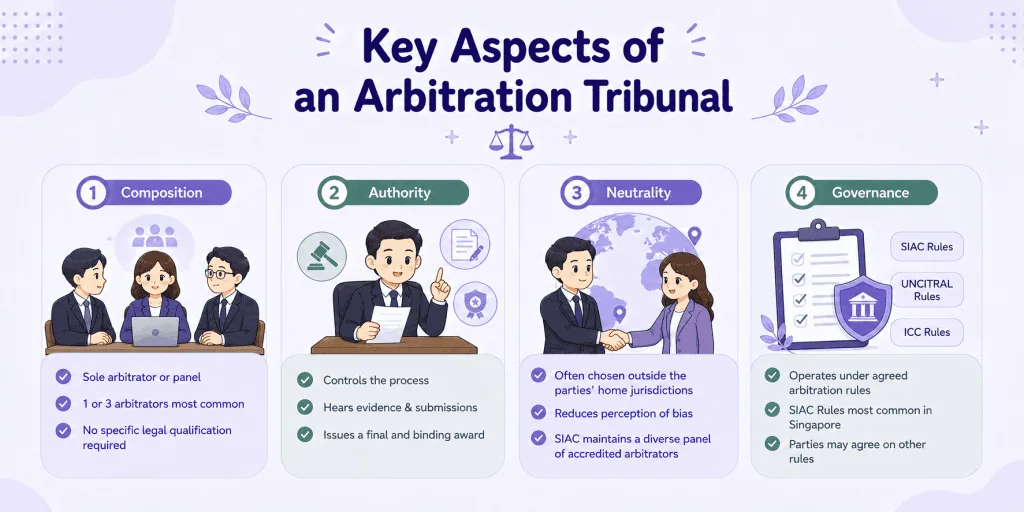
Composition
A tribunal can be a sole arbitrator or a panel, most commonly three members. A sole arbitrator is often enough, and more cost-effective, for smaller or more straightforward disputes, while a three-member panel is more common for higher-value or technically complex matters, where each side nominates an arbitrator with relevant expertise. Arbitrators don’t need to be lawyers or hold any specific formal qualification, unless the parties’ agreement requires one.
Authority
The tribunal decides procedural matters, hears evidence and submissions, and issues an award that is final and binding on the parties.
Neutrality
In cross-border disputes especially, arbitrators are often chosen from outside either party’s home jurisdiction, which reduces the perception of bias that can come with relying on either side’s local courts. SIAC maintains a panel of accredited arbitrators drawn from dozens of countries, which the appointing authority can draw on when parties can’t agree.
Governance
Tribunals seated in Singapore operate under a governing set of arbitration rules, most commonly the SIAC Rules, though parties may instead adopt the UNCITRAL Arbitration Rules or the ICC Rules of Arbitration, depending on what the parties agreed to in their contract.
Together, these four aspects are what keep arbitration fair, impartial and efficient as a way of resolving disputes, and they set the stage for the more detailed rules on formation, powers and costs covered below.
How Is an Arbitration Tribunal Formed in Singapore
Parties are generally free to agree on the number of arbitrators and the appointment procedure in their arbitration agreement. Where a three-member tribunal applies and the parties haven’t set out their own process, the usual approach is straightforward: each party nominates one arbitrator, and the two party-nominated arbitrators then agree on a third, presiding arbitrator.
If a party fails to nominate an arbitrator, or the two nominees can’t agree on a chair, the default appointing authority, the President of the SIAC Court of Arbitration, steps in and makes the appointment.
Where the parties haven’t agreed on the number of arbitrators at all, Singapore departs from the position under the UNCITRAL Model Law. Instead of defaulting to a three-member panel, a sole arbitrator is appointed unless the parties agree otherwise, which keeps smaller disputes from becoming disproportionately expensive to resolve.
Powers of the Tribunal Under SIAC Rules
Once constituted, a tribunal holds significant authority over how the dispute proceeds.
- It can rule on its own jurisdiction, including the validity of the arbitration agreement itself, a principle known as competence-competence and reflected in section 21 of the Arbitration Act
- It determines procedural matters, including the seat and language of the arbitration where the parties haven’t agreed
- It can order interim measures, such as preserving evidence or assets, and appoint experts to assist on technical issues
- It can consolidate related proceedings or hold concurrent hearings where appropriate
- It issues a final award that is binding on the parties and apportions costs between them
Challenging or Removing an Arbitrator
An arbitrator’s appointment can be challenged where there are justifiable doubts about their impartiality or independence, or where they lack a qualification the parties had agreed on. Separately, a party can seek an arbitrator’s removal where they are physically or mentally unable to continue, or where they’ve failed to act with reasonable despatch and this has caused substantial injustice.
Under the SIAC Rules, a challenge is first decided by the SIAC Court of Arbitration, whose decision is final and not open to appeal under those rules. Under both the Arbitration Act and the IAA, a party can also apply to the General Division of the High Court for an arbitrator’s removal in defined circumstances, though courts generally won’t intervene until any agreed institutional process has been exhausted.
Also Read: What Is Arbitration? Resolving Disputes in Singapore
Emergency Arbitrator and Interim Relief
Disputes don’t always wait for a tribunal to be fully constituted. Where a party needs urgent relief, such as freezing assets or stopping an imminent breach, before the regular tribunal is in place, the SIAC Rules provide for the appointment of an Emergency Arbitrator. This arbitrator can typically be appointed within a day and is empowered to grant interim relief that holds until the full tribunal takes over the case.
Arbitration Tribunal vs Singapore Court System
Choosing between arbitration and litigation often comes down to a handful of practical trade-offs, set out below.
| Aspect | Arbitration Tribunal | Singapore Court System |
|---|---|---|
| Privacy | Confidential by default under SIAC Rules, with hearings and awards generally kept private | Hearings are public and judgments are generally publicly available |
| Selection of adjudicator | Parties choose or help select the arbitrator, matching expertise to the dispute | A judge is assigned by the court registry, with no input from the parties |
| Speed | Often faster, since there’s generally no multi-tier right of appeal on the merits | Can take considerably longer once appeals to the High Court and Court of Appeal are factored in |
| Cost | Arbitrator and institution fees add to legal costs, though a sole arbitrator and expedited procedures can reduce this | Court filing fees are comparatively low, but costs can escalate through multiple stages of appeal |
| Right of appeal | Very limited; an award can only be set aside on narrow grounds, such as a lack of jurisdiction or breach of natural justice | Broader rights of appeal on questions of law and, in some cases, fact |
| Enforcement | Enforceable in over 170 countries under the New York Convention | Enforcement abroad depends on reciprocal arrangements between Singapore and the other country |
Cost of an Arbitration Tribunal in Singapore
Arbitration costs generally fall into three categories: the institution’s administration fee, the arbitrators’ fees, and the parties’ own legal representation costs. Under SIAC Rules, administration and arbitrator fees are typically calculated on an ad valorem basis tied to the sum in dispute, following SIAC’s published Schedule of Fees, unless the parties agree to hourly rates instead.
Venue hire, transcription, and expert witness costs can add to the total. The tribunal has the power to apportion these costs between the parties in its final award, and will generally take into account which side succeeded and how the dispute was conducted.
Choosing the Right Tribunal for Your Dispute
The tribunal you end up with shapes the entire arbitration, from how efficiently the case moves to how confidently you can predict the outcome.
A sole arbitrator with the right subject-matter expertise can resolve a straightforward commercial dispute quickly and economically, while a poorly chosen three-member panel, or an arbitrator without the right technical background, can add months and significant cost to a case that should have been resolved faster.
This is why the appointment stage deserves as much strategic attention as the arbitration clause itself. Decisions made early, such as whether to nominate a specialist or a generalist, or whether to invoke SIAC’s Emergency Arbitrator procedure, can materially affect how the dispute unfolds.
Also Read: Alternative Dispute Resolution (ADR) Methods in Singapore
How RBN Chambers Can Help With Arbitration Tribunals
At RBN Chambers, we advise clients at every stage of the arbitration process, from drafting arbitration clauses that set clear ground rules, to nominating arbitrators, challenging an appointment where necessary, and representing parties before a tribunal seated in Singapore or abroad.
Led by Ramesh Bharani Nagaratnam, our arbitration and commercial litigation teams work together so you get the right strategy whether your dispute is headed for a tribunal or a courtroom.
If you’re entering into a contract that includes an arbitration clause, or you’re already facing a dispute that may go to arbitration, contact RBN Chambers to discuss how we can help protect your position.
Frequently Asked Questions
How many arbitrators are usually in a tribunal?
Most tribunals in Singapore are either a sole arbitrator or a panel of three. Where the parties haven’t agreed on a number, Singapore’s default position is a sole arbitrator, unlike the UNCITRAL Model Law’s default of three.
Can a tribunal’s decision be appealed in Singapore?
Not in the way a court judgment can be. An arbitral award can only be set aside on narrow, specific grounds, such as a lack of proper jurisdiction, a breach of natural justice, or the award conflicting with Singapore’s public policy.
What is the difference between an arbitrator and a judge?
An arbitrator is privately appointed by the parties, or by an appointing authority such as the SIAC President, and only has authority over the specific dispute referred to arbitration. A judge is a public office holder assigned by the court with authority over any case before their court.
How much does an arbitration tribunal cost?
Costs typically include the institution’s administration fee, the arbitrators’ fees, calculated on an ad valorem basis or by the hour depending on the rules used, and each party’s own legal costs. The tribunal apportions these costs in its final award.
What is competence-competence?
Competence-competence is the principle that lets an arbitral tribunal rule on its own jurisdiction, including whether the underlying arbitration agreement is valid, rather than needing a court to decide this first.
Can I get urgent relief before the tribunal is formed?
Yes. SIAC Rules allow a party to apply for an Emergency Arbitrator, who can be appointed within about a day to grant interim relief until the full tribunal is constituted.

Delivering Solutions not just Answers to your legal disputes
We provide solutions to all our clients regardless of the scale or complexity of the cases. Let us know how we can help.
Contact UsAny information of a legal nature in this blog is given in good faith and has been derived from resources believed to be reliable and accurate. The author of the information contained herein this blog does not give any warranty or accept any responsibility arising in any way, including by reason of negligence for any errors or omissions herein. Readers should seek independent legal advice.