

Employment |
Employment Agency Regulations in Singapore: MOM Licensing Guide

Any organisation or individual that recruits or places job seekers with employers in Singapore is generally doing “employment agency work.” This applies whether the placement is local or overseas, and whether or not a fee is charged. Under the Employment Agencies Act 1958 (“the Act”), businesses doing this kind of work must hold a valid licence from the Ministry of Manpower (MOM) before they start operating.
The licensing system exists to protect job seekers, especially foreign and lower-wage workers, from unethical agencies and excessive fees. It also gives employers a way to check that the agency they are using meets MOM’s standards.
Before looking at licence types in detail, here is a quick checklist of what MOM expects from every employment agency.
Key compliance checklist for Singapore Employment Agencies (EA)
- Hold a valid MOM licence (Comprehensive or Select) before doing any EA work
- Ensure that key appointment holders (KAHs) and relevant staff have the required Certificate of Employment Intermediaries (CEI) if your employment agency operates under any of the Comprehensive Licences.
- Register every individual doing EA work separately as EA Personnel
- Provide the required security bond as an electronic banker’s guarantee
- Charge job seekers no more than the statutory fee cap
- Renew the licence before it expires after 3 years, and update MOM on any changes to key appointment holders or business details
When You Do Not Need an Employment Agency Licence
Before going further, it’s worth checking whether your activity is even covered by the licensing requirement.
- Hiring for your own company. If you recruit for your own organisation, or you’re an employee doing this on your employer’s behalf, no licence is needed. (MOM guidance, not the Act)
- Recruitment done fully online. If the entire recruitment and placement process happens through the internet, with no offline involvement, you’re exempt.
- Information-only platforms. Running a bulletin board or similar platform that only publishes job information, without arranging placements, does not require a licence.
- Short-term foreign EA work. Foreigners or foreign agencies doing EA work in Singapore for 30 days or less within any 6-month period are exempt, but they still need prior approval from the Commissioner of Employment Agencies.
If none of these apply to you, you will need to apply for a licence, and the type you choose depends on who you plan to place.
Employment Agency Licence Types
MOM offers two main licence categories. Which one you need depends on the type of job seekers you place and the salary range they fall into.
Comprehensive Licence
A Comprehensive Licence lets you place any category of job seeker, with no salary floor. This includes Work Permit and S Pass holders. There are three variants:
- Comprehensive Licence (All) — covers all categories, including migrant domestic worker (MDW) placement
- Comprehensive Licence (non-MDW) — covers all categories except MDW placement
- Comprehensive Licence (Local) — limited to Singapore citizens and permanent residents
Select Licence
A Select Licence is a lighter option for agencies that only place job seekers earning more than S$4,500 a month. It comes with fewer certification requirements, but it cannot be used to register maid agency activities (SSIC Code 78103).
| Licence Type | Placement Scope | CEI Required |
|---|---|---|
| Comprehensive (All) | All job seeker categories, no salary floor, includes Migrant Domestic Worker (MDW) placement | Yes, for all KAHs and EA personnel |
| Comprehensive (non-MDW) | All categories except MDWs | Yes |
| Comprehensive (Local) | Singapore citizens and PRs only, no MDW placement | Yes (reduced module scope) |
| Select | Job seekers earning above S$4,500/month, no MDW placement | Not required |
Certificate of Employment Intermediaries (CEI)
Holding a licence is not enough on its own. If your agency has any Comprehensive Licence, your key people also need to pass the Certificate of Employment Intermediaries (CEI). Select Licence agencies are exempt from this requirement.
CEI (KAH) for Key Appointment Holders
Every key appointment holder (KAH) needs this certificate, even if they don’t personally do EA work. It covers the Employment Agencies Regulatory Framework, the Employment of Foreign Manpower Act, the Employment Act, and related laws like the Prevention of Human Trafficking Act and PDPA. A KAH must get this before registration.
CEI (Basic) for EA Personnel
Staff who actually carry out EA work (but aren’t key appointment holders) take this instead. It covers similar topics but in less depth. They have up to one month after registration to complete it — if they miss this window, their registration is revoked.
Both courses also split into “non-MDW” and “without EFMA” versions depending on the licence type, which gives six possible course combinations in total.
EA Personnel Registration
This is a separate step from the CEI. The licence belongs to the company. The registration belongs to the individual person doing the work. Every staff member who performs EA work must be registered with MOM as EA Personnel — not just the key appointment holder. Both the licence and the registration must be in place before that person can legally handle a placement.
Security Bond Requirements
Every licensed agency must provide a security bond, in the form of an electronic banker’s guarantee, before MOM issues the licence. A common misconception is that this is always a flat S$60,000 — in practice, the amount depends on your licence type and your track record.
New Comprehensive Licence agencies start at S$60,000 in their first year. This can be reviewed after 12 months and reduced to as low as S$20,000, depending on demerit points and how many Work Permit or S Pass holders you’ve placed. Select Licence agencies start lower, at a minimum of S$20,000, rising to S$40,000 or S$60,000 if demerit points build up.
The bond is released six months after your licence ends or expires, to cover any outstanding liabilities.
Also Read: PIP Singapore: Performance Improvement Plan & Employee Rights
Fee Caps for Job Seekers
Overcharging is one of the most common compliance issues MOM deals with. The rule is straightforward: agencies cannot charge a job seeker more than one month of their fixed salary for each year of contracted service, up to a maximum of two months’ salary in total.
Agencies must also issue itemised receipts for any fees collected, and refund at least half if the worker’s job ends within the first six months. There’s no fixed cap on fees charged to employer clients, but these still need to be reasonable, excessive fees can draw scrutiny during a dispute or MOM audit.
Agencies are also expected to follow the Tripartite Guidelines on Fair Employment Practices and the Fair Consideration Framework (FCF). In practice, this means job ads and candidate selection have to be merit-based, without discriminatory requirements like nationality or age preferences.
How to Apply for an Employment Agency Licence
The application process involves six main steps, from confirming who can act as your Key Appointment Holder through to receiving MOM’s approval.
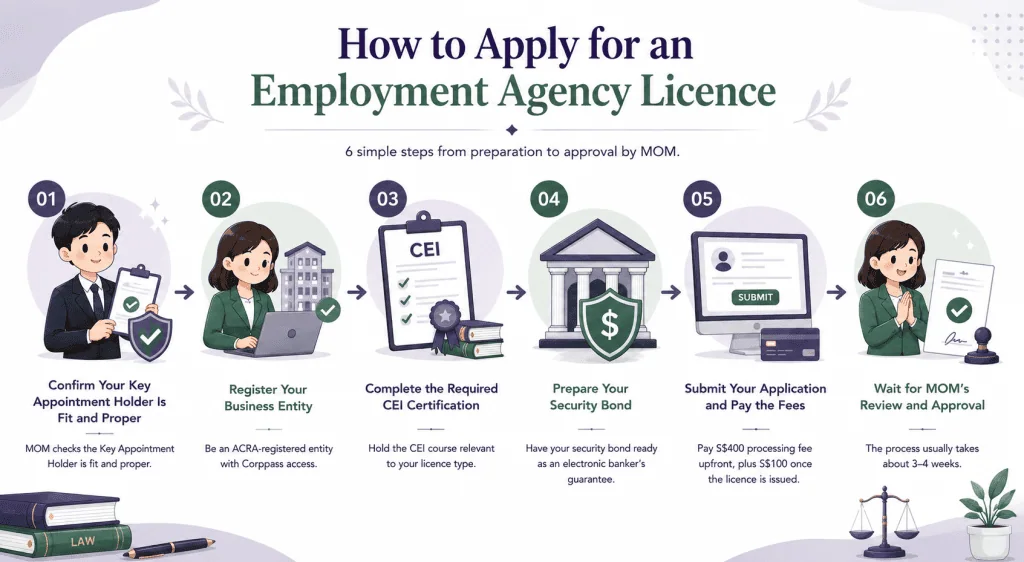
1. Confirm Your Key Appointment Holder Is Fit and Proper
The application is submitted by the Key Appointment Holder (KAH) — usually the owner, managing director, or partner of the business. MOM checks that this person is “fit and proper,” meaning no convictions for dishonesty, human trafficking, or offences under the Penal Code or the Employment Agencies Act, and no history of being a KAH at an agency whose licence was revoked.
2. Register Your Business Entity
You’ll need to be an ACRA-registered entity with Corppass access before you can apply. This is the legal entity that the licence will be issued to.
3. Complete the Required CEI Certification
Your KAH, and any relevant personnel, need to hold the CEI course appropriate to your licence type before the application can proceed. This step often takes the longest, so it’s worth starting early.
4. Prepare Your Security Bond
Have your security bond ready as an electronic banker’s guarantee. The required amount depends on your licence type, as covered in the security bond section above.
5. Submit Your Application and Pay the Fees
There’s a S$400 processing fee upfront, plus another S$100 once the licence is issued.
6. Wait for MOM’s Review and Approval
From CEI certification through to bond submission and approval, the whole process usually takes about three to four weeks. This depends on how complete your application is and which licence type you’re applying for.
Penalties for Non-Compliance
Operating without a valid licence is a serious offence. It carries a fine of up to S$80,000, imprisonment of up to 2 years, or both.
This isn’t just a theoretical maximum. In International Placements (S) Pte Ltd v Public Prosecutor and another matter [2020] 4 SLR 1195, the High Court upheld a S$40,000 fine against an agency for doing EA work without a licence — showing courts are willing to impose substantial penalties well below the ceiling.
| Offence | Consequence |
|---|---|
| Operating without a valid EA licence | Fine of up to S$80,000, imprisonment of up to 2 years, or both |
| Charging job seekers beyond the statutory fee cap | Written warning, composition fine, or licence revocation, depending on severity |
| Repeated or serious breaches of licence conditions | Accumulated demerit points, leading to surveillance or licence revocation |
Also Read: Employment Contract in Singapore: Legal Guide & Key Terms
Protecting Your Agency From Licensing and Compliance Risk
Choosing the wrong licence type, underestimating the CEI and personnel registration workload, or getting the security bond calculation wrong can delay your launch or expose your agency to enforcement action later.
Since MOM ties bond amounts and licence tiers to placement volume and compliance history, it’s worth mapping out your intended scope of operations, including whether MDW placement is part of the plan, before you apply.
RBN Chambers advises employers and employment agencies on regulatory compliance under the Employment Agencies Act, and represents clients in disputes involving licensing conditions, fee overcharging claims, and MOM enforcement action.
Our lawyer, Ramesh Bharani Nagaratnam, leads on employment matters. Contact RBN Chambers to discuss your situation, or read more about our employment disputes practice.
Frequently Asked Questions
What are the different types of employment agency licences in Singapore?
MOM issues Comprehensive Licences (All, non-MDW, and Local variants) and a Select Licence for agencies placing only job seekers earning above S$4,500 a month. Each has different CEI and security bond requirements.
Who needs to attend the CEI course?
All key appointment holders at a Comprehensive Licence agency, plus all EA personnel who perform EA work, need the relevant CEI. Select Licence agencies and staff who don’t do EA work are exempt.
What is the maximum fee an agency can charge a job seeker?
No more than one month of the worker’s fixed salary per year of contracted service, capped at two months’ salary total. Fees charged to employers aren’t statutorily capped, but must still be reasonable.
How long does it take to get an MOM employment agency licence?
Around three to four weeks, from CEI certification through to security bond submission and approval — though this varies by licence type and how complete the application is.
Is a licence required for recruitment done entirely online?
No. If the whole process happens online with no offline involvement, it falls outside the licensing requirement — along with own-need hiring, information-only bulletin boards, and short-term foreign EA work under 30 days.
Delivering Solutions not just Answers to your legal disputes
We provide solutions to all our clients regardless of the scale or complexity of the cases. Let us know how we can help.
Contact UsAny information of a legal nature in this blog is given in good faith and has been derived from resources believed to be reliable and accurate. The author of the information contained herein this blog does not give any warranty or accept any responsibility arising in any way, including by reason of negligence for any errors or omissions herein. Readers should seek independent legal advice.