

Business |
Frustration of Contract in Singapore: Comprehensive Guide

Contracts are an integral part of business and many other aspects of life. It is essential for parties to understand their rights and obligations under a contract and the legal implications of a breach of contract. But what happens when a contract becomes impossible to fulfil due to unforeseen events; that is, if a contract is frustrated?
In this article, we will discuss frustration of contract – what it is, how it is different from breach of contract, examples of frustration of contract, legal implications of frustration of contract, how can parties avoid, mitigate or minimize the risk of frustration of contract, and the benefits of using a contract disputes resolution process.
What is Frustration of Contract?
Frustration of contract is a legal doctrine that applies when an unforeseen event occurs after a contract has been formed, making performance impossible, unlawful, or fundamentally different from what was originally agreed upon.
When a contract is frustrated, both parties are released from performing their future contractual obligations. The doctrine exists because the law recognises that it would sometimes be unfair to hold parties liable for events completely outside their control.
However, frustration does not apply simply because a contract has become more expensive, difficult, or inconvenient to perform.
Common examples of frustrating events include:
- Death or incapacity in personal service contracts
- Natural disasters
- Government bans or restrictions
- Sudden changes in law
- Destruction of the subject matter of the contract
How is Frustration of Contract Different from Breach of Contract?
The key difference between frustration of contract and breach of contract is frustration of contract is event-driven, while breach of contract is party-driven. Breach of contract occurs when a party fails to perform its contractual obligations, regardless of the circumstances. On the other hand, frustration of contract is only applicable when an unexpected event makes the performance of the contract impossible or illegal.
Another important difference is frustration of contract is not dependent on a breach of contract. This means that even if a party has not breached its obligations, the doctrine of frustration could still apply if an event has occurred that has made it impossible or illegal to perform the contract.
| Frustration of Contract | Breach of Contract |
|---|---|
| Caused by unforeseen external events | Caused by failure of a party to perform |
| Neither party is necessarily at fault | One party breaches contractual obligations |
| Contract is automatically discharged | Innocent party may claim damages |
| Performance becomes impossible or radically different | Performance is still possible but not fulfilled |
| Governed by doctrine of frustration | Governed by contract law remedies |
In a breach of contract claim, liability generally arises because one party failed to honour their obligations.
By contrast, frustration occurs because circumstances beyond both parties’ control have fundamentally changed the nature of the agreement.
Force majeure vs. frustration of contract in Singapore
Force majeure and frustration are related but distinct concepts that are often confused — especially in commercial contracts.
A force majeure clause is a contractual provision, agreed upon by the parties themselves, that excuses one or both parties from performance when specified extraordinary events occur. The clause defines what events qualify, the notice requirements, and the consequences. If your contract contains a well-drafted force majeure clause, it is the first thing to review when a disruptive event occurs.
Frustration, by contrast, is a legal doctrine — it applies automatically by operation of law when no contractual provision covers the situation, or where the event goes beyond what a force majeure clause was designed to address.
| Key Difference | Force majeure | Frustration |
|---|---|---|
| Source | Contractual clause agreed by parties | Legal doctrine under common law and the 1959 Act |
| Requires a clause? | Yes — must be in the contract | No — applies by operation of law |
| Scope | Defined by what the clause specifies | Determined by courts on the facts |
| Effect | Suspends or excuses performance | Automatically discharges the contract |
| Applies if event was foreseeable? | Depends on clause drafting | No — foreseeability defeats frustration |
If your contract has a force majeure clause that covers the event in question, courts will generally apply that clause rather than the doctrine of frustration. A well-drafted force majeure clause gives parties far more certainty and control than relying on the doctrine alone.
Singapore Frustrated Contracts Act 1959
In Singapore, the Frustrated Contracts Act 1959 governs the enforcement of frustration of contract. Under this Act, a contract is frustrated if the contract becomes impossible or illegal to perform due to an event or change of circumstances that was not anticipated by the parties at the time of signing the contract. The Act also states that a contract can be considered frustrated if the event or change of circumstances renders the performance of the contract radically different from what the parties had expected.
For example, if a contract was made for the sale of a property, but the property is damaged by a natural calamity such as a flood. In this case, the contract is frustrated and the parties are relieved of their obligations under the contract.
When Does Frustration of Contract Apply?
Not every difficult situation qualifies as frustration under Singapore law. For frustration to apply, several legal requirements generally must be satisfied:
1. The Event Must Occur After the Contract is Formed
The frustrating event must arise after the parties entered into the contract. If the event already existed before signing the agreement, frustration usually cannot apply.
2. The Event Must Be Unforeseeable
The event must generally be something that the parties could not reasonably anticipate at the time of contracting. If the risk was foreseeable and not addressed in the contract, courts may be reluctant to find frustration.
3. The Event Must Be Beyond the Parties’ Control
The frustrating event must not be caused by either contracting party. This is known as the principle against self-induced frustration. For example, a party cannot deliberately create circumstances that prevent contractual performance and later rely on frustration as a defence.
4. Performance Must Become Impossible, Illegal, or Radically Different
The threshold for frustration is relatively high. The contract must become:
- Impossible to perform;
- Illegal to perform; or
- Fundamentally different from the original contractual intention.
Mere inconvenience, delay, or increased cost is generally insufficient.
Also Read: Letter of Administration Singapore: A Complete 2026 Guide
Examples of Frustration of Contract
Below are some common examples where frustration may arise under Singapore law.
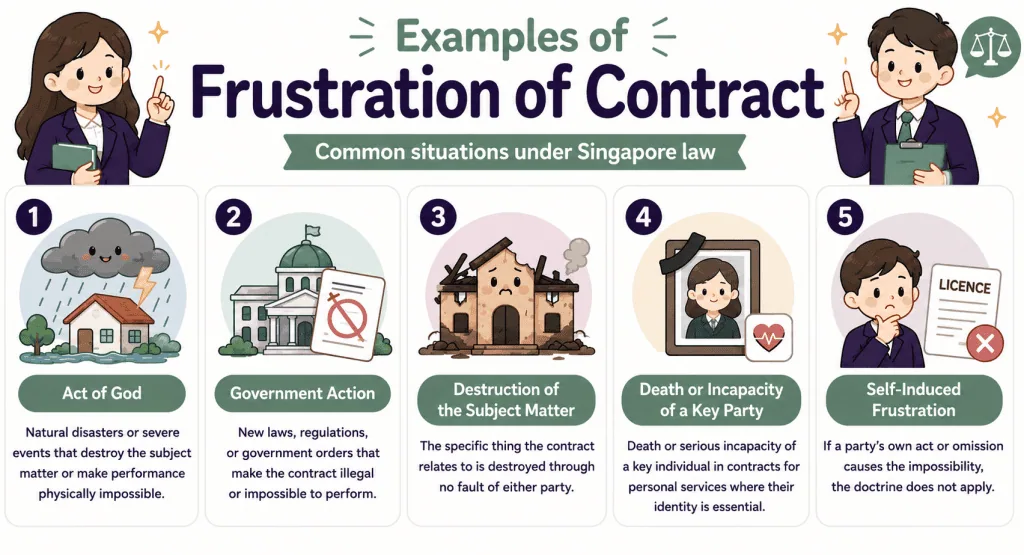
Act of God
Natural disasters — floods, earthquakes, severe storms — that destroy the subject matter of the contract or make performance physically impossible. The COVID-19 pandemic generated significant litigation globally on whether government-mandated closures constituted frustration; Singapore courts applied the doctrine carefully, distinguishing between contracts made impossible and those merely disrupted.
Government action
A new law, regulation, or government order that makes the performance of the contract illegal or impossible. For example, an export ban imposed after a supply contract is signed may frustrate that contract if no force majeure clause covers it.
Destruction of the subject matter
Where the specific thing that the contract relates to is destroyed through no fault of either party — such as a leased venue burning down before the event for which it was hired — the contract may be frustrated.
Death or incapacity of a key party
In contracts for personal services where the identity of the performing party is fundamental to the agreement, death or serious incapacity of that individual may frustrate the contract. This is common in professional services, performance, or specialist consulting engagements.
Self-induced frustration — what is not covered
Critically, if a party’s own act or omission causes the impossibility of performance, the doctrine does not apply. A company that allows its licence to lapse, for example, cannot rely on the resulting inability to perform as frustration. The event causing frustration must be truly external and beyond both parties’ control.
How to minimise the risk of frustration in your contracts
While frustration cannot always be avoided, parties can take practical steps to manage the risk and its consequences:
- Anticipate risk events. During contract negotiation, consider what events could disrupt performance — natural disasters, regulatory changes, key personnel loss — and address them explicitly.
- Draft a robust force majeure clause. A well-crafted clause should define qualifying events clearly, set out notice requirements, specify the consequences (suspension or termination), and address what happens to prepayments and partially completed work.
- Include risk allocation provisions. Where performance risk is significant, consider who bears cost overruns, delays, or partial non-performance. This can be addressed through price escalation clauses, material adverse change clauses, or hardship provisions.
- Obtain appropriate insurance. Business interruption insurance and specialist trade credit insurance can protect against financial loss where performance becomes impossible due to an insured event.
- Include a dispute resolution clause. Specify whether disputes arising from the contract — including disagreements about whether frustration has occurred — will be resolved through arbitration, mediation, or litigation in Singapore courts.
Resolving disputes about frustration of contract
When parties disagree about whether a contract has been frustrated, the dispute must be resolved either through negotiation, a formal dispute resolution process, or court proceedings. In Singapore, the main options are:
- Negotiation. The fastest and least costly route. If both parties accept that the contract is frustrated and agree on how to apportion any losses or return payments, a settlement agreement avoids further costs.
- Mediation. A neutral mediator facilitates settlement discussions. Mediation is confidential, cost-effective, and preserves business relationships better than adversarial proceedings. The Singapore Mediation Centre is a commonly used forum.
- Arbitration. A private, binding, and confidential process. Arbitral awards are enforceable internationally under the New York Convention — making arbitration particularly suitable for contracts with cross-border parties.
- Litigation. Where no agreement can be reached, the matter may proceed to the Singapore courts. The High Court has jurisdiction over commercial disputes, and judges with commercial expertise handle frustration claims.
Also Read: Contract Drafting Checklist Singapore: Essential Legal Guide
What Are the Benefits of Using a Contract Disputes Resolution Process?
Using a contract disputes resolution process such as arbitration or mediation can provide several benefits when it comes to the frustration of contract. These benefits include:
- Faster Resolution: A contract disputes resolution process can provide a faster resolution than traditional court proceedings.
- Cost-Effective: A contract disputes resolution process can be more cost-effective than traditional court proceedings.
- Confidentiality: A contract disputes resolution process can provide a confidential forum for parties to resolve their disputes.
- Flexibility: A contract disputes resolution process can provide parties with more flexibility in terms of the process and the outcome.
Protecting your business from frustrated contracts with RBN Chambers
Understanding the doctrine of frustration is one thing — building contracts that anticipate disruption before it happens is another. The most effective protection against the uncertainty of frustrated contracts is careful drafting from the outset: robust force majeure clauses, clear risk allocation, and termination provisions that reflect the realities of your business.
If you need professional guidance on contract drafting, review, or an assessment of whether frustration applies to your situation, the team at RBN Chambers is ready to help you protect your business interests with clear, enforceable agreements tailored to Singapore law. Contact us here!
Frequently Asked Questions
Can I recover my deposit if a contract is frustrated in Singapore?
Possibly. Under the Frustrated Contracts Act 1959, Singapore courts may allow recovery of payments made before frustration, depending on the circumstances.
Does increased cost make a contract frustrated?
Generally, no. Increased expense or inconvenience alone is usually insufficient to establish frustration.
Does force majeure prevent frustration?
Not necessarily. A force majeure clause may address certain risks contractually, but frustration may still apply in some situations depending on the wording and circumstances.

Delivering Solutions not just Answers to your legal disputes
We provide solutions to all our clients regardless of the scale or complexity of the cases. Let us know how we can help.
Contact UsAny information of a legal nature in this blog is given in good faith and has been derived from resources believed to be reliable and accurate. The author of the information contained herein this blog does not give any warranty or accept any responsibility arising in any way, including by reason of negligence for any errors or omissions herein. Readers should seek independent legal advice.