

General |
Letter of Administration Singapore: A Complete 2026 Guide

Applying for a Letter of Administration Singapore is a critical step when a loved one passes away without a will. This guide explains the legal process, eligibility requirements, estimated costs, and how RBN Chambers can assist you in navigating the Family Justice Courts efficiently.
Many families are unaware of just how many practical matters, from accessing bank accounts to transferring property, come to a complete standstill without this document in place. Understanding the process early can save significant time, reduce stress, and help you avoid costly mistakes during an already difficult period.
What Is a Letter of Administration and When Do You Need One?
When a person dies intestate, meaning without leaving a valid will, their estate cannot be touched, transferred, or distributed without a court-issued document known as a Letter of Administration (LOA). This legal document appoints an individual, known as the administrator, to manage and distribute the deceased’s assets according to Singapore’s laws of intestacy under the Intestate Succession Act 1967.
It is important to note that the LOA does not give the administrator the freedom to distribute assets however they wish — they are legally bound to follow the rules set out in the Act, regardless of what the family may have informally agreed upon.
Without this document, banks will freeze accounts, property cannot be transferred, and beneficiaries have no legal standing to claim what they are entitled to. Obtaining the LOA is not optional — it is the only lawful way to unlock and administer the estate. The sooner the application process begins, the sooner the family can move forward with settling the estate and providing closure for everyone involved.
Also Read: Contract Disputes in Singapore: A Practical Guide to Your Legal Options
Probate vs. Letter of Administration: What Is the Difference?
Two roles come up often in estate administration: executor and administrator. While both are responsible for managing and distributing the estate, they derive their authority from different sources.
An executor is a person specifically named in a valid will by the deceased to carry out the instructions in that will. Their authority is confirmed by the court through a Grant of Probate.
An administrator, on the other hand, is appointed by the court when there is no valid will — or when the named executor is unable or unwilling to act. The administrator performs similar duties: collecting assets, settling outstanding debts, and distributing what remains to the rightful beneficiaries. They act under the authority of Letters of Administration, not a Grant of Probate.
Many families are unsure whether they need Probate or a Letter of Administration. The distinction is straightforward, but choosing the wrong path can result in delays and additional costs at the court level. Understanding which applies to your situation from the outset is one of the most important early steps in estate administration.
| Key Differences | Probate | Letter of Administration |
| When is it used? | Deceased left a valid will | Deceased died without a will |
| Who applies? | The executor named in the will | An eligible family member |
| What does it authorise? | Executor to carry out the will | Administrator to distribute under intestacy rules |
| Governing law | Probate and Administration Act | Intestate Succession Act 1967 |
If there is no will, you need a Letter of Administration. If there is a will but no executor is named or able to act, you may still need to apply for a Grant of Letters of Administration with Will Annexed. If you are unsure which applies to your situation, speaking with an estate lawyer early can help you avoid filing the wrong application altogether.
Who Is Eligible to Apply Letter of Administration?
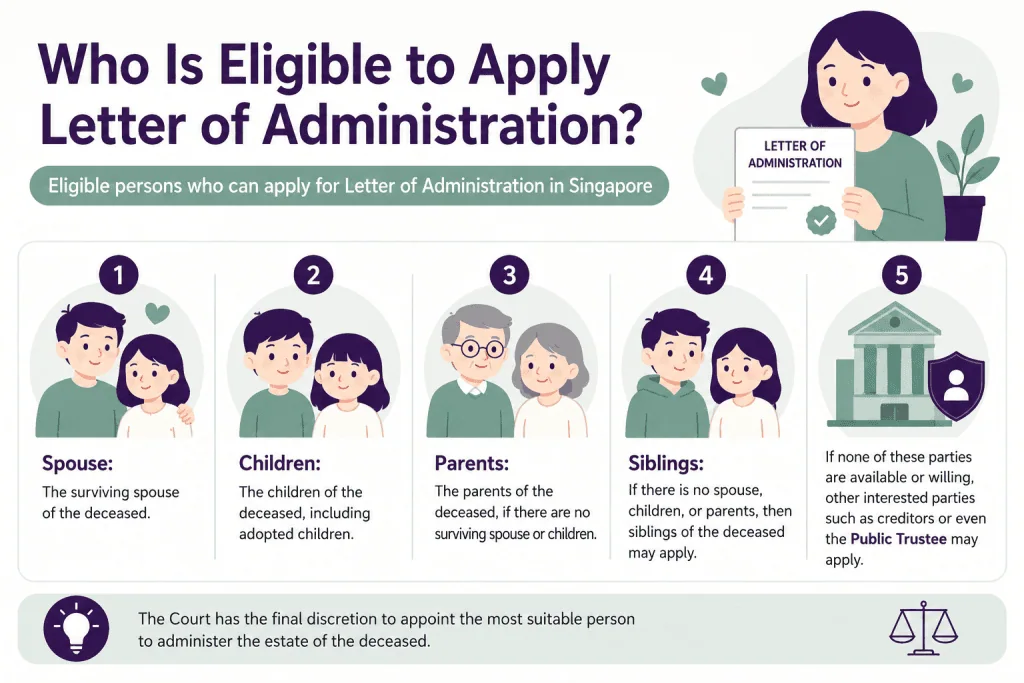
Not everyone can apply for Letters of Administration. Generally, the following individuals are eligible:
- Spouse: The surviving spouse of the deceased.
- Children: The children of the deceased, including adopted children.
- Parents: The parents of the deceased, if there are no surviving spouse or children.
- Siblings: If there is no spouse, children, or parents, then siblings of the deceased may apply.
If none of these parties are available or willing, other interested parties such as creditors or even the Public Trustee may apply.
How Are Assets Distributed Under the Intestate Succession Act?
One of the most important things families need to understand is that the law — not the family — decides how the estate is divided. The Intestate Succession Act 1967 sets out the following distribution rules:
| Surviving Family Members | Distribution |
|---|---|
| Spouse only (no children) | Spouse receives entire estate |
| Spouse and children | Spouse 50%, Children share 50% equally |
| Children only (no spouse) | Children share the entire estate equally |
| Parents only | Parents share the entire estate equally |
| Siblings only | Siblings share the entire estate equally |
This applies to most assets. However, CPF savings, insurance with named beneficiaries, and jointly held property are distributed separately and are not governed by the LOA process.
To be clear: this applies only when there is no valid will. If there is no valid will, it is the law — not any family arrangement or personal wish — that determines who receives what and in what proportion. Informal agreements among family members carry no legal weight under the Act.
Documents Required Before Filing
Before filing the application, the following documents should be prepared. Gathering these early and ensuring they are complete and accurate is one of the most practical ways to avoid unnecessary delays once the application is submitted to the court.
- Death certificate of the deceased
- NRIC or passport of the applicant
- Family tree document listing all surviving relatives
- Marriage certificate (if the applicant is the spouse)
- Birth certificates (to prove relationship to the deceased)
- Details of the deceased’s assets and liabilities
Having all documents ready before filing reduces delays and avoids the court returning the application for corrections. In more complex cases, for example, where the deceased had children from a previous marriage or assets held under different names, additional documentation may be required, and a lawyer can advise on exactly what the court will expect.
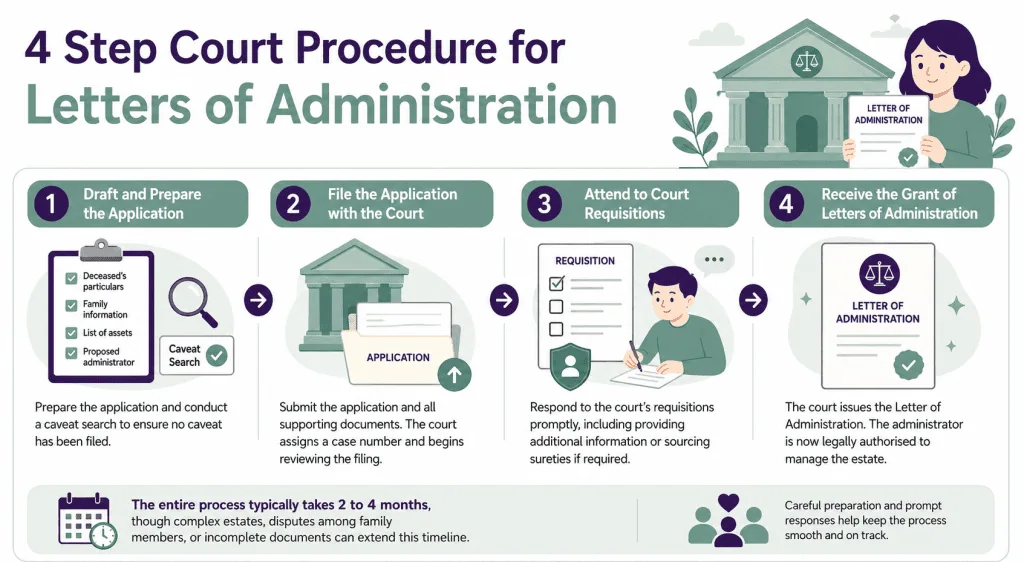
4 Step Court Procedure for Letters of Administration
The application should be filed within 6 months from the deceased’s date of death. If filing after 6 months, the applicant must include a reason for the delay in the application form. It is advisable not to wait, as late applications may complicate the process and require additional explanation to the court.
The application is filed with the Family Justice Courts in Singapore. The court process is structured but requires careful attention to detail at each stage — an incomplete or incorrectly prepared filing can result in requisitions that set the timeline back by weeks. Here is how the process works:
1. Draft and Prepare the Application
Prepare the originating application form with the deceased’s particulars, family information, a list of assets, and the proposed administrator’s details. At this stage, a caveat search is also conducted to confirm that no one has filed a caveat against the estate. If a caveat exists, it must be resolved before the application can proceed.
2. File the Application with the Court
Submit the completed application along with all supporting documents to the Family Justice Courts. The court will assign a case number and begin reviewing the filing. Ensuring that every supporting document is correctly certified and formatted at this stage is critical to keeping the process on track.
3. Attend to Court Requisitions
The court may issue requisitions, requests for additional information or clarification. These must be addressed promptly to keep the process moving. This stage can involve sourcing sureties (guarantors) if required by the court, which is common when the estate is of significant value. Delays at this stage are often the most common reason the process extends beyond the typical timeframe.
4. Receive the Grant of Letters of Administration
Once the court is satisfied, it issues the Letter of Administration. The administrator is now legally authorised to manage the estate. From this point, the administrator must act diligently and in accordance with the law, any mismanagement of the estate can result in personal legal liability.
The entire process typically takes 2 to 4 months, though complex estates, disputes among family members, or incomplete documents can extend this timeline.
Also Read: Misrepresentation in Singapore: Your Rights and Next Steps
How Much Does a Letter of Administration Cost in Singapore?
Costs vary depending on the size and complexity of the estate. Below is a general overview:
| Cost component | Estimated range |
|---|---|
| Court filing fees | From SGD 150 onwards, scaled to estate value |
| Legal fees (lawyer-assisted) | SGD 2,500 to SGD 8,000+ depending on complexity |
| Commissioner for Oaths fees | SGD 20 to SGD 50 per document |
| Caveat search fees | $20 (no existing cases) / $50 (existing cases found) |
| File an Originating Application (electronic grant only) | $210 |
| File an Originating Application (printed grant with embossed court seal) | $240 |
Caveat search fees and Originating Application fees are based on Part 4 of the Fifth Schedule of the Family Justice (Probate and Other Matters) Rules 2024, as listed on the SG Courts website. Please verify the latest figures directly as they may be updated from time to time
For smaller estates where the total value is below SGD 50,000, families may consider applying through the Public Trustee’s Office, which offers a simplified process at lower cost. For estates above this threshold, engaging a lawyer is strongly recommended to avoid costly errors or delays.
Administering the Estate After the Grant
Receiving the Letter of Administration is not the end of the process. The administrator must then carry out the following responsibilities:
- Compile an inventory of assets This includes bank accounts, property, investments, vehicles, and any other assets belonging to the deceased.
- Settle outstanding debts — All debts, taxes, and liabilities of the deceased must be paid before any distribution to beneficiaries.
- Distribute the remaining estate — Assets are distributed to the entitled beneficiaries according to the Intestate Succession Act 1967.
The administrator is personally liable if the estate is distributed incorrectly or if debts are overlooked. This is one of the key reasons why legal guidance throughout the process is strongly advisable.
What If There Are Assets in Foreign Countries?
If the deceased held assets overseas, such as property, bank accounts, or investments in another country, the Singapore Letter of Administration may not automatically be recognised abroad. Each jurisdiction has its own rules.
In many cases, a separate application must be made in the foreign country, and the Singapore LOA may need to be resealed or used as supporting evidence. Families dealing with cross-border estates should seek specialist legal advice early in the process.
Speak to RBN Chambers About Your Letter of Administration
Losing a loved one is difficult enough without having to navigate complex legal procedures alone. At RBN Chambers, our lawyers have extensive experience handling Letters of Administration across a wide range of estates, from straightforward cases to those involving property disputes, overseas assets, or contested applications.
We guide families through every step of the process clearly and efficiently, so you can focus on what matters most. If you need assistance applying for a Letter of Administration in Singapore, book a consultation with RBN Chambers today!
FAQ About Letter of Administration in Singapore
How long does it take to get a Letter of Administration in Singapore?
The process typically takes 2 to 4 months from the date of filing, provided all documents are in order and there are no disputes or court requisitions requiring additional time.
Can I apply for a Letter of Administration without a lawyer in Singapore?
Technically yes, but it is not straightforward. The process involves legal drafting, court requisitions, caveat searches, and potentially sourcing sureties. Errors or incomplete filings can cause significant delays. For most families, especially those dealing with property or larger estates, engaging a lawyer is the more practical and reliable option.
What happens if family members cannot agree on who should be the administrator?
If there is a dispute among eligible family members about who should administer the estate, the court will need to determine the matter. This can result in contested proceedings, which are more time-consuming and costly. Legal representation in these situations is essential.

Delivering Solutions not just Answers to your legal disputes
We provide solutions to all our clients regardless of the scale or complexity of the cases. Let us know how we can help.
Contact UsAny information of a legal nature in this blog is given in good faith and has been derived from resources believed to be reliable and accurate. The author of the information contained herein this blog does not give any warranty or accept any responsibility arising in any way, including by reason of negligence for any errors or omissions herein. Readers should seek independent legal advice.