

General |
Misrepresentation in Singapore: Your Rights and Next Steps

You sign a service contract after the salesperson assures you their platform has specific features. Weeks later, you discover those features do not exist and the upgrade will cost more.
The salesperson says it was a misunderstanding. This is a classic setup for misrepresentation, a false or misleading statement that induces a deal.
With more online sales, property launches, and complex service bundles in Singapore, such situations are increasingly common. Knowing what counts as misrepresentation and what you can do next helps you protect your position and reduce loss.
What Is Misrepresentation?
Misrepresentation occurs when one party makes a false statement of existing fact that induces another party to enter into a contract. In Singapore, the law on misrepresentation derives from two primary sources: common law principles developed through case precedent and statutory provisions under the Misrepresentation Act 1967.
Additionally, consumer transactions are also subject to the Consumer Protection (Fair Trading) Act 2003, which provides specific protections against misleading conduct in consumer-facing transactions.
The Misrepresentation Act addresses misrepresentation in three main ways: it removes certain bars to rescission for innocent misrepresentation (section 1), it makes a party liable in damages for a non-fraudulent misrepresentation unless they had reasonable ground to believe the statement was true, and allows the court to award damages instead of rescission (section 2), and it controls exclusion clauses that attempt to limit liability for misrepresentation (section 3). The right to rescind itself comes from common law, and damages for fraudulent misrepresentation come from the common law tort of deceit.
Four Essential Elements to Prove Misrepresentation
To succeed in a misrepresentation claim in Singapore, four elements generally need to be established:
1. A statement of fact was made from one party to another
The statement must be about an existing or past fact, not a statement of opinion, a statement of law, mere sales talk, or a promise about the future. A statement of future intention can still count if the person never actually held that intention when they made it. The representation must have been made directly to the representee, or to a class of persons that includes them, or have been passed on through someone else with the intention that it reach them.
2. The statement was false
The statement must have been false when it was made, or at the time the contract was entered into.
3. The party to whom the statement was made relied on that statement
The representee must have actually relied on the statement, meaning they believed it and acted on it in deciding what to do. A party who did not rely on the statement cannot claim for it.
4. The statement induced that party to enter into the contract
The false statement must have been a material factor in the representee’s decision to enter the contract. If the representee did not know about the statement, or would have entered the contract regardless, there is no valid claim.
Three Categories of Misrepresentation
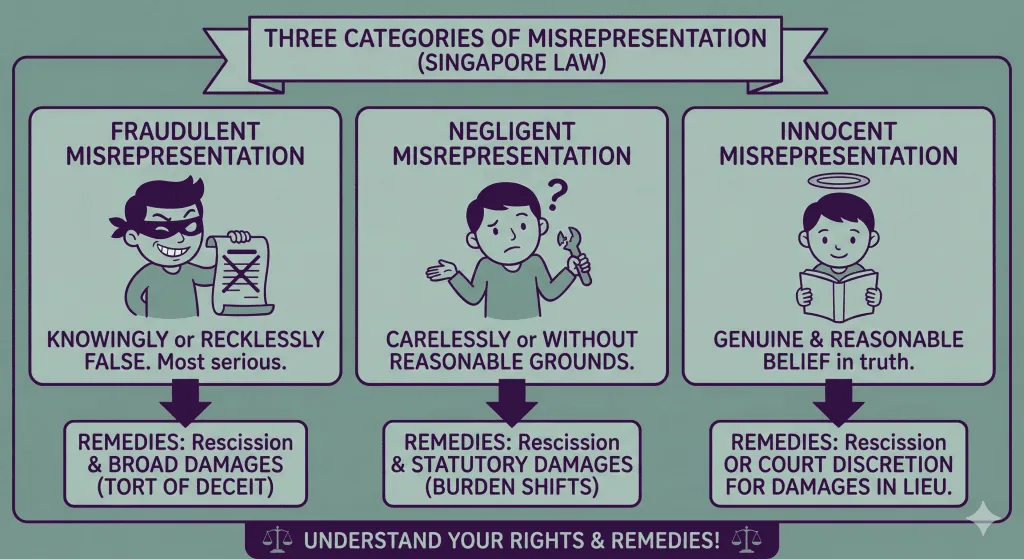
Singapore law recognizes three distinct types of misrepresentation, each carrying different legal consequences and remedial options.
1. Fraudulent Misrepresentation
Fraudulent misrepresentation requires proof that the statement was made knowingly, without belief in its truth, or recklessly without caring whether it was true or false. This is the most serious form and carries the broadest remedies.
The representor must have known the statement was false, had no honest belief in it, or been reckless as to its truth. Victims of fraudulent misrepresentation can pursue both rescission of the contract and damages in tort for deceit, which may include consequential losses flowing from the fraud.
The measure of damages is broader than for negligent misrepresentation, potentially covering all losses flowing from the fraud, regardless of whether or not they were foreseeable.
2. Negligent Misrepresentation
Negligent misrepresentation arises when a false statement is made carelessly or without reasonable grounds for believing it to be true. Section 2(1) of the Misrepresentation Act makes a party liable in damages for a non-fraudulent misrepresentation, unless they can show that they had reasonable ground to believe, and did believe, up to the time the contract was made, that the facts represented were true. Section 2(1) applies only where the misrepresentation was made by another party to the contract. If the statement was made by a third party, the representee would need to bring a common law negligence claim instead.
Notably, the Act reverses the burden of proof: once the representee proves a false statement induced them to enter the contract and caused loss, the representor must demonstrate they had reasonable grounds to believe, and did believe up to the time the contract was made, that the facts represented were true.
This shifted burden makes negligent misrepresentation claims significantly more accessible than common law negligence claims, which require the claimant to prove breach of duty.
3. Innocent Misrepresentation
Innocent misrepresentation occurs when a false statement is made without fraud or negligence—the representor genuinely and reasonably believed the statement was true. While rescission remains available for innocent misrepresentation, there is no right to damages for a wholly innocent misrepresentation. The only routes are the court’s discretion under section 2(2) of the Misrepresentation Act and an indemnity that may come with rescission.
Section 2(2) allows the court to award damages instead of rescission where rescission would be disproportionate. This recognizes that unwinding an entire contract may sometimes be excessive when the misrepresentation was minor or made in good faith.
Misrepresentation vs Breach of Contract
Misrepresentation and breach of contract are related but legally distinct problems, and the right one to plead can affect the remedies available. The key difference comes down to whether the false statement became a term of the contract or remained only a representation that induced you to sign.
| Aspect | Misrepresentation | Breach of Contract |
|---|---|---|
| What it is | A pre-contractual statement that induced you to enter the contract, whether or not it also became a term of the contact | A broken promise that forms part of the contract itself |
| Legal basis | Misrepresentation Act 1967 and common law | The terms of the contract and general contract law |
| Remedies available | Rescission and/or damages, depending on whether it’s fraudulent, negligent, or innocent | Damages for loss of the bargain; for a serious breach, the innocent party can terminate the contract. |
| Aim of damages | Puts you back in the position you were in before the contract was made | Puts you in the position you would have been in had the contract been properly performed |
| Can both be claimed together | Yes, where a false statement was also incorporated as a term | Yes, together with misrepresentation where applicable |
The Singapore Court of Appeal considered this distinction in Tan Chin Seng and others v Raffles Town Club Pte Ltd [2003] 3 SLR(R) 307, examining whether certain pre-contractual statements amounted to representations at all.
The practical difference matters: breach of contract generally lets you claim for the loss of the bargain you were promised, while misrepresentation (particularly if fraudulent) can allow broader damages that put you back in the position you were in before the contract, and may also entitle you to rescind it entirely.
Also Read: How to Sue Someone in Singapore? 8 Steps (2026)
Can Silence Amount to Misrepresentation?
As a general rule, silence alone is not misrepresentation — a party is not automatically obliged to volunteer every fact relevant to a deal. Singapore courts recognise several exceptions, however:
- Half-truths – If what is said creates a false or misleading impression because of what is left unsaid, silence can amount to misrepresentation. In Trans-World (Aluminium) Ltd v Cornelder China (Singapore) Pte Ltd [2003], the Singapore courts confirmed that a wilful suppression of material facts, which renders an earlier statement untrue, can be actionable.
- Change of circumstances – If a statement was true when made but becomes false before the contract is signed, failing to correct it can amount to misrepresentation.
- Duty to disclose – In relationships involving utmost good faith, such as insurance contracts, the law imposes a positive duty to disclose material facts.
Common Scenarios or Triggers
This issue arises more often than people expect, especially where marketing, property brochures, or verbal assurances influence a purchase.
| Scenario | What Typically Happens |
| Property marketing claims | Floor area, facing, or facilities are described inaccurately, and buyer discovers discrepancies after signing the Option to Purchase. |
| Used car purchase | “Accident-free” or “low mileage” claims turn out false once inspection or records surface. |
| Franchise or investment pitch | Promised earnings or “guaranteed returns” do not materialise, and supporting data was incomplete or misleading. |
| Software or service contracts | Sales assurances about features, integrations, or service levels are untrue, but the contract is already signed. |
| Tenancy and home renovation | Landlord or contractor downplays defects, licences, or timelines that later prove inaccurate. |
| Employment offers | Job scope, pay structure, or bonus scheme was misrepresented during hiring, and the written terms differ. |
Legal Remedies in Singapore
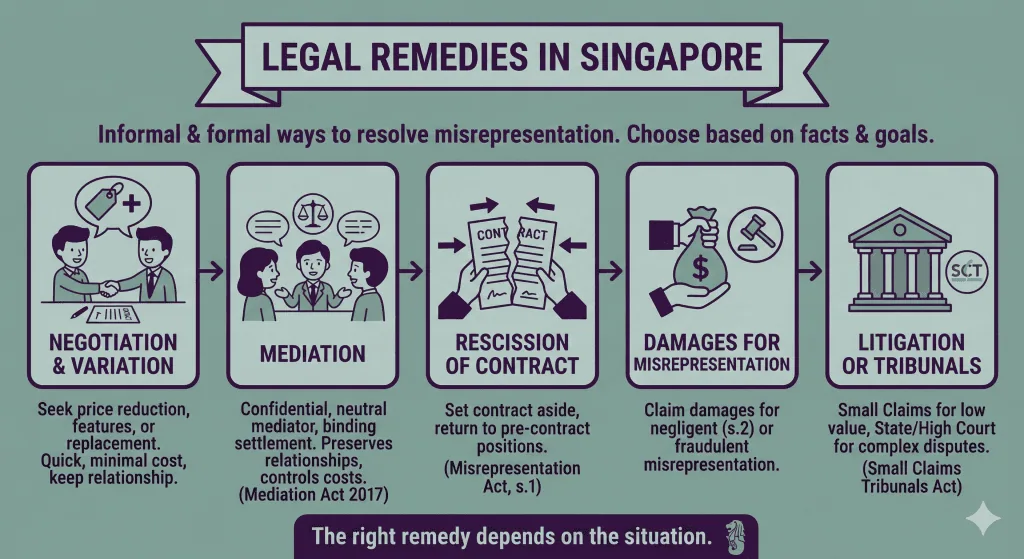
There are both informal and formal ways to resolve misrepresentation. The right next step depends on the facts and your goals.
- Negotiation and contract variation
A practical first step. You can seek a price reduction, added features, or a replacement product. Best if you want to keep the relationship or resolve things quickly with minimal cost. - Mediation
A confidential process led by a neutral mediator to reach a binding settlement. Useful for preserving relationships and controlling costs. Mediated settlements can be recorded and enforced under the Mediation Act 2017. See https://sso.agc.gov.sg/Act/MA2017 - Rescission of contract
Setting the contract aside for misrepresentation, returning parties to their pre-contract positions where possible. The right to rescind comes from common law and equity. Section 1 of the Misrepresentation Act only removes certain bars to rescission, such as where the statement became a term of the contract or the contract has been performed. Other bars may still apply, such as affirmation or third-party rights having intervened. See https://sso.agc.gov.sg/Act/MA1967 - Damages for misrepresentation
Under section 2 of the Misrepresentation Act, you may claim damages for negligent misrepresentation, unless the maker proves reasonable grounds for belief. Fraudulent misrepresentation can attract broader damages at common law. - Litigation or Small Claims Tribunals
For low-value consumer contracts, the Small Claims Tribunals can be a faster route. For higher-value or complex disputes, file in the State Courts or High Court. See Small Claims Tribunals Act: https://sso.agc.gov.sg/Act/SCTA1984
Bars to Rescission
Even where misrepresentation is established, the right to rescind is not unlimited. Singapore courts recognise four situations where rescission will be barred:
- The misrepresentee has affirmed the contract after learning the truth.
- Restoring the parties to their original positions (restitutio in integrum) is no longer practically possible.
- There has been an inordinate lapse of time since the contract was made.
- A bona fide third party has since acquired rights, for value, in property affected by the rescission.
The right remedy depends on the situation.
If any of these apply, damages may still be available even where rescission is off the table.
- Damages for misrepresentation – Under section 2 of the Misrepresentation Act, you may claim damages for negligent misrepresentation, unless the maker proves reasonable grounds for belief. Fraudulent misrepresentation can attract broader damages at common law.
- Litigation or Small Claims Tribunals – For low-value consumer contracts, the Small Claims Tribunals can be a faster route. For higher-value or complex disputes, file in the State Courts or High Court. See Small Claims Tribunals Act: https://sso.agc.gov.sg/Act/SCTA1984
Why Early Legal Advice Matters
Many people wait, hoping the other side will fix the problem or fearing legal costs. Delay often makes things harder.
- Evidence fades
Messages get deleted, staff move on, and records change. Early advice helps you preserve proof and identify key statements that matter. - Legal deadlines apply
Most contract and tort claims carry a six-year limit from when the cause of action accrues, with special rules for fraud or concealment. See Limitation Act, section 6: https://sso.agc.gov.sg/Act/LA1959 - Early remedies are cheaper and more effective
Prompt negotiation or mediation often resolves disputes faster and at lower cost than full litigation. Early action reduces disruption and stress.
Early legal advice often prevents bigger, more expensive problems.
Also Read: Litigation vs Arbitration: What’s Better for Resolving Disputes?
How RBN Chambers Can Help
Misrepresentation disputes are common, and the facts are rarely black and white. Ramesh Bharani Nagaratnam and the team at RBN Chambers provide clear, practical advice on your legal position, the strength of your evidence, and realistic outcomes, mapping out options from negotiation to court action and explaining costs and timelines upfront.
If you need to unwind a deal or recover losses from a misrepresentation, contact RBN Chambers to discuss your situation.
Frequently Asked Questions
What is the limitation period for misrepresentation in Singapore?
Claims generally must be brought within 6 years from when the cause of action accrued, under section 6 of the Limitation Act. Where the misrepresentation was fraudulently concealed, this period may only begin running once the fraud was, or reasonably could have been, discovered.
Can silence constitute misrepresentation?
Generally no — a party is not automatically required to volunteer information. Exceptions exist where silence creates a misleading half-truth, where a previously true statement becomes false before the contract is signed, or where the relationship imposes a duty of disclosure, such as insurance contracts.
What is the difference between a term of a contract and a representation?
A term is a promise that forms part of the binding contract, and its breach is a breach of contract. A representation is a statement that induces someone to enter into the contract, and gives rise to a misrepresentation claim if it is false. The two are not mutually exclusive. A single statement can be both a term and a representation, and the claimant can sue on either.

Delivering Solutions not just Answers to your legal disputes
We provide solutions to all our clients regardless of the scale or complexity of the cases. Let us know how we can help.
Contact UsAny information of a legal nature in this blog is given in good faith and has been derived from resources believed to be reliable and accurate. The author of the information contained herein this blog does not give any warranty or accept any responsibility arising in any way, including by reason of negligence for any errors or omissions herein. Readers should seek independent legal advice.