

General |
Arbitration: A Comprehensive Guide to Alternative Dispute Resolution in Singapore
What is Arbitration?
Arbitration is a form of alternative dispute resolution (ADR) where a dispute between two or more parties agree is decided by a neutral third party, known as an arbitrator or a panel of arbitrators appointed pursuant to the agreement of the disputing parties. This agreement between the disputing parties to resolve their dispute is referred to as arbitration agreement.
Unlike litigation, which involves courts and judges, arbitration is a private and flexible process that allows parties to tailor proceedings to their needs. It is widely used for commercial disputes, especially when confidentiality, speed, and expert decision-making are required. In Singapore, arbitration is an increasingly popular method for both businesses and individuals to resolve their dispute alongside mediation and litigation.
What Kind of Disputes Can Be Managed with Arbitration?
Arbitration is suitable for various types of disputes, including domestic and international commercial conflicts. It is commonly used for:
- Commercial contract disputes – Breach of contract, payment issues, and service agreements.
- Construction disputes – Delays, defective works, and contract interpretation issues.
- Financial and banking disputes – Loan defaults, investment agreements, and cross-border financial transactions.
- Technology and intellectual property disputes – Software licensing, patent disputes, and trade secrets.
- Oil, gas, and energy disputes – Joint venture disagreements, exploration and distribution conflicts.
- International disputes – Arbitration is frequently chosen for cross-border business conflicts where parties come from different legal jurisdictions, as it provides a neutral and enforceable resolution method.
What is “not” Arbitration?
Arbitration, although commonly misunderstood, is not a form of informal negotiation between individuals and businesses. Additionally, arbitration is not mediation.
When parties agree to arbitrate any dispute and submit the dispute to the arbitrator/panel of arbitrators, the arbitrator has to power, similar to a judge, to decide matters that is binding upon the parties. The award (or the decision given) by the Arbitrator has the same effect as a court’s decision, meaning it is enforceable.
Arbitration cannot be a solution for every dispute. Not every dispute can be arbitrated. Usually commercial disputes, contractual disputes can be arbitrated but issues relating to criminal matters simply cannot be arbitrated.
Arbitration cannot be forced on parties. Arbitration can only take place if parties have consented to it.
Key Features of Arbitration
- Confidentiality – Arbitration proceedings and outcomes remain private, unlike litigation.
- Neutrality – International arbitration allows parties to resolve disputes in a neutral forum.
- Flexibility – Parties have control over procedural rules and arbitrator selection.
- Finality – Arbitral awards are legally binding with limited grounds for appeal.
- Enforceability – Awards are enforceable in over 160 countries under the New York Convention.
Advantages & Disadvantages of Arbitration
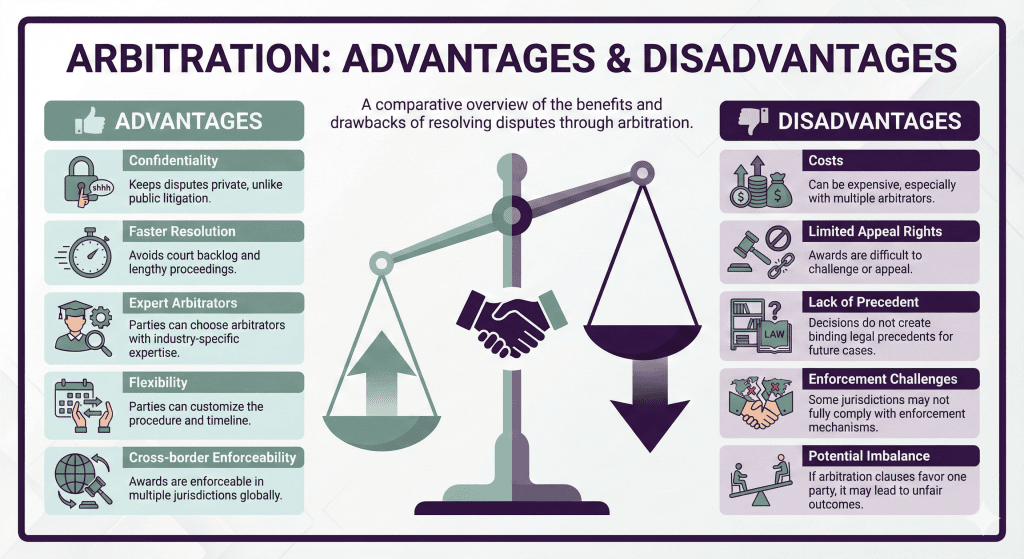
| Advantages | Disadvantages |
|---|---|
| Confidentiality – Unlike litigation, arbitration keeps disputes private. | Costs – Arbitration can be expensive, especially with multiple arbitrators. |
| Faster resolution – Avoids court backlog and lengthy proceedings. | Limited appeal rights – Arbitration awards are difficult to challenge. |
| Expert arbitrators – Parties can choose arbitrators with industry-specific expertise. | Lack of precedent – Unlike litigation, arbitration decisions do not create binding legal precedents. |
| Flexibility – Parties can customize the procedure and timeline. | Enforcement challenges – Some jurisdictions may not fully comply with enforcement mechanisms. |
| Cross-border enforceability – Awards are enforceable in multiple jurisdictions. | Potential imbalance – If arbitration clauses favor one party, it may lead to unfair outcomes. |
Arbitration Process in Singapore
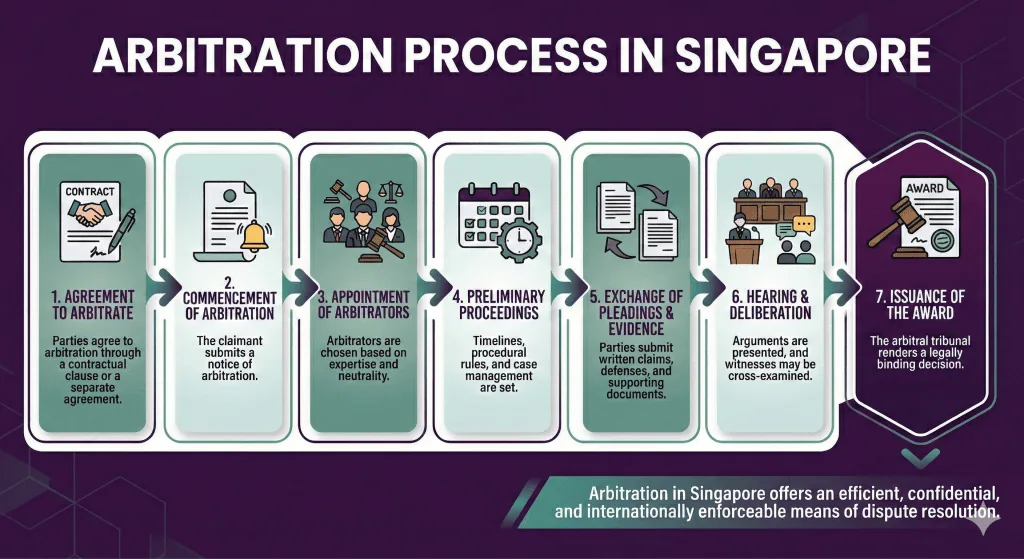
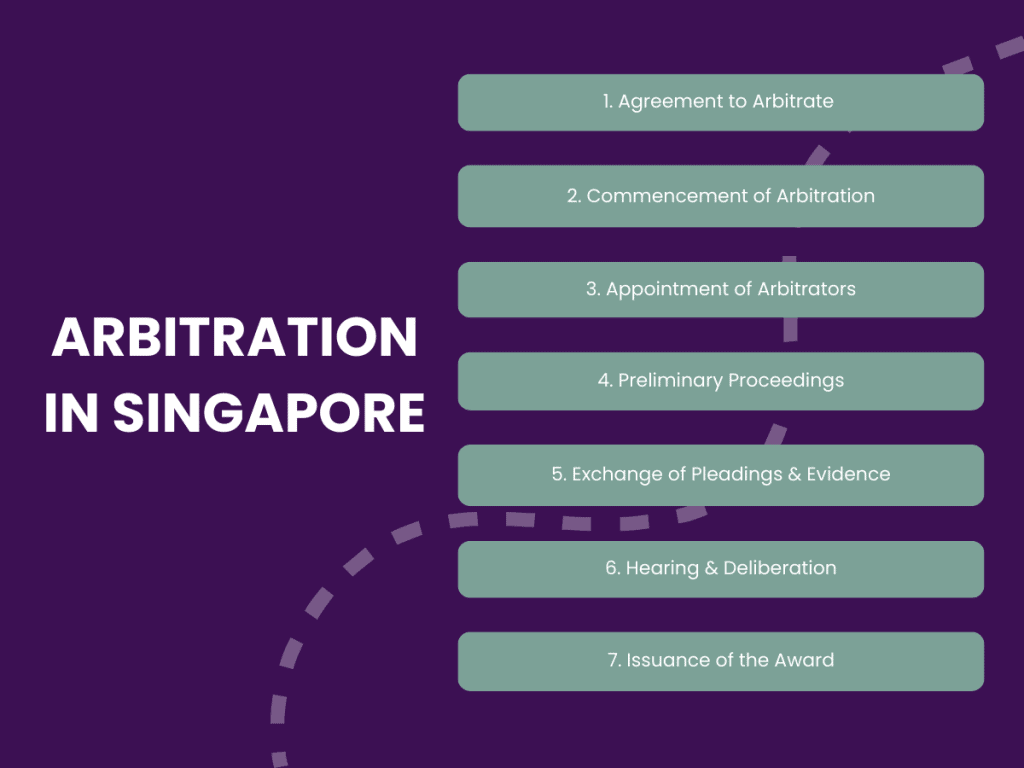
Arbitration in Singapore is a well-structured alternative dispute resolution method, commonly chosen for its efficiency, confidentiality, and enforceability. The arbitration process generally follows a clear sequence of steps, as outlined below:
- Agreement to Arbitrate – Parties agree to arbitration through a contractual clause or a separate agreement.
- Commencement of Arbitration – The claimant submits a notice of arbitration.
- Appointment of Arbitrators – Arbitrators are chosen based on expertise and neutrality.
- Preliminary Proceedings – Timelines, procedural rules, and case management are set.
- Exchange of Pleadings & Evidence – Parties submit written claims, defenses, and supporting documents.
- Hearing & Deliberation – Arguments are presented, and witnesses may be cross-examined.
- Issuance of the Award – The arbitral tribunal renders a legally binding decision. [A flow chart that shows this arbitration process
Laws Relevant to Arbitration
Singapore’s arbitration framework is governed by the following laws:
- Arbitration Act 2001 – Governs domestic arbitration proceedings.
- International Arbitration Act 1994 – Regulates international arbitration, incorporating the UNCITRAL Model Law.
- Arbitration Act 1968 – The historical foundation for arbitration laws in Singapore.
How Much Does Arbitration Usually Cost?
The cost of arbitration depends on factors such as case complexity, the number of arbitrators, and hearing duration:
- Simple disputes – SGD 30,000 to SGD 100,000.
- Complex commercial disputes – Can exceed SGD 500,000.
- Institutional fees – Costs vary depending on arbitration institutions such as SIAC.
Who Pays the Cost of Arbitration?
Firstly, arbitration is a consensual process. This means that the parties can decide whether each party want to bear their own cost or if the “losing” party should bear all the cost.
Importantly, there are different types of cost associated in an arbitration
- If the arbitration is administered by an arbitral institution such as ICC, SIAC, LCIA, then the parties have to pay the administrative fees to such institution;
- The fees of arbitrator/arbitrators
- Legal fees paid by the parties to their lawyers
- In case there are experts required, the fees of experts
- Logistical costs associated with the hearing
Cost allocation follows Section 21 of the International Arbitration Act
Who Can Be Appointed as an Arbitrator?
Arbitrators can be professionals with legal, industry, or subject-matter expertise. The selection process is determined by the arbitration agreement or institutional rules, such as those of SIAC.
This means that either the parties can agree and choose one arbitrator, or an arbitration tribunal may be formed according to the applicable rules to oversee the appointment and conduct of the proceedings.
Is the Decision by Arbitration (the Arbitrator?) Final? Can It Be Overturned?
Arbitration decisions, known as arbitral awards, are generally final and binding on the parties. Unlike court judgments, , arbitration awards can be challenged on “limited grounds”.
In Singapore, under the International Arbitration Act and the Arbitration Act, an arbitration award can only be set aside under specific circumstances, such as:
– Instances of fraud, corruption, or undue influence in the arbitration process.
– Situations where the arbitrator exceeded their jurisdiction or the award conflicts with public policy.
– Cases involving serious procedural irregularity affecting the fairness of the proceedings.
However, these challenges are rare and difficult to succeed, making arbitration a reliable and conclusive dispute resolution method. The finality of arbitration is one of its main advantages, as it prevents drawn-out legal battles commonly seen in litigation.
Why Choose Arbitration for Business Disputes?
As dispute resolution experts, we strongly recommend arbitration for businesses seeking efficient, enforceable, and confidential resolutions. Compared to litigation, arbitration offers:
For businesses operating internationally, arbitration is an ideal mechanism to protect commercial interests while maintaining confidentiality and neutrality.
Frequently Asked Questions
Do I need an arbitration clause to start arbitration in Singapore?
Usually, yes. Arbitration is consent-based, so it typically happens because there’s an arbitration clause in the contract (or both sides later sign a separate arbitration agreement). If the other party won’t agree to arbitrate, you may need to consider other dispute resolution options.
Can I appeal an arbitration award in Singapore if I think it’s wrong?
Generally, no “appeal” like a court case. Arbitration awards are meant to be final and binding, and Singapore law only allows challenges on limited grounds (for example, serious procedural unfairness or the tribunal acting beyond its powers). Successful set-aside applications are uncommon.
Is an arbitration award enforceable outside Singapore?
Often, yes. this is a major reason businesses choose arbitration. Awards can be enforced internationally in many jurisdictions under the New York Convention, subject to local enforcement procedures and limited defences. If enforcement is a concern, a lawyer (including RBN Chambers) can guide you on the practical steps.
Delivering Solutions not just Answers to your legal disputes
We provide solutions to all our clients regardless of the scale or complexity of the cases. Let us know how we can help.
Contact UsAny information of a legal nature in this blog is given in good faith and has been derived from resources believed to be reliable and accurate. The author of the information contained herein this blog does not give any warranty or accept any responsibility arising in any way, including by reason of negligence for any errors or omissions herein. Readers should seek independent legal advice.