

General |
Misrepresentation in Singapore: Your Rights and Next Steps
You have been misled into a deal
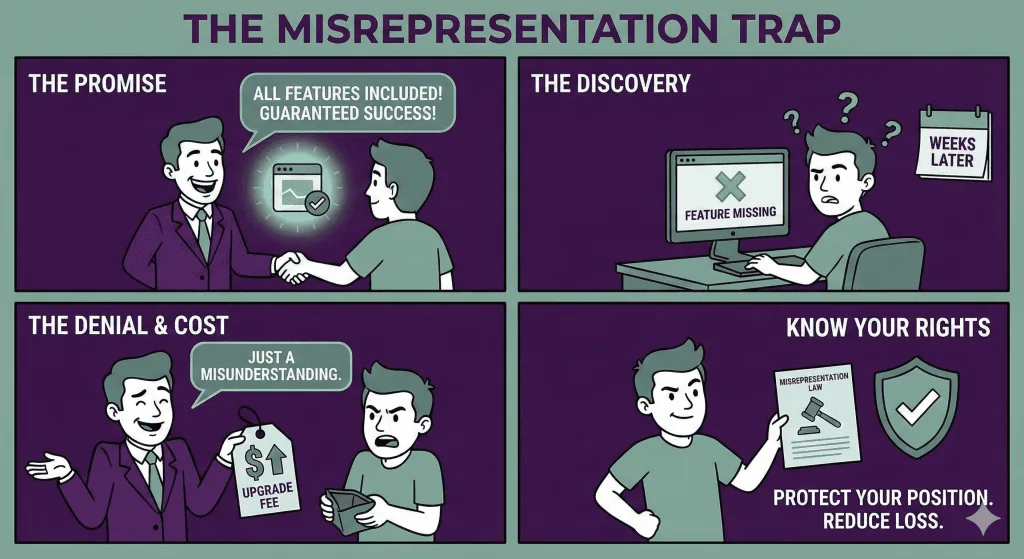
You sign a service contract after the salesperson assures you their platform has specific features. Weeks later, you discover those features do not exist and the upgrade will cost more. The salesperson says it was a misunderstanding. This is a classic setup for misrepresentation, a false or misleading statement that induces a deal. With more online sales, property launches, and complex service bundles in Singapore, such situations are increasingly common. Knowing what counts as misrepresentation and what you can do next helps you protect your position and reduce loss.
What Is Misrepresentation?
Misrepresentation occurs when one party makes a false statement of existing fact that induces another party to enter into a contract. In Singapore, the law on misrepresentation derives from two primary sources: common law principles developed through case precedent and statutory provisions under the Misrepresentation Act (Cap 390). Additionally, consumer transactions are governed by the Consumer Protection (Fair Trading) Act (Cap 52A), which provides specific protections against misleading conduct in consumer-facing transactions.
The Misrepresentation Act establishes three core mechanisms for addressing misrepresentation: the right to rescind contracts (section 1), the right to claim damages for negligent or fraudulent misrepresentation (section 2), and controls on exclusion clauses that attempt to limit liability for misrepresentation (section 3)
Key Legislation:
- Misrepresentation Act: https://sso.agc.gov.sg/Act/MA1967
- Consumer Protection (Fair Trading) Act: https://sso.agc.gov.sg/Act/CPFTA2003
- Limitation Act: https://sso.agc.gov.sg/Act/LA1959
Three Categories of Misrepresentation
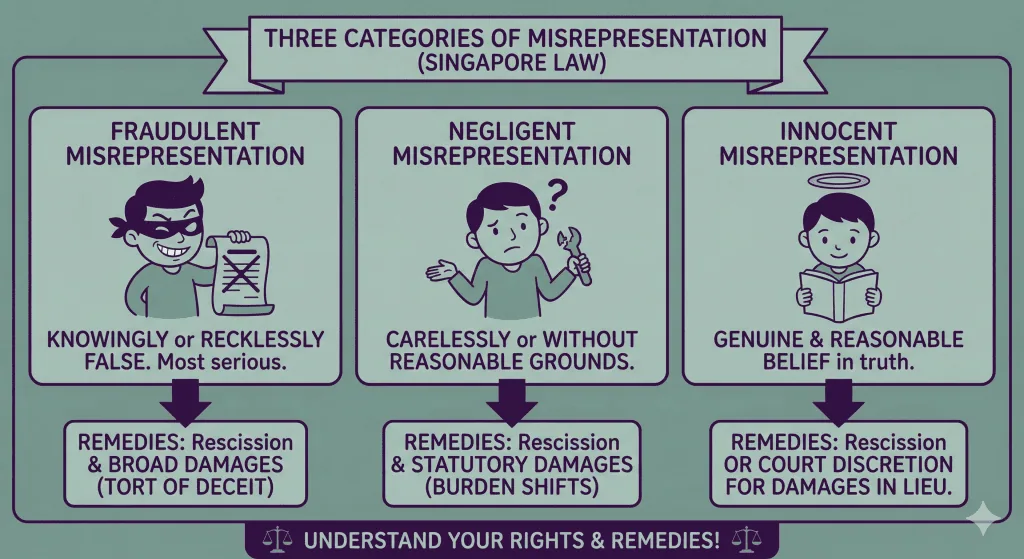
Singapore law recognizes three distinct types of misrepresentation, each carrying different legal consequences and remedial options.
Fraudulent Misrepresentation
Fraudulent misrepresentation requires proof that the statement was made knowingly, without belief in its truth, or recklessly without caring whether it was true or false. This is the most serious form and carries the broadest remedies. The representor must have had actual knowledge of the falsity or demonstrated willful blindness to the truth. Victims of fraudulent misrepresentation can pursue both rescission of the contract and damages in tort for deceit, which may include consequential losses flowing from the fraud. The measure of damages is broader than for negligent misrepresentation, potentially covering all direct losses caused by entering the contract.
Negligent Misrepresentation
Negligent misrepresentation arises when a false statement is made carelessly or without reasonable grounds for believing it to be true. Section 2(1) of the Misrepresentation Act creates a statutory right to damages for negligent misrepresentation. Notably, the Act reverses the burden of proof: once the representee proves a false statement induced the contract, the representor must demonstrate they had reasonable grounds to believe, and did believe up to the time the contract was made, that the facts represented were true. This shifted burden makes negligent misrepresentation claims significantly more accessible than common law negligence claims, which require the claimant to prove breach of duty.
Innocent Misrepresentation
Innocent misrepresentation occurs when a false statement is made without fraud or negligence—the representor genuinely and reasonably believed the statement was true. While rescission remains available for innocent misrepresentation, the right to damages is more limited. However, section 2(2) of the Misrepresentation Act grants courts discretionary power to award damages in lieu of rescission where rescission would be disproportionate. This recognizes that unwinding an entire contract may sometimes be excessive when the misrepresentation was minor or made in good faith.
Common Scenarios or Triggers
This issue arises more often than people expect, especially where marketing, property brochures, or verbal assurances influence a purchase.
| Scenario | What Typically Happens |
| Property marketing claims | Floor area, facing, or facilities are described inaccurately, and buyer discovers discrepancies after signing the Option to Purchase. |
| Used car purchase | “Accident-free” or “low mileage” claims turn out false once inspection or records surface. |
| Franchise or investment pitch | Promised earnings or “guaranteed returns” do not materialise, and supporting data was incomplete or misleading. |
| Software or service contracts | Sales assurances about features, integrations, or service levels are untrue, but the contract is already signed. |
| Tenancy and home renovation | Landlord or contractor downplays defects, licences, or timelines that later prove inaccurate. |
| Employment offers | Job scope, pay structure, or bonus scheme was misrepresented during hiring, and the written terms differ. |
Legal Remedies in Singapore
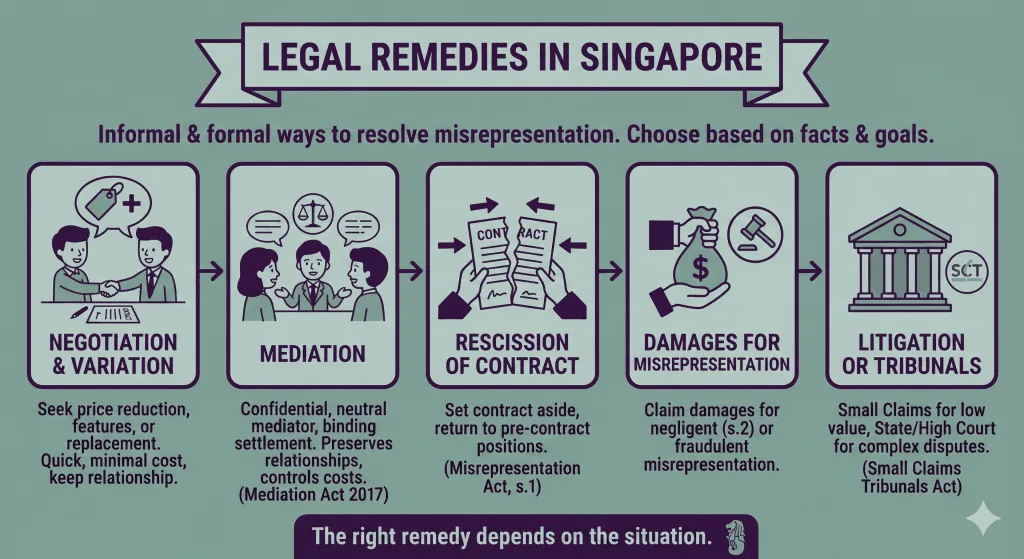
There are both informal and formal ways to resolve misrepresentation. The right next step depends on the facts and your goals.
- Negotiation and contract variation
A practical first step. You can seek a price reduction, added features, or a replacement product. Best if you want to keep the relationship or resolve things quickly with minimal cost. - Mediation
A confidential process led by a neutral mediator to reach a binding settlement. Useful for preserving relationships and controlling costs. Mediated settlements can be recorded and enforced under the Mediation Act 2017. See https://sso.agc.gov.sg/Act/MA2017 - Rescission of contract
Setting the contract aside for misrepresentation, returning parties to their pre-contract positions where possible. Typically available under the Misrepresentation Act, section 1, though bars may apply if affirmation or third-party rights have intervened. See https://sso.agc.gov.sg/Act/MA1967 - Damages for misrepresentation
Under section 2 of the Misrepresentation Act, you may claim damages for negligent misrepresentation, unless the maker proves reasonable grounds for belief. Fraudulent misrepresentation can attract broader damages at common law. - Litigation or Small Claims Tribunals
For low-value consumer contracts, the Small Claims Tribunals can be a faster route. For higher-value or complex disputes, file in the State Courts or High Court. See Small Claims Tribunals Act: https://sso.agc.gov.sg/Act/SCTA1984
The right remedy depends on the situation.
Why Early Legal Advice Matters
Many people wait, hoping the other side will fix the problem or fearing legal costs. Delay often makes things harder.
- Evidence fades
Messages get deleted, staff move on, and records change. Early advice helps you preserve proof and identify key statements that matter. - Legal deadlines apply
Most contract and tort claims carry a six-year limit from when the cause of action accrues, with special rules for fraud or concealment. See Limitation Act, section 6: https://sso.agc.gov.sg/Act/LA1959 - Early remedies are cheaper and more effective
Prompt negotiation or mediation often resolves disputes faster and at lower cost than full litigation. Early action reduces disruption and stress.
Early legal advice often prevents bigger, more expensive problems.
How RBN Chambers Can Help
Misrepresentation disputes are common, and the facts are rarely black and white. RBN Chambers provides clear, practical advice on your legal position, the strength of your evidence, and realistic outcomes. We map out options from negotiation to court action, explain costs and timelines upfront, and stay approachable throughout. If you need to unwind a deal or recover losses, our team can help you move quickly and decisively. Contact us to discuss your situation.

Delivering Solutions not just Answers to your legal disputes
We provide solutions to all our clients regardless of the scale or complexity of the cases. Let us know how we can help.
Contact UsAny information of a legal nature in this blog is given in good faith and has been derived from resources believed to be reliable and accurate. The author of the information contained herein this blog does not give any warranty or accept any responsibility arising in any way, including by reason of negligence for any errors or omissions herein. Readers should seek independent legal advice.