

Employment |
MOM Compliance Checklist for Singapore Employers

A Singapore HR manager receives a WhatsApp message from a new hire asking whether the contract’s probation clause changes after confirmation. At the same time, payroll is due, and the finance team is unsure whether CPF should already have been updated. Situations like this are common in Singapore, where employer obligations can arise at hiring, during payroll processing, and again at termination.
A small oversight can trigger a MOM query, a CPF underpayment issue, or a records problem during an audit. This checklist walks through every stage of the employment lifecycle, from hiring to offboarding, so employers can identify the key compliance points and understand their rights and duties under Singapore law before a problem surfaces.
For official references, employers should check the Ministry of Manpower (MOM), the CPF Board, and the Singapore Statutes Online for the Employment Act.
MOM Compliance Checklist at a Glance
| Compliance Category | Core Requirement | Relevant Authority / Act |
|---|---|---|
| Employment terms | Issue clear employment particulars, track working hours, rest days, salary dates, and leave entitlements | Employment Act, MOM |
| Work passes | Ensure the employee has a valid pass before work starts and keep conditions under review | MOM |
| CPF contributions | Make CPF contributions correctly and on time for eligible employees | CPF Board, CPF Act |
| Payroll | Pay salary on time, maintain itemised payslips, and keep payroll records | Employment Act, MOM |
| Leave and public holidays | Apply statutory leave and holiday entitlements correctly | Employment Act |
| Safety and health | Provide a safe workplace and comply with workplace safety duties | Workplace Safety and Health Act, MOM |
| Termination | Follow contractual or statutory notice requirements and close records properly | Employment Act |
Employment Act Compliance in Singapore
Employment Act compliance is the foundation of the Singapore MOM compliance checklist. The Employment Act sets the minimum rules for many employment relationships, including salary payment, hours of work, rest days, paid annual leave, sick leave, and notice of termination. Employers should not rely on contract wording alone if the contract offers less than the statutory minimum.
Start by checking whether the employee falls within the Employment Act’s coverage, then confirm that the written contract and HR processes match the Act.
Under section 24 of the Employment Act, salary must be paid within the required timeline. Under sections 80 and related provisions, employers must keep proper employment records. Under section 10, notice terms should be clearly stated. These points matter because MOM may request records during complaints or inspections.
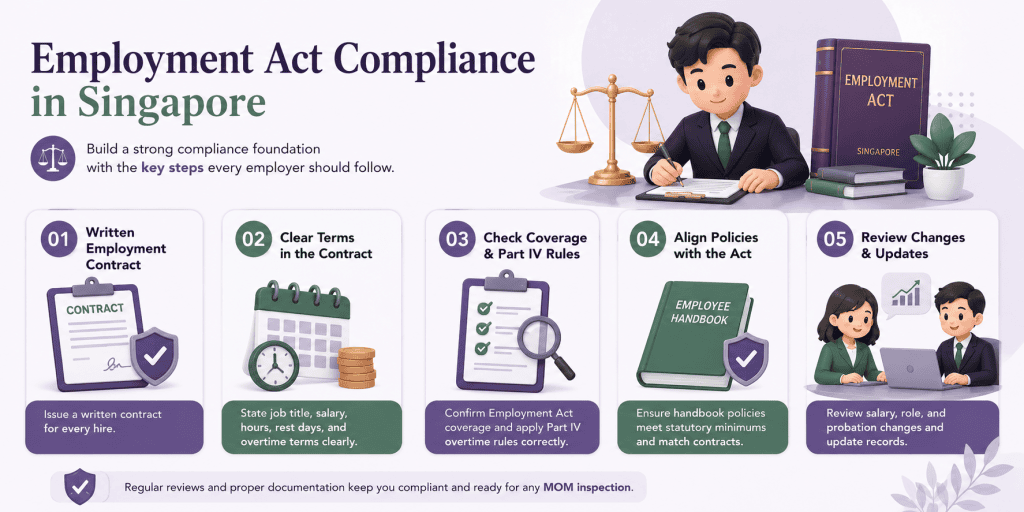
1. Issue a Written Employment Contract for Every Hire
A written contract is the first line of defence in any compliance review, giving both MOM and the employee a clear reference point if a dispute arises. Verbal agreements or informal offer letters are not enough, even for short-term or part-time roles. The contract should be signed before day one and kept on file for the duration of employment.
2. Confirm Job Title, Salary, Hours, Rest Days, and Overtime Terms
Every contract should clearly state the employee’s job title, salary, working hours, rest day arrangement, and overtime calculation. Ambiguity here is one of the most common causes of employee complaints to MOM. Employers should review these clauses whenever a role changes, and confirm the day-to-day arrangement still matches what’s written.
3. Check Employment Act Coverage and Part IV Overtime Rules
Not every employee is covered by the same provisions of the Employment Act. Part IV, which governs hours of work, rest days, and overtime, only applies to workmen and other employees earning up to specific salary caps. Employers need to check which category each employee falls into, since this determines how overtime and rest day entitlements are calculated.
4. Align Handbook Policies with Contract Terms and Statutory Minimums
Company handbooks can offer more than the Employment Act requires, but should never fall below the statutory minimum or contradict individual employment contracts. Employers should review the handbook periodically, especially after any change in law or policy, to keep the Act, the contract, and the handbook consistent with each other.
5. Keep a Process to Review Salary Changes, Role Changes, and Probation Confirmations
Compliance gaps often appear at the moments when something changes, not when everything stays the same. A promotion, salary adjustment, or probation confirmation should trigger a review of the employment contract to make sure it still reflects reality. This process should be tied to payroll and HR system updates, not left to informal emails.
For a deeper review of your employment contracts and HR policies, consider an internal audit or a legal review by an employment lawyer in Singapore. Employers can also link this stage to their HR consulting service page for a structured compliance check.
Work Pass Requirements for Hiring Foreign Employees
Before a foreign employee starts work, employers must verify the correct work pass and ensure the person is legally allowed to work in Singapore. This is a core part of work pass requirements under MOM rules. Hiring without a valid pass, or allowing someone to work outside the approved pass conditions, can lead to enforcement action.
Employers should confirm the pass type, validity period, occupation, salary requirements, and any applicable quota or levy obligations. If the role is for an Employment Pass or S Pass holder, the employer should track renewal dates well before expiry and ensure the employee’s job scope remains within the approved terms. For pass-specific guidance, link internally to your Employment Pass and S Pass articles.
Managing Foreign Worker Compliance
Foreign worker compliance does not end when the pass is approved. Employers must continue to monitor quotas, levies, medical requirements, housing or accommodation obligations where applicable, and any changes in the employee’s work arrangement. If the employee changes job scope, work location, salary structure, or employer entity, MOM requirements may be affected.
Action checklist:
- Verify the pass status on MOM’s official portal before first day of work.
- Store copies of the pass approval and employment records together.
- Track expiry and renewal dates in a central HR calendar.
- Check whether quotas, levies, or sponsorship duties apply.
- Do not assign work outside the pass conditions.
Employers should use the MOM website as the primary source for work pass rules and renewal timelines. This reduces the risk of relying on outdated advice or informal assumptions.
Payroll and CPF Contribution Compliance
Payroll compliance is one of the most common sources of avoidable mistakes in Singapore. Employers must pay salary on time, provide itemised payslips, and ensure deductions are lawful. Section 21 of the Employment Act and MOM guidance are especially relevant here, since delays or underpayments can quickly become complaint issues.
A practical payroll process should include a monthly cutoff, approval workflow, salary release date, and post-payment review. If your payroll process is manual, a payroll software solution can help reduce calculation errors and improve audit trails.
CPF Contribution Requirements for Employers
CPF contribution requirements apply to eligible Singapore Citizen and Permanent Resident employees, and rates depend on age group, wage level, and employment status. Employers should use the CPF Board’s latest rates and calculator to confirm exact amounts before making contributions.
To stay on top of this each month, employers should:
- Confirm whether the employee is CPF-liable.
- Make contributions by the stated deadline.
- Reconcile CPF deductions against payroll.
- Keep records of the wage components used in the calculation.
A missed CPF contribution can create both financial exposure and compliance issues, so it’s worth folding this into the same monthly review as payroll rather than treating it separately.
Also Read: Restrictive Covenants in Singapore Employment Contracts: A Complete Guide
Leave and Public Holiday Compliance
Leave and holiday compliance is another area where employers must follow statutory minimums, not just company practice. The Employment Act provides for paid annual leave, paid sick leave, hospitalisation leave, and public holiday entitlements for eligible employees. Company policy can be more generous, but it should never undercut the law.
Annual leave accrual should be tracked based on length of service, and sick leave with medical certificates should be filed as they come in rather than reconstructed later. If a public holiday falls on a non-working day, or an employee works on one, the compensatory arrangement should follow the Act and the contract terms.
To reduce disputes, employers should publish a clear leave policy, keep statutory and discretionary leave clearly separated, and document approvals in writing or through the HR system.
Workplace Safety and Health Compliance
Safety and health compliance is essential for protecting staff and meeting Singapore workplace obligations. Depending on the worksite, employers may need to comply with the Workplace Safety and Health Act, MOM notices, and sector-specific requirements.
This duty isn’t limited to factories or construction sites; office employers also need safe systems of work, proper incident reporting, and reasonable workplace controls.
| Focus Area | What Employers Should Check |
|---|---|
| Risk assessment | Identify hazards specific to the worksite and update when conditions change |
| Training | Ensure staff know safe work procedures and how to report incidents |
| Equipment and inspections | Keep dated records of inspections and corrective actions |
| Remote or split-location work | Address ergonomic setup and off-site incident reporting |
| Incident escalation | Report notifiable incidents to MOM promptly where required |
A clear safety process also supports better audit readiness if MOM requests evidence of workplace controls.
Employment Records Checklist for MOM Audits
Employment records are often overlooked until a dispute arises. MOM expects employers to keep proper records of employment terms, wages, hours of work, overtime, and leave. Proper records would help prove compliance during a complaint or audit.
At a minimum, a personnel file should include:
- Signed employment contract and job description.
- Payslips, CPF submissions, and leave records.
- Work pass documents.
- Disciplinary notes and termination documents.
Records should be accurate, dated, and kept together rather than scattered across systems. A useful test: could a third party reconstruct the employee’s full history from the file alone?
Termination Notice Compliance Under the Employment Act
Termination notice compliance becomes important as soon as employment ends, whether by resignation, dismissal, retrenchment, or mutual agreement. Under section 10 of the Employment Act, notice periods depend on what the contract says. If the contract is silent, the statutory default below applies.
| Length of Service | Minimum Notice Period Required |
|---|---|
| Less than 26 weeks | 1 day |
| 26 weeks to less than 2 years | 1 week |
| 2 years to less than 5 years | 2 weeks |
| 5 years and above | 4 weeks |
Under Section 11 of the Employment Act, either party to a contract of service may terminate the contract without giving notice, or without waiting for the notice period to expire if notice has been given, by paying the other party compensation equal to the employee’s gross salary for the length of notice that would otherwise have applied.
Once notice is confirmed, employers should move quickly to calculate final salary, leave encashment, and outstanding CPF, and close out handover, property return, and a signed exit acknowledgement.
For employers managing separations at scale, a standard offboarding workflow reduces legal risk and avoids disputes over the final payout.
Also Read: Non-Compete Clause in Singapore Employment Contracts: Are They Enforceable?
Keeping Your Business Compliant with RBN Chambers
MOM compliance is not a one-time task completed at hiring and forgotten until an employee leaves. It runs through every stage of employment, from the contract signed on day one, to the payslip issued each month, to the notice period calculated on the way out.
Employers who build these checks into a regular routine, rather than reacting only when MOM sends a query or an employee raises a complaint, are far less likely to face disputes, back-payments, or enforcement action.
RBN Chambers advises Singapore employers on employment contracts, HR policy reviews, and compliance disputes with MOM and CPF Board requirements.
If your business needs a legal review of its employment records, payroll processes, or termination procedures, contact RBN Chambers to have your compliance checklist assessed by an experienced commercial and litigation lawyer.
Frequently Asked Questions
What are the mandatory employment records required by MOM?
Employers should keep signed employment contracts, job details, salary and payroll records, payslips, leave records, CPF submissions, work pass documents, disciplinary notes, and termination records. MOM may request these during a dispute or inspection.
How do I ensure foreign worker compliance and work pass validity in Singapore?
Check that the employee has the correct MOM work pass before work starts, track expiry and renewal dates, and make sure the job scope, salary, and employer details match the approved pass conditions.
What are the current CPF contribution requirements for employers?
CPF contributions apply to eligible Singapore Citizen and Permanent Resident employees. Employers should use the latest CPF Board rates and calculators to determine the correct amount and pay it by the required deadline.
Delivering Solutions not just Answers to your legal disputes
We provide solutions to all our clients regardless of the scale or complexity of the cases. Let us know how we can help.
Contact UsAny information of a legal nature in this blog is given in good faith and has been derived from resources believed to be reliable and accurate. The author of the information contained herein this blog does not give any warranty or accept any responsibility arising in any way, including by reason of negligence for any errors or omissions herein. Readers should seek independent legal advice.