

Business |
How to Legally Start a Business in Singapore (2026)

You have a signed draft contract, a customer is waiting for the first invoice, and your co-founder has already asked whether the company can open a bank account this week. At that point, the main question is no longer whether the idea works, but whether the business is properly set up under Singapore law.
For founders, especially those new to Singapore, the legal steps can feel scattered across ACRA, IRAS, and MOM. That matters because a missed filing, wrong licence, or delayed work pass can slow launch plans and create avoidable risk.
Before you move ahead, it helps to understand the rules that govern your rights and obligations.
Legal Requirements to Start a Business in Singapore
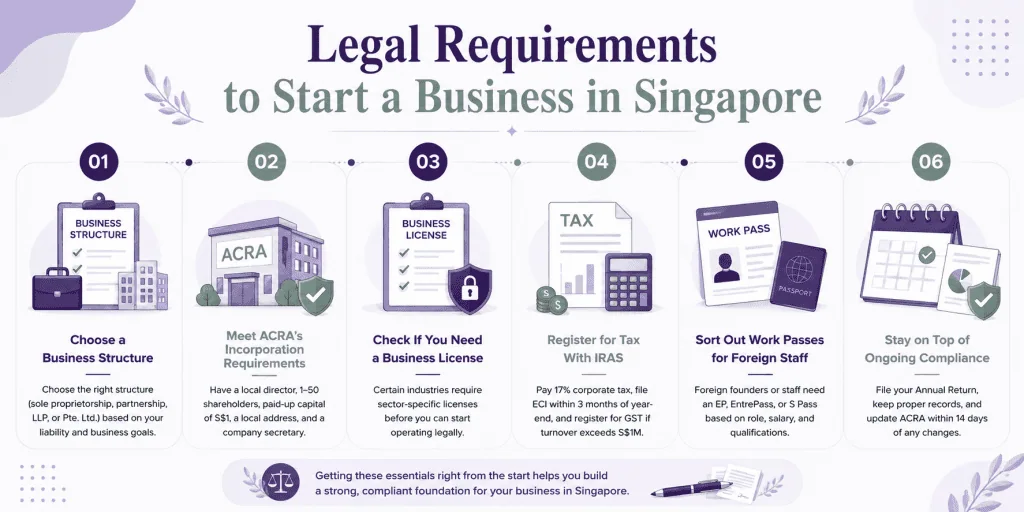
Before you can trade legally in Singapore, there are six things founders need to get right. Here is the full picture, with each area covered in more detail further down the page.
1. Choose a Business Structure
Founders can register as a sole proprietorship, partnership, LLP, or private limited company (Pte. Ltd.), each with a different liability and compliance profile. Most founders planning to raise capital or scale choose a private limited company for the liability protection it offers.
2. Meet ACRA’s Incorporation Requirements
Incorporating with ACRA means having at least one Singapore-resident director, 1 to 50 shareholders, a minimum paid-up capital of S$1, a local registered office address, and a company secretary appointed within 6 months of incorporation.
3. Check If You Need a Business License
Not all businesses need a licence, but regulated sectors such as F&B, education, financial services, healthcare, and recruitment require sector-specific approval before operations begin.
4. Register for Tax With IRAS
Once incorporated, a company is generally treated as a taxpayer for corporate tax purposes, currently at 17%. Founders should also file Estimated Chargeable Income (ECI) within 3 months of financial year-end, and register for GST once taxable turnover exceeds S$1 million.
5. Sort Out Work Passes for Foreign Staff
Foreign founders or employees need an Employment Pass, EntrePass, or S Pass depending on role, salary, and qualifications. Owning shares in the company does not grant the right to work on the ground.
6. Stay on Top of Ongoing Compliance
Compliance continues after incorporation, with an Annual Return filed with ACRA every year, proper financial reporting, and updates to ACRA within 14 days of any officer or address change.
Also Read: Non-Disclosure Agreement (NDA) in Singapore: Legal Guide
Choosing the Right Business Structure Before You Register
Before filing anything with ACRA, decide on the legal structure your business will trade under, since each option carries a different set of legal requirements. A sole proprietorship is the simplest to set up and suits a single owner willing to take on personal liability for business debts.
A partnership works similarly but is shared between two to twenty partners, each personally liable, including for debts run up by the others. A limited liability partnership (LLP) combines a partnership’s flexibility with limited liability for its partners.
Most founders planning to raise capital, hire a team, or scale beyond Singapore choose a private limited company (Pte. Ltd.), since it is a separate legal entity that shields personal assets and is generally easier to contract with clients and investors.
| Structure | Liability | Best Suited For |
|---|---|---|
| Sole Proprietorship | Owner is personally liable for all debts | Solo freelancers and very small, low-risk operations |
| Partnership | Partners share unlimited personal liability, including for each other’s debts | Small professional practices, such as a law firm, with 2 to 20 partners |
| Limited Liability Partnership (LLP) | Partners have limited liability, similar to a company | Professional service partnerships wanting liability protection without full company structure |
| Private Limited Company (Pte. Ltd.) | A separate legal entity; shareholders’ liability is limited to their share capital | Startups planning to raise funding, hire staff, or scale |
ACRA Requirements for Company Incorporation
The first legal checkpoint is company registration with the Accounting and Corporate Regulatory Authority (ACRA). In Singapore, most founders use a private limited company because it is a separate legal entity and is generally easier to scale, contract with clients, and manage liability. ACRA administers business registration through BizFile+.
If you are comparing business registration Singapore options, the key point is this: you should confirm your entity type, required officers, and registered details before you submit the incorporation application.
The Companies Act 1967 and the Business Names Registration Act 2014 govern different structures, so choosing the right one matters from day one.
For official filing, ACRA’s BizFile+ portal is the central platform: https://www.bizfile.gov.sg/. Once ACRA approves the application, the company receives a free business profile and a Unique Entity Number (UEN), which functions as its identifier for dealings with government agencies going forward.
The Business Registration Process in Singapore
The incorporation process usually follows a clear sequence. First, choose a company name and check that it is available. Then prepare the constitution, officer details, shareholder information, registered address, and share capital details.
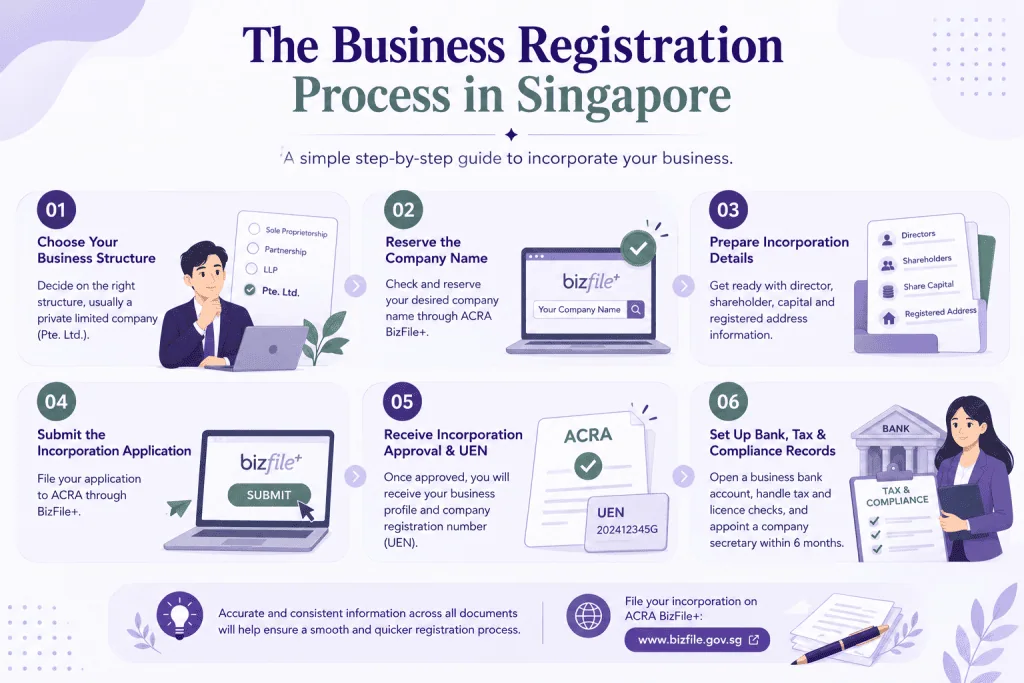
After that, submit the incorporation application through BizFile+. Once approved, most incorporations are processed within one to a few working days, though some applications may be referred for further review.
A practical flowchart for this process would look like this: choose structure, clear name approval, confirm officers and address, submit ACRA filing, receive incorporation approval, then set up bank, tax, and compliance records, including appointing a company secretary.
If you want the process to move cleanly, make sure the information supplied is consistent across all documents, especially names, identification numbers, and shareholdings.
This is the step-by-step Singapore company incorporation process.
- Step 1: Decide on the business structure, usually a private limited company.
- Step 2: Reserve the company name through ACRA BizFile+.
- Step 3: Prepare incorporation details, including directors, shareholders, capital, and registered address.
- Step 4: Submit the incorporation application to ACRA.
- Step 5: Once approved, obtain the business profile and company registration number (UEN).
- Step 6: Appoint a company secretary within six months, and put in place post-incorporation compliance, tax, and licence checks.
You can review ACRA’s official filing portal here: https://www.bizfile.gov.sg/. If you want support with company incorporation requirements, an incorporation service or corporate secretary can help ensure the filing is complete and compliant.
Securing the Right Business License in Singapore
Not every business needs a licence, but many regulated activities do — the requirement depends on what the company actually does, not just the fact that it is incorporated.
- Check if your sector is regulated — common licensed sectors include food and beverage, education, financial services, healthcare, recruitment, travel, and import or export of controlled goods
- Use the GoBusiness Licensing Portal — it lists sector-specific licence requirements and includes a licensing wizard to help identify what applies to your business
- Don’t assume incorporation is enough — being incorporated correctly with ACRA doesn’t mean you’re cleared to operate; many founders still need separate approval before starting, and skipping this step is one of the most common mistakes new founders make
- Incorporate first, then check licences — confirm sector licences before signing premises leases, hiring staff, or marketing your service, to avoid opening before you’re legally allowed to trade
- Confirm the exact permit early — the issuing authority depends on the activity involved, so identify it as soon as possible rather than at launch
Navigating Corporate Tax and GST Registration
After incorporation, the next step is tax setup with the Inland Revenue Authority of Singapore (IRAS). Companies should understand corporate tax registration, filing deadlines, and whether GST registration applies. Official tax information is available on IRAS’s website.
Corporate Tax Registration Essentials
Once incorporated, a company is automatically treated as a taxpayer for corporate income tax — there is no separate “sign up” step. The obligation is to keep proper records, prepare tax computations, and file returns on time. Singapore’s corporate tax rate is 17%, subject to available exemptions and reliefs under the Income Tax Act 1947.
Companies must also file Estimated Chargeable Income (ECI) within three months of financial year-end, unless exempt — missing this deadline can trigger penalties. The safest approach is to track revenue, expenses, payroll, and invoices from day one rather than reconstructing records later.
Understanding the GST Registration Threshold
Goods and Services Tax (GST) registration is required once a company’s taxable turnover exceeds, or is expected to exceed, S$1 million. A company can be trading legally and still fail to register for GST when it crosses this threshold, creating exposure for the unregistered period, so turnover should be monitored closely as revenue grows. A tax adviser can help assess whether compulsory or voluntary GST registration makes sense based on your customers and pricing model.
Employment Pass and Work Pass Requirements for Foreigners
Foreign founders and employees should check Ministry of Manpower (MOM) rules before assuming they can work from Singapore. The right pass depends on role, salary, and qualifications. Official information is available on MOM’s website.
Pass Type, Target Audience, and Key Eligibility Criteria
- Employment Pass: professionals, managers, executives, and certain founders — requires suitable qualifications, a genuine role, and meeting MOM salary and assessment criteria
- EntrePass: foreign entrepreneurs — for eligible founders building an innovative business; if already registered, the company must generally be less than 6 months old at application
- S Pass: mid-skilled employees — subject to MOM salary, qualification, and quota requirements
Owning shares in a company does not grant the right to work in Singapore, that requires a valid work pass. Foreign founders should confirm the correct pass with MOM and plan the application timeline before relocating.
Also Read: What to Include in a Singapore Partnership Agreement
Ongoing Compliance and Annual Filing Requirements
Compliance obligations continue every year after incorporation. Many companies stay compliant at setup but fall behind later by treating this as a one-time task. ACRA handles corporate filing, IRAS handles tax filing, and companies with employees also have payroll and CPF obligations.
Annual Filing Requirements with ACRA
ACRA requires companies to file an Annual Return (AR) after each financial year, updating the company’s officers, registered office, and financial statement status.
Missing the deadline can lead to penalties or enforcement action, which is why many companies appoint a corporate secretary to track due dates and prepare filings. Keeping records of share transfers, board resolutions, and officer or address changes up to date and notifying ACRA of changes within 14 days, makes the process smoother.
Financial Reporting Obligations and Deadlines
Financial reporting obligations depend on the company’s size — some qualify for simplified reporting, while others must prepare full financial statements. Directors remain responsible for proper accounting records regardless. Key deadlines to track are ECI, the corporate tax return, and the Annual Return, though exact dates depend on the company’s financial year-end.
Filing Type, Governing Body, and Deadline
- Estimated Chargeable Income (ECI) — IRAS — within 3 months from financial year-end, unless exempt
- Annual Return (AR) — ACRA — within the statutory filing timeline after financial year-end and required approvals
- Corporate Tax Return (Form C-S/C) — IRAS — by the annual tax filing deadline set by IRAS
The best compliance habit is simple, close the books on time, track deadlines in a shared calendar, and appoint a responsible person or service provider to oversee filings.
Start Your Business With the Right Legal Foundation
If you want support with business registration Singapore, ongoing annual filing requirements, or corporate tax registration, RBN Chambers can help with incorporation, corporate secretary services, and tax compliance planning.
Ramesh Bharani Nagaratnam and the corporate and commercial team at RBN Chambers regularly advise founders on structuring, incorporating, and staying compliant from day one, so that legal setup does not become a bottleneck to launching.
You can also review our internal service pages for company incorporation, corporate secretary packages, and tax advisory support. Contact us here!
Frequently Asked Questions
Can a foreigner start a business in Singapore without relocating?
Yes. A foreigner can own shares in a Singapore company without relocating, but the company must still have at least one locally resident director. If the foreigner wants to manage work on the ground, the correct MOM work pass must also be obtained.
What is the minimum paid-up capital required for company incorporation?
The minimum paid-up capital for a Singapore private limited company is S$1. Many businesses start with a higher amount for commercial reasons, but the legal minimum is S$1.
What happens if I miss my annual filing requirements with ACRA?
Missing ACRA annual filing requirements can lead to late penalties and further enforcement action. Companies should keep records updated throughout the year and use a corporate secretary or compliance adviser to track deadlines.
Delivering Solutions not just Answers to your legal disputes
We provide solutions to all our clients regardless of the scale or complexity of the cases. Let us know how we can help.
Contact UsAny information of a legal nature in this blog is given in good faith and has been derived from resources believed to be reliable and accurate. The author of the information contained herein this blog does not give any warranty or accept any responsibility arising in any way, including by reason of negligence for any errors or omissions herein. Readers should seek independent legal advice.