

Business |
What to Include in a Singapore Partnership Agreement

You and your future partner may already have a working rhythm. Maybe one of you has sent a draft by WhatsApp, or an invoice has already been issued under the new business name.
That can feel like enough to move forward, but in Singapore the real question is what happens when money, control, or timing becomes unclear. A partnership agreement answers that before the first disagreement starts.
If you are looking into what to include in a partnership agreement in Singapore, the key is to make sure your rights, obligations, and exit position are properly documented under Singapore law.
How Singapore Partnership Law Affects Your Agreement
In Singapore, partnerships are governed by the Partnership Act, which you can review on Singapore Statutes Online. If your agreement does not cover a topic clearly, the default legal rules may fill the gap. That is risky because the statutory position may not match what you and your partner assumed verbally.
For example, under the Act, partners generally share profits equally unless agreed otherwise, and each partner can be exposed to joint and several liability for partnership obligations. That means a creditor may pursue one partner for the full debt, not just a proportionate share. Partners also owe fiduciary duties, which require them to act honestly and in the partnership’s best interests, not to secretly benefit at the expense of the business.
This is why a written agreement matters. It lets you override or clarify default rules on profit sharing, management, decision-making, and exit. For business owners considering structure and registration, it is also worth checking ACRA’s partnership guidance and related services such as company incorporation, legal drafting and opening a corporate bank account in Singapore.
General Partnership vs LLP vs Limited Partnership
Not every structure called a “partnership” in Singapore is governed by the same law, and the agreement you need depends on which one you’re actually forming.
A general partnership is the simplest structure, governed by the Partnership Act 1890. It has no separate legal identity from its partners, and every partner carries unlimited personal liability for the business’s debts.
A limited liability partnership (LLP), governed by the Limited Liability Partnerships Act 2005, is a separate legal entity that can own property and sue or be sued in its own name. Partners are generally shielded from the LLP’s debts and from each other’s individual wrongdoing, though each remains liable for their own acts.
A limited partnership (LP), governed by the Limited Partnerships Act 2008, sits between the two. It requires at least one general partner with unlimited liability who runs the business, and at least one limited partner whose liability is capped at their capital contribution, provided they stay out of day-to-day management.
This article focuses on the agreement for a general partnership. If you’re forming an LLP or an LP, the governing law and the clauses you need, particularly around liability, management authority, and ACRA registration, are different, and the agreement should be drafted for that specific structure.
Do You Need a Written Partnership Agreement in Singapore
A partnership agreement is not a legal requirement for registering a partnership with ACRA. Many small partnerships operate on a verbal understanding, and that understanding can still be legally binding.
The risk is proof, not validity. If a disagreement reaches the point of a dispute, a verbal agreement is only as strong as what each partner can recall and corroborate, and the Partnership Act’s default rules apply to anything that was never clearly agreed.
For a business with real capital, ongoing revenue, or more than two partners, that gap is usually more expensive to resolve later than a written agreement would have cost to draft at the start.
Also Read: Frustration of Contract in Singapore: Comprehensive Guide
Key Clauses for a Singapore Partnership Agreement
A partnership agreement earns its value by answering the questions partners tend to disagree on only after money or control is already at stake.
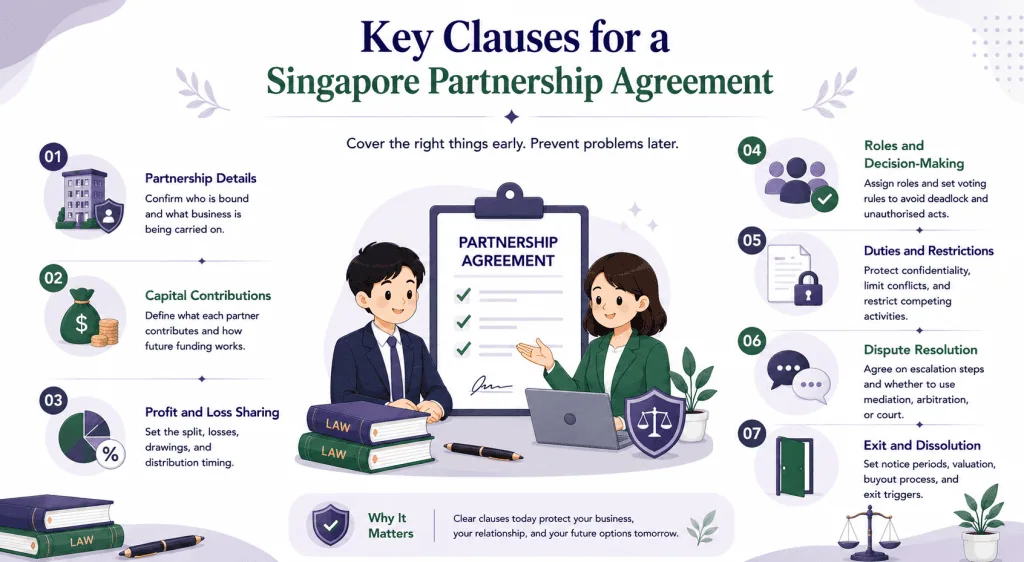
1. Partnership Details and Purpose
State the partnership’s business name, registered address, the nature of the business, the effective date, and each partner’s full name and identification details. This section sounds administrative, but it is what ties the agreement to the actual entity registered with ACRA and to each partner’s filings with IRAS, so it should match those records exactly.
2. Capital Contributions
Set out exactly what each partner is contributing at the start, whether cash, equipment, intellectual property, or existing client relationships being brought into the business. Be precise about value, timing, and whether the contribution is treated as a loan, an equity contribution, or a reimbursable expense.
Also address what happens if the business needs more funding later. If one partner injects extra capital, does that change ownership, get treated as a loan, or get repaid first from future profits? Without this clause, disputes tend to surface quickly the first time cash flow gets tight.
3. Profit and Loss Sharing
Do not assume the split will follow instinct or effort. If you want a 60/40 split, or one that changes after a milestone, write it down. State how losses are shared, whether partner drawings are allowed, and when profits can be distributed versus retained for working capital.
Left unaddressed, the Partnership Act points toward equal sharing by default, which is not always the right outcome and can create resentment if the partners’ actual contributions were never equal.
4. Roles, Responsibilities and Decision-Making
A good agreement explains who handles sales, operations, finance, compliance, and client management, not just that the partners are “equal.” It should also separate day-to-day authority from decisions that require a vote, so one partner cannot bind the business to a major commitment without the others’ agreement.
| Decision Type | Approval Required | Example |
|---|---|---|
| Day-to-day spending within budget | Individual partner discretion | Paying a routine supplier invoice |
| Hiring or vendor selection | Majority vote | Appointing a freelance contractor |
| Borrowing, guarantees or leases | Unanimous vote | Signing a multi-year office lease |
| Admission of a new partner | Unanimous vote | Bringing in a partner with equity |
| Amending the agreement | Unanimous vote | Changing the profit split or exit terms |
5. Duties, Restrictions and Confidentiality
Define what partners may not do without consent, such as signing contracts above a set amount, using partnership assets for personal purposes, or competing with the business. These clauses reinforce the fiduciary duties partners already owe each other and reduce the risk of unauthorised commitments.
If a partner has access to sensitive client or supplier information, confidentiality obligations should be stated explicitly, along with any non-compete or non-solicitation terms that apply if a partner later leaves.
6. Dispute Resolution
Even well-run partnerships disagree. The agreement should set out a stepped process before anyone threatens legal action, typically internal discussion, then formal notice, then mediation, with litigation or arbitration as the last resort.
RBN Chambers’ guide to contract disputes in Singapore covers how this escalation process plays out in practice.
7. Exit, Withdrawal and Dissolution
Exit provisions govern what happens when a partner resigns, becomes incapacitated, dies, breaches the agreement, or wants to sell their interest. State the required notice period, the valuation method, whether remaining partners get a right of first refusal, and how outstanding liabilities are settled.
Without clear exit terms, a departing partner can end up stuck in a business they no longer want to be part of, or in a dispute over what their share is actually worth. The agreement should also state what triggers dissolution and how remaining assets and obligations get wound up.
Should You Use a Free Partnership Deed Template
A free template can be a reasonable way to organise your thinking, but it should be treated as a draft, not a finished legal document. Most templates are not written specifically for Singapore’s Partnership Act and can miss local issues such as joint and several liability, dispute escalation, and the specific approval thresholds your business actually needs.
If you use one, check every clause against your actual business model. Does it reflect your capital structure, who has authority to sign contracts, how decisions get made, and how a partner can leave? If not, revise it, or have a corporate lawyer review it, before anyone signs.
This matters more once the business takes on debt, holds client money, uses intellectual property, or involves unequal contributions. For the registration process itself, ACRA’s guidance covers what’s needed to set up the partnership entity.
Also Read: Essential Shareholder Agreement Clauses in Singapore
Protect Your Partnership With a Properly Drafted Agreement
A well-drafted partnership agreement is not about assuming the relationship will fail. It is about making sure that when circumstances change, whether through growth, a disagreement, or a partner’s exit, your business already has answers instead of having to negotiate them under pressure while money and working relationships are on the line.
RBN Chambers helps business partners draft and review partnership agreements that reflect how the business actually operates, not just a generic template.
Led by Ramesh Bharani Nagaratnam, the corporate and commercial team can also step in to represent you if a dispute over an existing agreement needs to be resolved. Contact RBN Chambers or visit our sevices to arrange a consultation.
Frequently Asked Questions
Is a partnership agreement a legal requirement in Singapore?
No. ACRA does not require a partnership agreement to register a general partnership. It is strongly recommended, though, because without one, disputes fall back on the default rules in the Partnership Act, which may not reflect what the partners actually intended.
What happens if partners in Singapore don’t have a written agreement?
The Partnership Act 1890 fills the gap. This typically means equal profit and loss sharing regardless of each partner’s actual contribution, and continued exposure to joint and several liability for partnership debts.
Is a partnership agreement the same as an LLP agreement in Singapore?
No. A general partnership agreement is governed by the Partnership Act 1890, while an LLP agreement is governed by the Limited Liability Partnerships Act 2005 and comes with different liability protections. The clauses needed for each are not interchangeable.
How is a Singapore partnership taxed?
The partnership itself does not pay income tax. The precedent partner files an annual Form P with IRAS declaring the partnership’s income, and each partner reports their share of the profit or loss in their personal income tax return.
Can we use a free partnership agreement template for a Singapore partnership?
A free template can be a reasonable starting point, but most are not written for Singapore’s Partnership Act and can miss issues around liability, voting rights, and exit terms. Have a lawyer review it against your actual business arrangement before signing.

Delivering Solutions not just Answers to your legal disputes
We provide solutions to all our clients regardless of the scale or complexity of the cases. Let us know how we can help.
Contact UsAny information of a legal nature in this blog is given in good faith and has been derived from resources believed to be reliable and accurate. The author of the information contained herein this blog does not give any warranty or accept any responsibility arising in any way, including by reason of negligence for any errors or omissions herein. Readers should seek independent legal advice.