

Business |
Essential Shareholder Agreement Clauses in Singapore

A Singapore startup has just closed its first seed round, and the founders are reviewing a draft agreement after a message from the lead investor asking for “standard protections.” One clause on board control looks harmless at first, but another limits how shares can be sold if someone wants out.
The team isn’t fully sure who gets the final say on budgets, hiring, or a future sale. This is a common situation in Singapore, where companies often move quickly from handshake trust to formal equity arrangements.
The issue is not just legal formality, it’s about who controls the business, how value is protected, and what happens when expectations diverge.
What Is a Shareholder Agreement and Why Is It Important?
A shareholders’ agreement (SHA) is a private contract between the shareholders of a company. It works alongside the company’s Constitution and the Companies Act 1967 of Singapore, but the two documents serve different purposes.
The Constitution is filed with Accounting and Corporate Regulatory Authority (ACRA) and becomes a public document; the SHA stays confidential between the parties and sets the internal rules on governance, transfers, profits, disputes, and exits.
For founders and investors, the real value is clarity. A well-drafted SHA:
- Defines ownership, voting rights, and board control
- Protects minority shareholders from being overridden on major decisions
- Sets a clear process for resolving disputes before they escalate
- Provides a plan for what happens on exit, sale, or deadlock
This matters especially in Singapore, where ownership structures are often lean, decision-making is fast, and many companies rely on a small group of key people.
When raising capital for a company in Singapore, the Venture Capital Investment Model Agreements (VIMA) may be adopted. The VIMA is a set of standard templates developed by the Singapore Academy of Law and the Singapore Venture & Private Capital Association. These templates already include model clauses on pre-exemption, tag-along, and drag-along rights. Although VIMA provides a useful starting point, it is intended to be further tailored to your specific transaction.
Key Shareholder Agreement Clauses in Singapore
A comprehensive SHA in Singapore typically covers the following clauses.
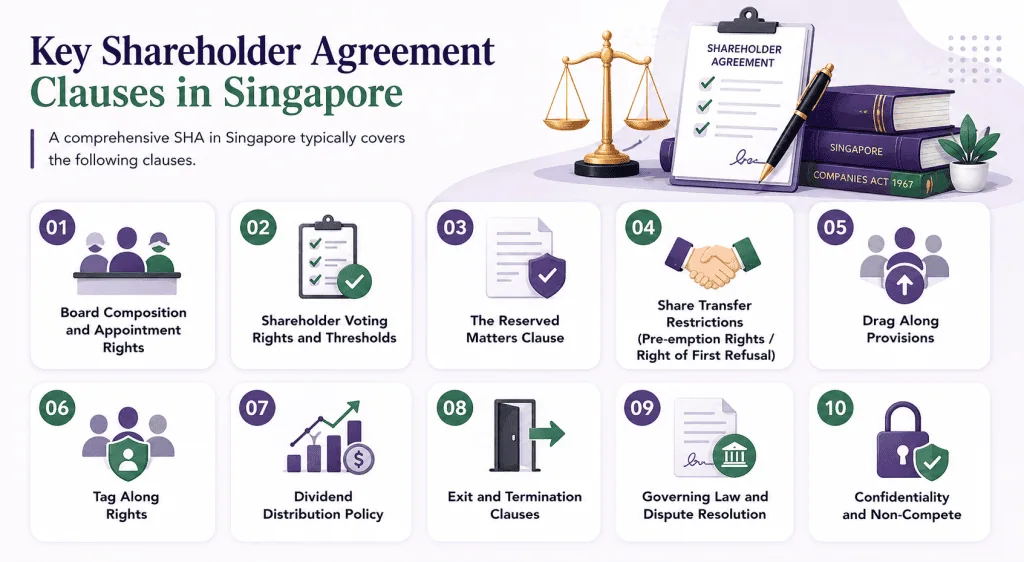
Board Composition and Appointment Rights
Board composition clauses decide who gets to sit on the board and how directors are appointed or removed. This matters because directors make operational decisions, oversee strategy, and approve important transactions.
For founders, board seats can preserve operational influence after dilution. For investors, a board seat provides visibility and a voice in governance. Without clear appointment rights, disputes can arise if one party tries to shift control by changing the board unexpectedly.
In Singapore, board control also connects to director responsibilities under the Companies Act 1967. A shareholders’ agreement should not contradict statutory duties, but it can still allocate appointment rights and board mechanics clearly.
Shareholder Voting Rights and Thresholds
Voting rights determine how ordinary and special decisions are approved. Some decisions should pass by simple majority, while others may require a higher threshold, such as 75% approval.
This clause matters because a shareholder with more voting power can otherwise push through decisions that affect everyone. Well-drafted thresholds protect against abrupt changes in strategy, share issuance, or constitution amendments.
For example, a startup may allow ordinary decisions to be made by a simple majority, but reserve structural decisions for supermajority approval. That gives the business flexibility while protecting key stakeholders from surprise moves.
Also Read: Alternate Dispute Resolutions Methods
The Reserved Matters Clause
The reserved matters clause is one of the most important clauses in a Singapore SHA. It lists decisions that cannot be made without consent from specified shareholders, directors, or both.
Typical reserved matters include issuing new shares, taking on major debt, changing the business line, approving annual budgets, declaring dividends, selling key assets, or appointing auditors. The point is not to block management — it’s to stop major decisions from being made without proper investor or founder consent.
For minority shareholders, this clause is a practical safeguard, and it works alongside — not instead of — the statutory oppression remedy under Section 216 of the Companies Act. For founders, it can also create discipline by requiring consultation before major strategic changes.
Share Transfer Restrictions (Pre-emption Rights / Right of First Refusal)
Share transfer restrictions limit who can buy shares and on what terms. Pre-emption rights — also called right of first refusal (ROFR) — usually require a shareholder who wants to sell to first offer the shares to existing shareholders before selling to an outsider.
This protects the existing ownership structure. It stops unwanted third parties from entering the company and helps current shareholders maintain control. It also gives founders and investors a fair chance to preserve their percentage ownership.
Without these restrictions, one shareholder could sell to a competitor, a passive investor, or someone who doesn’t share the company’s goals. In a Singapore private company, that can quickly create operational tension.
Drag Along Provisions
Drag along provisions allow majority shareholders to require minority shareholders to join in a sale of the company, usually on the same terms. This is useful when a buyer wants 100% ownership and the majority has agreed to sell.
For the majority, this clause makes the company easier to sell. For the buyer, it avoids being blocked by a small minority. For minority shareholders, the protection lies in ensuring the sale terms are fair and aligned with the agreement.
Well-drafted drag along provisions usually specify the minimum price, same terms for all shareholders, and the process for giving notice. That prevents the majority from forcing a sale on unfair terms.
Tag Along Rights
Tag along rights protect minority shareholders if the majority is selling its stake to a third party. The minority can join the transaction and sell on the same terms.
This is important because when control changes, the value and future direction of the company can change too. Tag along rights stop minority shareholders from being left behind with a new controlling owner they did not choose. These rights are especially useful in founder-led companies where one founder may sell control but others want a clean exit as well.
| Feature | Drag Along Provisions | Tag Along Rights |
|---|---|---|
| Definition | Allows majority shareholders to require minority shareholders to sell in a company sale | Allows minority shareholders to join a sale by majority shareholders on the same terms |
| Primary beneficiary | Majority shareholders and the buyer | Minority shareholders |
| Typical trigger events | Sale of the company, acquisition of control, or exit transaction | Sale of control by majority shareholders to a third party |
A practical way to think about it: drag along helps get a deal done, while tag along helps minority shareholders avoid being stranded.
Dividend Distribution Policy
A dividend distribution policy sets when dividends may be declared, who approves them, and whether the company must meet certain financial conditions first. This gives shareholders a shared understanding of how profits will be handled.
In practice, founders may prefer to reinvest profits into growth, while investors may expect some return over time. The agreement can specify that dividends are only declared if the company is solvent, has met working capital needs, and the board recommends distribution, balancing cash preservation against shareholder returns.
Without a written policy, disputes can arise when one group wants to retain earnings and another wants payout, which is especially sensitive in smaller Singapore companies where cash flow is tight.
Exit and Termination Clauses
Exit and termination clauses (sometimes drafted as a standalone buy-sell agreement) explain when a shareholder can leave, how shares are valued, and what happens after departure. They may also cover compulsory transfer events such as breach, incapacity, insolvency, or death.
These clauses matter because an investor or founder may not remain involved forever. If the agreement is silent, the company can face uncertainty over valuation, payment timing, and control after exit.
Good exit clauses often cover valuation methods, payment instalments, permitted transfers, and what restrictions continue after termination, and should align with the company Constitution and the Companies Act 1967 where relevant.
For a founder, this gives a clear route out without damaging the business. For the company, it reduces the risk of a disruptive shareholder remaining on the cap table indefinitely.
Deadlock Resolution Mechanisms
A deadlock happens when shareholders cannot agree on a key matter and the company is stuck. This can happen in 50-50 ownership structures, family businesses, or founder-investor setups where consent is split.
A deadlock resolution clause gives the parties a planned way out. Common mechanisms include negotiation, mediation, buy-sell procedures, and, in some cases, winding up.
Without a deadlock clause, the business may remain stuck for months or years, with board decisions blocked and commercial opportunities lost — that can reduce value quickly.
| Mechanism | How It Works | Best Used For |
|---|---|---|
| Russian Roulette | One shareholder names a price; the other must buy at that price or sell at that price | Closely held companies where both sides want a clean break |
| Texas Shootout | Both parties submit confidential bids; higher bidder buys the other out | Situations where both sides may be willing to acquire control |
| Mediation/Arbitration | A neutral third party helps resolve the dispute, or makes a binding decision if agreed | Disputes that may be solved without an immediate ownership change |
| Liquidation | The company is wound up and assets are distributed according to rights and priorities | Severe deadlocks where continuation is no longer practical |
Each mechanism has trade-offs. Russian Roulette can be efficient but aggressive. Texas Shootout can be fair but expensive. Mediation can preserve relationships, while liquidation is usually the last resort.
Also Read: Contract Disputes in Singapore: A Practical Guide to Your Legal Options
What Happens Without These Clauses
Without a shareholders’ agreement, or with one that’s missing key clauses, a company falls back on whatever the Constitution and the Companies Act provide, and little else. That gap tends to surface at the worst possible time:
- mid-negotiation on a sale
- mid-dispute between co-founders
- when a shareholder wants out and there’s no agreed process or valuation method.
For minority shareholders specifically, the fallback is the statutory oppression remedy under Section 216 of the Companies Act, which lets a court intervene where the majority’s conduct is unfairly prejudicial. It’s a real protection, but it means going to court to fix a problem that a reserved matters clause or a tag-along right could have prevented in the first place.
Our article on minority shareholder oppression under Section 216 covers how that remedy works in more detail.
Keeping Your Shareholder Agreement Up to Date with RBN Chambers
An Shareholder Agreement that fit a two-founder startup rarely still fits after a new funding round, a new shareholder, or a board reshuffle. It’s worth revisiting the agreement whenever the company’s ownership or governance changes materially, rather than treating it as a one-time document signed at incorporation.
Before signing or updating an SHA, many owners also review their structure with a corporate lawyer and company secretary to ensure it works with the company’s Constitution and internal governance documents. You can learn more about our corporate secretarial services and director duties in Singapore pages.
For statutory reference, you may also review the Companies Act 1967 on Singapore Statutes Online and ACRA website.
RBN Chambers helps founders, investors, and business owners draft and review shareholder agreements that reflect commercial priorities and legal risk.
If you’re setting up a new company, closing a funding round, or updating an existing agreement, contact RBN Chambers for a legal review before gaps become disputes.
Frequently Asked Questions
What are the most critical shareholder agreement clauses for a new Singapore startup?
The most critical SHA clauses usually cover board composition, shareholder voting rights, reserved matters, share transfer restrictions (pre-emption/ROFR), drag along provisions, tag along rights, dividend policy, and deadlock resolution.
How does a reserved matters clause protect minority shareholders?
A reserved matters clause protects minority shareholders by requiring consent for major decisions such as issuing new shares, taking on significant debt, or selling key assets. It limits unilateral control by the majority.
What happens if a company faces a dispute without a deadlock resolution clause?
Without a deadlock resolution clause, the company may remain stuck with blocked decisions, delayed operations, and rising conflict. The parties may need to negotiate an exit, seek mediation, or apply to court in serious cases.
Can share transfer restrictions prevent founders from leaving the company?
Share transfer restrictions can limit how founders sell or transfer shares, but they usually do not completely prevent departure. They often require existing shareholders to be offered the shares first or impose approval conditions before a transfer.
Is a shareholders’ agreement the same as the company’s Constitution?
No. The Constitution is filed with ACRA and is a public document; the SHA is a private, confidential contract between shareholders that can add rules the Constitution doesn’t cover, such as voting thresholds, exit mechanics, and dispute resolution.
Delivering Solutions not just Answers to your legal disputes
We provide solutions to all our clients regardless of the scale or complexity of the cases. Let us know how we can help.
Contact UsAny information of a legal nature in this blog is given in good faith and has been derived from resources believed to be reliable and accurate. The author of the information contained herein this blog does not give any warranty or accept any responsibility arising in any way, including by reason of negligence for any errors or omissions herein. Readers should seek independent legal advice.