

Employment |
Singapore Labour Law for Foreign Workers: Legal Guide

Two colleagues can sit at adjacent desks in the same Singapore office, one on an Employment Pass and one a Singapore citizen, and still be subject to different rules on hiring, salary benchmarks and work pass conditions. On the day-to-day terms of work, such as leave, pay and dismissal, the law is largely the same for both.
That dual structure is where most misunderstandings begin. Employees do not always know which rights they can enforce, and employers do not always know which obligations attach to a work pass holder. This guide explains the framework in plain legal terms.
Singapore Labour Law for Foreign Workers
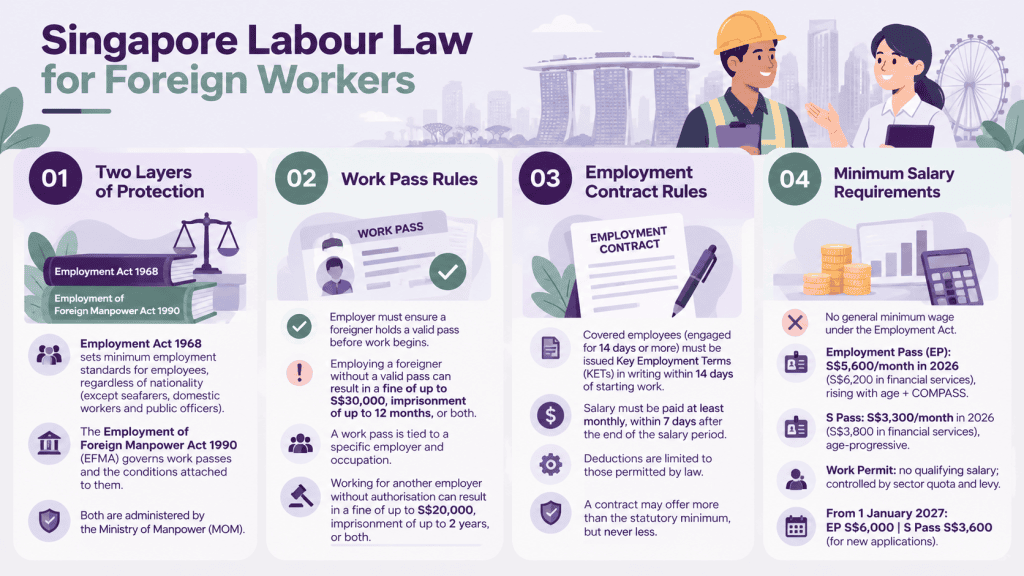
Singapore labour law for foreign workers operates on two layers. The Employment Act 1968 sets minimum employment standards for employees under a contract of service, whatever their nationality, except seafarers, domestic workers and public officers. The Employment of Foreign Manpower Act 1990 (EFMA) separately governs work passes and the conditions attached to them.
The Ministry of Manpower (MOM) administers both. A foreign employee therefore enjoys statutory protection as an employee and, at the same time, is bound by the conditions of their pass.
Work Pass Labour Law
Work pass labour law covers the obligations that arise because a person is employed on an Employment Pass (EP), S Pass or Work Permit. Under the EFMA, an employer must ensure a foreigner holds a valid pass before work begins. Employing a foreigner without one carries a fine of up to S$30,000, imprisonment of up to 12 months, or both.
A work pass is tied to a specific employer and occupation. A pass holder who works illegally for another employer faces a fine of up to S$20,000, imprisonment of up to 2 years, or both. None of this displaces the Employment Act, which continues to apply to pass holders in full.
Employment Contract Rules
The Employment Act sets minimum standards that no employment contract can undercut. For employees covered by the Act and engaged for 14 days or more, the employer must issue Key Employment Terms (KETs) in writing within 14 days of the start of employment, setting out matters such as job scope, salary, working hours, leave and notice.
Salary must be paid at least monthly, within 7 days after the end of the salary period, and deductions are limited to those the law permits. A contract may offer more than the statutory floor, but never less.
Minimum Salary Requirements
The Employment Act does not set a general minimum wage. The minimum salary requirements that matter to foreign workers come from work pass rules, which MOM revises periodically.
For 2026, the qualifying salary for a new Employment Pass is S$5,600 a month (S$6,200 in financial services), rising with age, and applicants must also pass the COMPASS points assessment. For a new S Pass it is S$3,300 (S$3,800 in financial services), also age-progressive. Work Permits carry no qualifying salary and are controlled by sector quota and levy instead. From 1 January 2027, the EP floor rises to S$6,000 and the S Pass floor to S$3,600 for new applications, and existing holders will be assessed against the new levels on later renewals.
Leave Entitlement for Foreign Workers
Annual leave, sick leave and paid public holidays are core provisions of the Employment Act, so they apply to foreign employees on the same footing as citizens, regardless of salary or job title. The table sets out the statutory minimums.
| Leave type | Statutory minimum | Qualifying condition |
|---|---|---|
| Annual leave | 7 days in the first year, rising by 1 day a year to 14 days from the eighth year | At least 3 months’ service, pro-rated in the first year |
| Outpatient sick leave | 14 days a year | At least 6 months’ service, pro-rated from 3 months |
| Hospitalisation leave | 60 days a year, including outpatient days | At least 6 months’ service, pro-rated from 3 months |
| Paid public holidays | 11 days a year | Employees covered by the Act |
Statutory Holidays Entitlement
Employees covered by the Act are entitled to 11 paid public holidays a year. Where a holiday falls on a rest day, the next working day becomes a day off in lieu. An employee required to work on a public holiday must receive either an extra day’s salary or a day off in lieu.
Foreign Worker Overtime
Overtime is where salary caps matter. Part 4 of the Employment Act regulates hours of work, rest days and overtime, and covers only workmen earning up to S$4,500 a month in basic salary and non-workmen earning up to S$2,600. Managers and executives fall outside Part 4, so their hours and overtime depend on their contract. Work Permit holders doing manual work will usually fall within Part 4, while most Employment Pass holders will not.
For covered employees, overtime must be paid at no less than 1.5 times the hourly basic rate within 14 days after the salary period ends, and overtime is limited to 72 hours a month. MOM’s guidance on overtime sets out the calculation.
| Employee category | Basic salary threshold | Overtime entitlement | Legal basis |
|---|---|---|---|
| Workman (mainly manual labour) | Up to S$4,500 | At least 1.5 times hourly basic rate | Employment Act, Part 4 |
| Non-workman, non-managerial | Up to S$2,600 | At least 1.5 times hourly basic rate, with the hourly rate capped at S$13.60 | Employment Act, Part 4 |
| Manager or executive, or above the thresholds | Above the limits | As agreed in the contract | Contract |
CPF Contributions for Foreigners
CPF contributions are payable only for Singapore citizens and Permanent Residents. Employers make no CPF contributions for foreign employees on an Employment Pass, S Pass or Work Permit, although a foreign worker levy may apply to some S Pass and Work Permit categories. The levy is paid by the employer to MOM and cannot be deducted from the worker’s salary.
The position changes on the date an employee is granted Permanent Resident status. From that date CPF contributions become payable, at graduated rates for the first two years.
Workplace Safety Regulations
Under the Workplace Safety and Health Act 2006, employers must take reasonably practicable steps to ensure the safety and health of their employees, and this duty does not depend on nationality.
Injured employees may also claim under the Work Injury Compensation Act (WICA) without proving fault. Employers must buy WICA insurance for all employees doing manual work, and for non-manual employees earning S$2,600 or less a month.
Where insurance is not required or not bought, the employer remains liable to pay compensation on a valid claim. For Work Permit and S Pass holders, employers must also maintain medical insurance with at least S$60,000 of annual coverage, at their own cost.
Also Read: Employment Disputes Singapore: Types, Process & How to Handle
Termination Notice Period for Foreign Workers
The notice period in the contract governs. If the contract is silent, the Employment Act’s default applies: 1 day for service under 26 weeks, 1 week for 26 weeks to under 2 years, 2 weeks for 2 to under 5 years, and 4 weeks for 5 years or more. Salary in lieu of notice may be paid instead. An employer may dismiss without notice only for misconduct, and only after due inquiry.
An employee dismissed without just cause or excuse may bring a wrongful dismissal claim, which must be filed within 1 month of the last day of employment. Retrenchment benefit is not a statutory entitlement. Under the tripartite advisory, employees with at least 2 years’ service are eligible, and the prevailing norm is 2 weeks to 1 month’s salary per year of service, subject to the contract. Employers with at least 10 employees must notify MOM of a retrenchment within 5 working days.
The Workplace Fairness Act, passed in 2025 and slated to take effect at the end of 2027, will add statutory protection against discriminatory dismissal.
Labour Dispute Resolution for Foreigner
A foreign worker’s right to claim does not depend on pass type. Domestic workers, seafarers and public servants are generally excluded from the tribunal system. For a wider overview, see our guide to common employment disputes in Singapore.
TADM mediation
The first formal step is mediation at the Tripartite Alliance for Dispute Management (TADM), which is compulsory before a claim reaches the tribunal.
- Wrongful dismissal claims must be filed within 1 month of the last day of employment
- Salary-related claims must be filed within 1 year after the dispute arose if still employed, or within 6 months of the last day of work
- If mediation fails, TADM issues a claim referral certificate
Employment Claims Tribunals
The Employment Claims Tribunals (ECT) hear salary-related and wrongful dismissal claims that TADM could not resolve.
- A claim must be filed within 4 weeks of the claim referral certificate
- The cap is S$20,000 per claim, or S$30,000 after tripartite or union-assisted mediation
- Lawyers are not allowed to represent parties before the ECT
- Appeals to the High Court are limited to questions of law or jurisdiction
Civil claims in court
A civil suit may be the better forum where the tribunal is not suitable. Typical situations include:
- Matters that turn on complex contractual or statutory questions
- Claims above the ECT cap that the claimant is unwilling to abandon
- Disputes over restraint or confidentiality clauses, or where an injunction is needed
Also Read: Collection of Personal Data by Employer: Does It Infringe the PDPA?
Get Legal Advice on Employment Matters from RBN Chambers
Many disputes are decided before a claim is filed, by how a contract is worded, how a dismissal is documented and whether a limitation period is missed. Because lawyers cannot represent parties before the ECT, advice is most valuable at the outset, and it is essential where the matter falls outside the tribunal, such as claims above the ECT cap, restraint clauses or injunction applications.
Navigating a complex labour dispute or ensuring corporate compliance requires precise legal counsel. Ramesh Bharani Nagaratnam and our employment lawyers advise employers on contracts and work pass compliance and employees on their statutory rights, and act in the courts where the tribunal is not the right forum. To discuss your matter, contact RBN Chambers for a consultation.
Frequently Asked Questions
Do foreign workers have the same rights as Singaporeans under the Employment Act?
For the core provisions, yes. The Act covers employees under a contract of service whatever their nationality, except seafarers, domestic workers and public officers. Part 4 protections on hours and overtime depend on salary and job type.
Can an employer keep a foreign worker’s passport?
No. Under the Passports Act, it is an offence to keep or withhold a passport that does not belong to you. A worker whose employer refuses to return it can contact MOM for assistance.
What is the notice period if the contract is silent?
The Employment Act sets a default of 1 day for service under 26 weeks, 1 week for under 2 years, 2 weeks for under 5 years, and 4 weeks for 5 years or more.
Are foreign workers entitled to retrenchment benefits?
Not by statute. Entitlement depends on the contract or a collective agreement, although the tripartite norm for employees with 2 years’ service or more is 2 weeks to 1 month’s salary per year of service.
Can a foreign worker claim unpaid salary in Singapore?
Yes. Workers on any work pass can claim through TADM and, if unresolved, the ECT, up to S$20,000 (S$30,000 in some cases). Claims must be filed within 1 year while still employed, or within 6 months of the last day of work.

Delivering Solutions not just Answers to your legal disputes
We provide solutions to all our clients regardless of the scale or complexity of the cases. Let us know how we can help.
Contact UsAny information of a legal nature in this blog is given in good faith and has been derived from resources believed to be reliable and accurate. The author of the information contained herein this blog does not give any warranty or accept any responsibility arising in any way, including by reason of negligence for any errors or omissions herein. Readers should seek independent legal advice.