

Employment |
Salary Deduction Rules in Singapore: Excess MC & Legal Limits

Under the Employment Act 1968, an employer cannot deduct money from your salary simply because the company believes it is owed. Every deduction has to fall into a category the law specifically allows, follow the correct process, and stay within a legal cap.
This guide sets out exactly what a Singapore employer can and cannot deduct from an employee’s pay, using a real workplace scenario, excess medical leave (MC), as a worked example.
What the Employment Act Says About Salary Deductions
Salary deductions in Singapore are governed by Part 3 of the Employment Act 1968. Section 26 sets the default position: no deduction may be made from an employee’s salary except as authorised under the Act. Section 27 then lists the specific categories of authorised deductions, and Sections 28 to 32 set out the process and the caps that apply to each category.
This means a clause in an employment contract or staff handbook does not, by itself, make a deduction lawful.
If the reason for the deduction does not fall within one of the categories in Section 27, the employer needs the employee’s written consent, and even then, the deduction must genuinely benefit the employee rather than the company. A generic “the company may deduct any amount owed to it” clause will not convert an otherwise unauthorised deduction into a lawful one.
Illustration of How Excess MC Becomes a Salary Deduction
One of the most common salary deduction disputes in Singapore involves medical certificates. The following exchange between Idris and his legally trained friend Muthu illustrates how this plays out in practice.
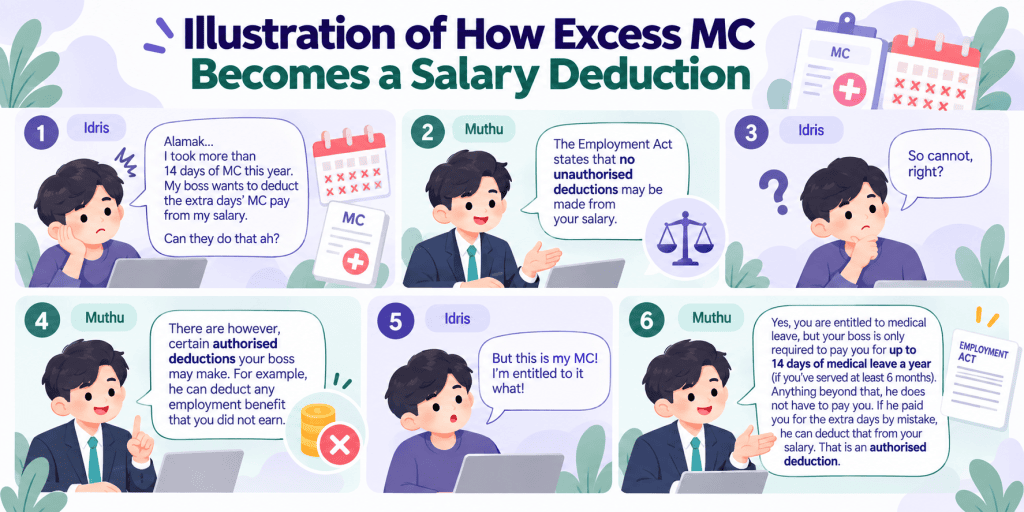
Idris: Eh Muthu, long time no see bro!
Muthu: Ya man! Why you look so stressed dei?
Idris: Alamak… I took more than 14 days of MC this year la. So, my boss want to deduct the extra days’ MC pay from my salary bro. Eh bro, you mama fella all good lawyer right? Tell me la, they can do that ah?
Muthu: Well, the Employment Act does state that no unauthorised deductions may be made from your salary.
Idris: So cannot, right?
Muthu: Relax, dei. Let me finish. There are however, certain authorised deductions your boss may make from your salary. For example, he can deduct from your salary, any employment benefit that you did not earn.
Idris: But this is my MC! I am entitled to it what!
Muthu: Yes, you are entitled to medical leave or even excess medical leave, but your boss is only required by the Employment Act to pay you for up to 14 days of medical leave a year, which is the full entitlement for employees who have served at least six months. Anything more than that, he does not have to pay you. And if he did pay you for the extra medical leave days accidentally, he can deduct that from your salary. That is an authorised deduction.
Idris: Wa, liddat mati la bro! But at least now you tell me, I know.
Muthu: No problem. This month no kopi money la! Remember, there are certain deductions in the Employment Act your boss is authorised to make! Go and read la, last time ask you to come law school with me, you don’t want!
To put a number on what Muthu is talking about: an employee covered by the Employment Act who has served at least three months is entitled to paid outpatient sick leave and paid hospitalisation leave. However, the entitlement is pro-rated according to the length of service until the employee has worked for six months. The full entitlement of up to 14 days of paid outpatient sick leave a year, or up to 60 days of paid hospitalisation leave a year, only applies once the employee has worked for six months or more (the 60 days already includes the 14 outpatient days, they are not stacked on top of each other).
Employees with three to six months of service get a pro-rated number of days based on their length of service, not the full 14 or 60 days. If Idris has served at least six months and has already used his full 14 outpatient days and takes more MC on top of that without being hospitalised, his employer is not required to pay for those extra days.
If the employer pays anyway and later realises the mistake, recovering that amount through a salary deduction is treated as recovery of an unearned benefit under Section 27, not an unauthorised deduction.
Also Read: Can Employers Reject Annual Leave Requests in Singapore?
Types of Authorised Salary Deductions
Beyond the MC scenario, the Employment Act allows a limited, specific list of deduction categories. Each comes with its own process and cap, summarised below.
| Authorised deduction | Legal basis | Cap or condition |
|---|---|---|
| Absence from work | Section 28, EA 1968 | Calculated proportionately to the period of absence |
| Damage or loss of company property (goods, tools, equipment, vehicles, money) | Section 29, EA 1968 | Up to 25% of one month’s salary, made only once, and only after an inquiry that gives the employee a chance to explain |
| Accommodation the employee has consented to in writing | Section 30, EA 1968; s 27(1)(d), EA 1968 (written consent) | Up to 25% of the salary period, combined with any deduction for amenities and services (not 25% each), and never more than the value supplied. Requires the employee’s written consent |
| Amenities and services approved by the Commissioner for Labour (e.g. childcare, recreational facilities) | Section 30, EA 1968; s 27(1)(e), EA 1968 (written consent) | Up to 25% of the salary period, combined with any deduction for accommodation (not 25% each). Requires the employee’s written consent. |
| Advances or loans from the employer | Section 31, EA 1968 | Each instalment capped at 25% of the salary period; advances repaid over no more than 12 months |
| Overpaid salary or unearned employment benefits (e.g. excess MC pay) | Section 27, EA 1968 | The full amount may be recovered |
| CPF contributions (employee’s share) | CPF Act 1953 | Statutory rate, deducted from the correct month’s salary |
| Payments to a registered co-operative society | Section 27, EA 1968 | Requires the employee’s written consent |
| Other items the employee consents to in writing | Section 27, EA 1968 | Must genuinely benefit the employee (this requirement comes from MOM guidance, not the Act); consent must be withdrawn by written notice |
How Much an Employer Can Deduct in Total
Even where several of the categories above apply at once, Section 32 caps the total deductions from a salary period at 50% of the employee’s total salary payable for that period. This overall cap excludes deductions for absence from work, recovery of advances, loans, overpaid salary or unearned benefits, and consented payments to a co-operative society, so those items can push actual take-home pay below 50% in a given month.
Another exception is the last salary payment. Under Section 32(2), the 50% cap does not apply to the last salary payment made when a contract of service is terminated or completed, and the employer may deduct the full amount owed against that final payment. The cap still applies to every earlier salary period.
Unauthorised Salary Deductions
Just as important as knowing what is allowed is knowing what is not. Poor performance, missed sales targets, or general “the company is unhappy with your work” are not valid grounds for a salary deduction under the Employment Act, no matter what the employment contract says.
- Deducting pay for underperformance, missed KPIs, or productivity shortfalls.
- Charging employees for tools, uniforms, or equipment the employer is required to provide.
- Deducting for cash register or till shortfalls, unless the loss of money for which the employee is required to account is directly attributable to the employee’s neglect or default (Section 27(1)(b), EA 1968). Even then, the deduction cannot exceed 25% of one month’s wages, and the employee must first be given an opportunity to show cause against the deduction before it is made (Section 29(1), EA 1968).
- Deducting the cost of mandatory training from salary. If the employee has signed a valid training bond agreeing to cover that cost, the employer’s right to repayment is a contractual right, not a statutory right to deduct. The employer must therefore demand repayment from the employee instead of recovering it out of the employee’s salary.
- Deducting “liquidated damages” or contractual penalty amounts that do not fall within an authorised category.
- For migrant workers specifically, deducting or recovering the foreign worker levy, security bond, medical insurance, repatriation costs, compulsory training, or work pass renewal fees. Employers of Work Permit, S Pass, and Employment Pass holders also need written consent and must notify MOM before reducing salary or introducing new deductions.
What to Do About an Unauthorised Deduction
If a deduction does not fit any of the categories above, or the process was not followed correctly (for example, no inquiry was held before a damage-related deduction), the employee can raise the matter with the Tripartite Alliance for Dispute Management. TADM mediates salary-related disputes before they proceed to the Employment Claims Tribunal (ECT), which can order repayment.
A few practical points on timing and limits matter here. An employee still with the company generally has one year from when the dispute arose to file a claim, while a former employee has six months from their last day of employment, and the amount that can be recovered is capped at one year’s worth of arrears counted back from the filing date.
Claims are currently capped at S$20,000, or S$30,000 where a union files on the employee’s behalf. Payslips, the employment contract, CPF statements, and any written correspondence about the deduction all help establish the claim.
For disputes that cannot be resolved through mediation, or where the amount or legal question is more complex, speaking with an employment lawyer before filing can help clarify whether the deduction was in fact authorised.
Also Read: Know Your Employee Rights in Singapore
Talk to an Employment Lawyer at RBN Chambers
Salary deduction disputes rarely come down to a single clause. Whether it involves excess MC, a damaged piece of equipment, or a deduction that was never explained, the outcome depends on whether the employer followed the specific process the Employment Act requires for that category of deduction, and whether the amount stayed within the legal cap.
If you are an employer trying to structure a deduction correctly, or an employee who believes a deduction from your pay was not authorised, Ramesh Bharani Nagaratnam and the employment disputes team at RBN Chambers can review the facts against the Employment Act and advise on the strongest path forward, whether that is a TADM claim, a response to one, or a broader dispute over your employment terms. Get in touch with RBN Chambers to discuss your situation.
Frequently Asked Questions
Can my employer deduct my salary if I take more than 14 days of MC?
Yes, but only for the portion beyond your paid entitlement, and only as recovery of an unearned benefit, not as a penalty. Employees with at least three months of service are entitled to paid outpatient sick leave and paid hospitalisation leave, but the number of days is pro-rated according to length of service until they have worked for six months. Once an employee has worked for six months or more, the full entitlement applies: up to 14 days of paid outpatient sick leave a year, or up to 60 days of paid hospitalisation leave a year (the 60 days includes the 14 outpatient days).
What is the maximum amount my employer can legally deduct from my salary?
As a general rule, total deductions cannot exceed 50% of your salary in one salary period. This cap excludes deductions for absence, recovery of advances or loans, overpaid salary, and consented co-operative society payments, and it does not apply to your last salary payment when your employment ends, whether through termination or completion of your contract.
Are CPF contributions considered a salary deduction?
Yes. Your share of CPF contributions is deducted from your monthly salary under the CPF Act and is one of the authorised deduction categories under the Employment Act.
Can my employer deduct my salary for being late to work?
Employers cannot impose an arbitrary “lateness fine.” Deductions must be calculated as absence from work under Section 28, proportionate to the actual time not worked, not as a flat penalty for tardiness.
What can I do if my employer makes an unauthorised deduction?
You can file a claim with the Tripartite Alliance for Dispute Management (TADM), which will mediate the dispute. If mediation does not resolve it, the matter can proceed to the Employment Claims Tribunal.

Delivering Solutions not just Answers to your legal disputes
We provide solutions to all our clients regardless of the scale or complexity of the cases. Let us know how we can help.
Contact UsAny information of a legal nature in this blog is given in good faith and has been derived from resources believed to be reliable and accurate. The author of the information contained herein this blog does not give any warranty or accept any responsibility arising in any way, including by reason of negligence for any errors or omissions herein. Readers should seek independent legal advice.