

Employment |
Salary in Lieu of Notice in Singapore: Legal Guide

If you have been told to leave immediately, or you want to resign without working out your notice, three questions matter. How much money changes hands, who pays whom, and can the other side refuse? In Singapore, the answers sit in your employment contract and the Employment Act 1968, and the rules apply to employers and employees alike.
The amount is only part of the picture. How it is calculated, whether CPF and income tax apply, and what a court will enforce when a notice period is unusually long all affect what you owe or receive. This guide explains each point from a legal perspective.
What Is Salary in Lieu of Notice?
Salary in lieu of notice, also called notice pay or payment in lieu of notice, is a sum equal to the salary an employee would have earned during the notice period. MOM explains that either the employer or the employee may end the contract without waiting for the notice period to run by paying the other party this amount.
The right runs both ways. An employer who wants an employee to stop work immediately pays the employee. An employee who wants to leave early pays the employer. It is the price of skipping notice, and it is not a severance or retrenchment benefit.
Salary in Lieu of Notice Under the Employment Act and Your Contract
The employment contract comes first. MOM states that where the contract specifies a notice period, the employee must either serve it or pay salary in lieu, and the length must be the same for employer and employee.
Section 11 of the Employment Act is the provision that allows either side to end the contract without notice by making this payment. Notice must be in writing, and neither side needs to give a reason for terminating with notice.
If the contract is silent, section 10 of the Employment Act supplies a default notice period based on length of service.
| Length of service | Default notice period |
|---|---|
| Less than 26 weeks | 1 day |
| 26 weeks to less than 2 years | 1 week |
| 2 years to less than 5 years | 2 weeks |
| 5 years or more | 4 weeks |
Notice can also be waived by mutual consent, which should be done in writing. When both sides waive, neither owes salary in lieu. Not every worker is covered by the Act, so check who is covered before relying on the statutory default.
Salary in Lieu Calculation
Salary in lieu is calculated at the gross rate of pay for the notice period not served. The steps below follow MOM’s daily salary formula.
Identify the gross rate of pay
- Includes basic pay and fixed allowances.
- Leaves out overtime pay, bonuses, annual wage supplement and travel, food and housing allowances.
- Your contract may define “salary” differently, so read the clause before assuming.
Calculate full months of notice
- One month of notice equals one month’s gross pay.
- Multiply for longer periods. At S$6,000 gross a month, three months’ salary in lieu is S$18,000.
Calculate part of a month
- Daily gross rate = (12 × monthly gross rate of pay) ÷ (52 × average days worked per week).
- Salary in lieu = daily rate × number of working days of notice not served.
- Example for S$5,000 a month on a five-day week: 12 × 5,000 ÷ 260 = S$230.77 a day. Two weeks of unserved notice (10 days) comes to S$2,307.70.
3 Months Salary in Lieu and Long Notice Clauses
Contracts for senior roles often require three or even six months’ notice. Courts treat these clauses as enforceable bargains. In Aerospace Solutions Enterprises Pte Ltd v Low Eng Wah (Liu Ronghua) [2026] SGMC 89, a manager on S$9,000 a month had a six-month notice clause but left after serving two.
The Magistrate’s Court ordered him to pay S$36,000, the four unserved months. It held that salary in lieu is a contractual debt rather than damages, so the employer did not have to prove loss. It also rejected the argument that six months was unreasonably long, because the clause bound both sides and either could pay in lieu.
The same case shows why variations should be in writing. The employee could not prove an oral agreement to shorten his notice.
CPF Contributions on Salary in Lieu of Notice
MOM states that CPF contributions are not required for salary in lieu of notice. This applies whether the employer pays the employee or the employee pays the employer. By contrast, salary earned while an employee is actually serving notice still attracts CPF, because the employee remains in employment until the last day.
Also Read: Workplace Injury Compensation Singapore: Limits & Claims
Is Salary in Lieu of Notice Taxable in Singapore?
Yes. Inland Revenue Authority of Singapore (IRAS) lists salary in lieu of notice paid by an employer as taxable income. It is not the same as compensation for loss of employment. IRAS treats genuine compensation for loss of employment as a non-taxable capital receipt, but it looks at the facts of each payment and not the label the employer uses.
| Payment | Income tax treatment |
|---|---|
| Salary in lieu of notice | Taxable |
| Gratuity for past service | Taxable |
| Compensation solely for loss of employment | Generally not taxable, depending on the facts |
Employers report notice pay under the gratuity, notice pay and ex-gratia item (item d3) of Form IR8A. Where a foreign employee is leaving Singapore, the payment is also relevant to tax clearance under Form IR21.
Salary in Lieu Notice Letter
A notice letter is the written record that fixes the last day of employment and the amount payable. It helps prevent later disputes about what was agreed. A sound letter should state:
- The employee’s name and the date of the letter.
- The contractual or statutory notice period, and the clause relied on.
- Which party is paying salary in lieu, and for how many days or months.
- The amount and how it was calculated, including the gross rate of pay used.
- The last day of employment.
- The breakdown of final pay, such as outstanding salary and unused leave.
For an employer-initiated termination, outstanding salary is generally due on the day of dismissal or, if that is not possible, within three working days. The employee should acknowledge receipt in writing.
Common Disputes Over Salary in Lieu of Notice
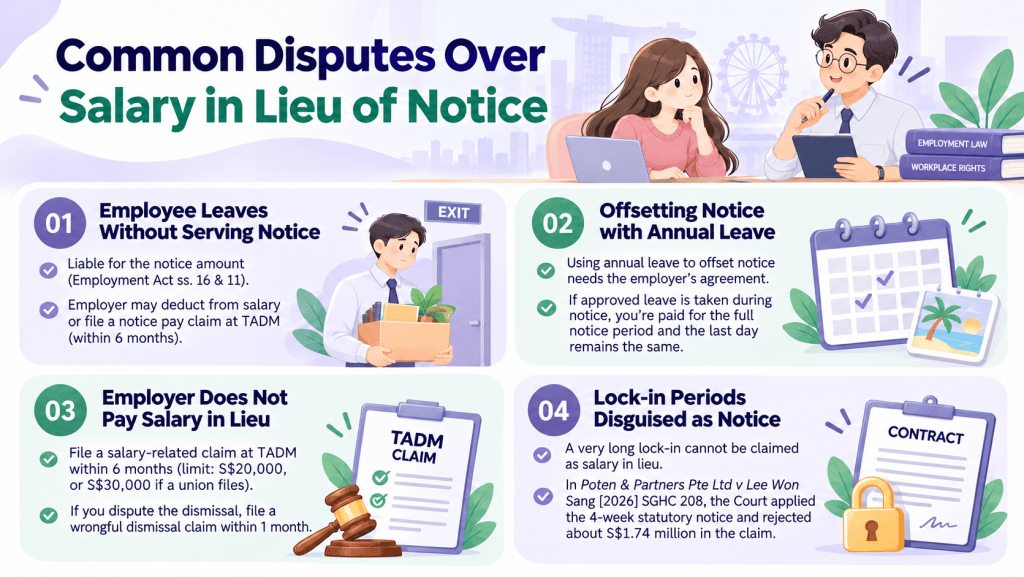
Employee leaves without serving notice
Section 16 of the Employment Act makes an employee who breaks the contract by leaving without notice liable for the amount payable under section 11. Under section 23(3), the employer may deduct that sum from salary due, subject to any court or Commissioner order. An employer can also file a notice pay claim at TADM within six months of the employee’s last day, provided the employee is covered by the Act.
Offsetting notice with annual leave
Using annual leave to cover part of the notice period needs the employer’s agreement. MOM states that if leave is used to offset notice, the last day is brought forward and the employee is paid only up to that day. Approved leave taken during the notice period is different. The employee is paid for the full notice period and the last day does not change.
Employer does not pay salary in lieu
An employee who does not dispute the dismissal but has not been paid can file a salary-related claim at Tripartite Alliance for Dispute Management (TADM) within six months of the last day of employment. The claim limit is S$20,000, or S$30,000 if a union files on the employee’s behalf. If the employee disputes the grounds of dismissal, a wrongful dismissal claim must be filed within one month of the last day of employment.
Lock-in periods disguised as notice
Employers sometimes tie a very long fixed term to a notice clause and then claim the balance as salary in lieu. In Poten & Partners Pte Ltd v Lee Won Sang [2026] SGHC 208, the employer claimed about S$1.74 million after a broker resigned during a lock-in running to 2029. The High Court refused. It applied the four-week statutory default because the clause provided no real notice period before the last six months, and it indicated that salary for the rest of the term would likely be an unenforceable penalty. Contracts should state a notice period that actually applies throughout the lock-in.
Also Read: Retrenchment in Singapore: Rights, Benefits and Legal Process
When Legal Advice on Salary in Lieu Becomes Necessary
Most notice pay questions can be settled by reading the contract and applying the formula. Legal advice is worth seeking when the clause is unusually long, when a lock-in or repayment term sits alongside the notice clause, or when the amount in dispute is high. Disputes about whether a termination was wrongful, or whether an allowance forms part of gross pay, are also better handled with a lawyer.
A lawyer can review your contract before you resign or terminate, assess whether a claimed sum is enforceable, and represent you at TADM, the Employment Claims Tribunals or in court.
Speak to RBN Chambers About Your Notice Pay Matter
RBN Chambers, led by Ramesh Bharani Nagaratnam, advises employers and employees on termination terms, notice periods and employment disputes in Singapore. Whether you need a notice clause reviewed or a notice pay claim defended or pursued, the team can set out your position clearly.
If you are facing a dispute over salary in lieu of notice, contact our lawyers to discuss your situation.
Frequently Asked Questions
Can an employer terminate me immediately by paying salary in lieu?
Yes, where the contract or section 11 of the Employment Act allows it, and no reason is required for termination with notice. Dismissal can still be wrongful if it is discriminatory or intended to deprive the employee of a benefit.
Does salary in lieu include bonuses and allowances?
It is calculated at the gross rate of pay, which generally excludes bonuses, overtime, annual wage supplement and travel, food and housing allowances. Check how your contract defines salary.
Can I use my annual leave to cover my notice period?
Only with your employer’s agreement. If agreed, your last day is brought forward and you are paid up to that day, and the leave used is not paid out.
Is CPF payable on salary in lieu of notice, and is it taxable?
CPF contributions are not required on salary in lieu of notice, but the payment is taxable income under IRAS’s treatment of lump sum payments.
What can I do if my employer does not pay salary in lieu?
If you do not dispute the dismissal, file a salary-related claim at TADM within six months of your last day. Keep your contract, termination letter and payslips ready.

Delivering Solutions not just Answers to your legal disputes
We provide solutions to all our clients regardless of the scale or complexity of the cases. Let us know how we can help.
Contact UsAny information of a legal nature in this blog is given in good faith and has been derived from resources believed to be reliable and accurate. The author of the information contained herein this blog does not give any warranty or accept any responsibility arising in any way, including by reason of negligence for any errors or omissions herein. Readers should seek independent legal advice.