

General |
What Makes a Contract Legally Binding in Singapore

Contracts are part of everyday life, from purchasing goods and services to signing employment and business agreements. However, not every agreement is automatically legally binding under Singapore law. To be enforceable, a contract must satisfy several legal requirements, including offer, acceptance, consideration, and the intention to create legal relations.
This guide explains what makes a contract legally binding in Singapore, the essential elements of contract formation, common factors that can affect enforceability, and when legal advice may be necessary.
What Is a Legally Binding Contract in Singapore?
A legally binding contract creates enforceable obligations. Courts in Singapore can require parties to perform or pay damages if terms are breached. Enforceability depends on specific elements being satisfied rather than on signatures alone.
Difference between an agreement and a contract
An agreement is a mutual understanding between parties. A contract is an agreement that meets all legal requirements and can be upheld by law. Not every agreement qualifies as a contract.
Essential Elements of a Contract in Singapore
For a contract to be legally binding in Singapore, six elements must generally be present. Each plays a distinct role in establishing whether an agreement can be enforced by law.
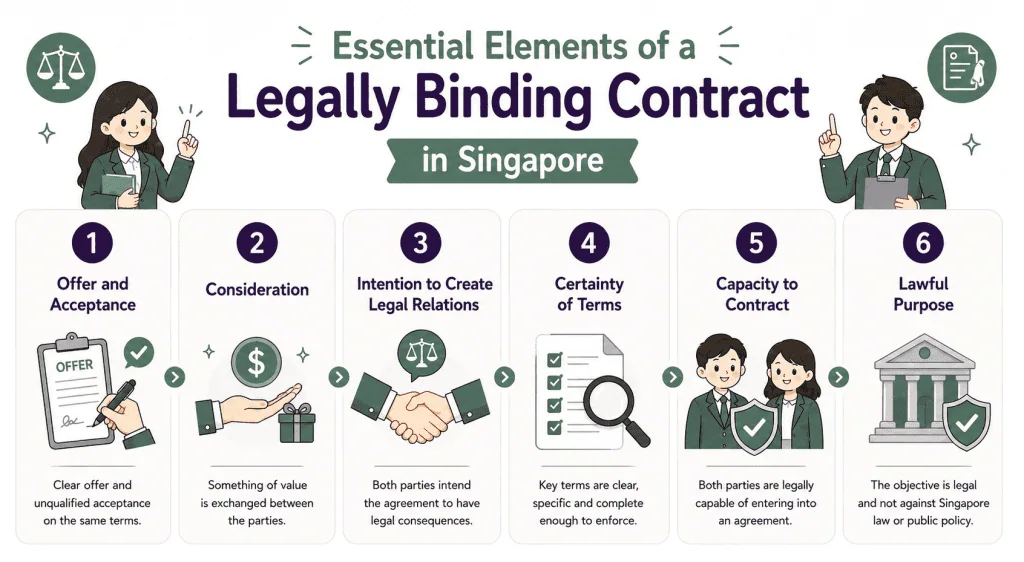
1. Offer and acceptance
is the foundation of any contract. One party must make a clear proposal, and the other must accept it without changes. Any modification to the offer is treated as a counter-offer, not an acceptance, and no binding contract arises until both sides agree on the same terms.
2. Consideration
refers to something of value exchanged between the parties — this can be money, goods, services, or even a promise to do or refrain from doing something. Without consideration, a promise is generally treated as a gift and cannot be enforced as a contract.
3. Intention to create legal relations
distinguishes enforceable contracts from casual or social arrangements. Courts generally presume this intention exists in commercial dealings, but not in domestic or social contexts unless clearly demonstrated.
4. Certainty of terms
requires that the key details of the agreement — such as price, scope of work, and timelines — are defined clearly enough for both parties and the courts to understand their obligations. Vague or incomplete terms can prevent a contract from being enforceable.
5. Capacity to contract
means both parties must be legally capable of entering into an agreement. This generally means they must be adults (18 years and above) of sound mind and not under any legal disability that would restrict their ability to contract.
6. Lawful purpose
ensures the contract’s objective does not violate any Singapore statute or public policy. Any agreement formed for an illegal purpose is void from the outset, regardless of whether the other elements are met.
| Element | Why It Matters |
|---|---|
| Offer and acceptance | Establishes mutual consent to the same bargain |
| Consideration | Prevents one-sided promises from being enforced |
| Intention to create legal relations | Separates social promises from legal obligations |
| Certainty of terms | Allows courts to enforce the exact duties agreed |
| Capacity to contract | Protects vulnerable individuals from unfair commitments |
| Lawful purpose | Invalidates deals involving illegal activities |
Contract Formation Rules in Singapore
When an agreement becomes binding
Binding occurs once offer, acceptance, consideration and intention align with certainty. Communication of acceptance is usually required, and the moment of formation determines when obligations start.
Written and oral contracts
Many contracts are valid whether written or oral. Written records simply make proof easier if disagreements occur later.
Electronic signatures and online agreements
Electronic signatures and click-wrap agreements can satisfy formation rules when they demonstrate clear consent and meet technical reliability standards.
Contract signing requirements
Signing is not mandatory for all contracts but provides strong evidence of acceptance. Parties should ensure terms are read and understood before signing.
Also Read: Contract Drafting Checklist Singapore: Essential Legal Guide
What Can Make a Contract Void or Voidable?
A contract may be either void or voidable depending on the circumstances.
- Void Contracts
A void contract is invalid from the outset and has no legal effect. For example, an agreement to engage in unlawful activity would generally be void.
- Voidable Contracts
A voidable contract is initially valid but may be cancelled by the affected party under certain circumstances.
- Misrepresentation
If one party enters into a contract based on false statements made by another party, they may be entitled to rescind the agreement or seek damages.
- Duress, Mistake, and Undue Influence
Contracts entered into because of threats, improper pressure, or fundamental mistakes may be challenged and potentially set aside.
- Unlawful or Impossible Terms
A contract may be void if its terms are illegal or impossible to perform.
How to Tell If a Contract May Be Enforceable
Several issues can affect whether a contract holds up legally in Singapore. Understanding these warning signs helps parties assess their agreements before disputes arise.
Unclear or missing terms
put the certainty of a contract in doubt. If key details such as price, deliverables, or timelines are vague or left out entirely, courts may struggle to determine what each party actually agreed to — making the contract difficult or impossible to enforce.
Lack of consideration
is one of the most common reasons a promise fails to qualify as a contract. If one party is not giving anything of value in return, the agreement may be treated as a gratuitous promise rather than a binding obligation.
No intention to be legal
means the agreement may be viewed as informal only. This often arises in family or social arrangements where neither party intended for the courts to get involved. Without a clear intention to create legal relations, no enforceable contract exists.
One party lacking capacity
leaves the contract open to challenge at a later stage. If one party was a minor, of unsound mind, or under a legal disability at the time of signing, the affected party may have grounds to void the agreement.
Signs of pressure or mistake
go to the heart of valid consent. If a party entered the contract under duress, undue influence, or based on a fundamental error — whether about the nature of the contract or a material fact — they may be entitled to rescind it.
| Issue | What It May Affect |
|---|---|
| Unclear or missing terms | Certainty of terms |
| Lack of consideration | Consideration requirement |
| No intention to be legal | Intention to create legal relations |
| One party lacks capacity | Capacity to contract |
| Signs of pressure or mistake | Consent and validity |
Common signs of valid contract formation
- Clear offer and unqualified acceptance.
- Exchange of value between parties.
- Explicit or implied intention for legal effect.
- Precise and complete terms.
- Both parties have legal capacity.
- Purpose is lawful.
Common red flags
- Vague or contradictory wording.
- Absence of any exchange.
- Informal setting suggesting no legal intent.
- One party is a minor or impaired.
- Evidence of misrepresentation or coercion.
Why Legally Binding Contracts Matter in Singapore
Whether you are entering a business deal, signing a service agreement, or formalising a property transaction, having a legally binding contract in place is one of the most important steps you can take to protect your interests.
- Legal Protection
A properly formed contract gives you the right to seek remedies in court if the other party fails to fulfil their obligations — whether through specific performance, damages, or other relief available under Singapore law. - Clarity and Certainty
Clear and enforceable terms reduce the risk of misunderstandings between parties. When everyone knows exactly what they have agreed to, disputes are less likely to arise in the first place. - Business Relationships
Contracts establish a framework of mutual expectations between partners, clients, and suppliers. This foundation of trust and accountability supports stronger, longer-lasting professional relationships. - Compliance
A legally binding contract ensures that your agreement aligns with Singapore’s statutory requirements — reducing the risk of your deal being declared void or unenforceable on technical grounds.
When to See a Lawyer
- Unclear terms or disputed agreements: Seek advice promptly when wording is ambiguous or parties disagree on meaning.
- High-value, employment, business, or property contracts: Complex or high-stakes agreements warrant review before signing to identify hidden risks.
- Suspected misrepresentation or invalid consent: Professional assessment helps determine if grounds exist to challenge or withdraw from the contract.
Also Read: Frustration of Contract in Singapore: Comprehensive Guide
Prevention or Management
How to reduce contract disputes before signing
Read all terms fully, confirm understanding with the other party, and record key points in writing. Use plain language where possible.
Keep records and confirm terms clearly
Retain copies of all communications and signed documents. Written confirmation emails after verbal discussions can help establish evidence.
Drafting a Legally Binding Contract With RBN Chambers
Knowing what makes a contract legally binding is one thing, ensuring your agreements actually meet every requirement under Singapore law is another. The difference between a valid contract and an unenforceable one often comes down to how terms are drafted, whether consideration is properly structured, and whether consent was freely and clearly given from the outset.
If you need professional guidance on contract formation, review, or an assessment of whether your agreement is enforceable, the team at RBN Chambers is ready to help you protect your interests with clear, legally sound contracts tailored to Singapore law. Contact us here!
Frequently Asked Questions
What are the essential elements of a legally binding contract in Singapore?
A contract usually needs offer, acceptance, consideration, and intention to create legal relations. The terms also need to be clear, and both sides must have capacity to agree.
Can a contract still be binding if it is not in writing?
Some contracts can be binding even if they are oral or informal. In practice, written terms often make it easier to prove what was agreed.
What is the difference between a void and voidable contract?
A void contract is not legally valid from the start. A voidable contract may still be valid unless one party challenges it because of issues like misrepresentation or pressure.
Is every signed document automatically a legally binding contract?
Not always. A signature can be important, but a binding contract still depends on the legal elements being present and the terms being clear.
When should I seek legal advice about a contract?
It may be useful if the terms are unclear, the contract is high-value, or there is a dispute about consent, misrepresentation, or enforceability.

Delivering Solutions not just Answers to your legal disputes
We provide solutions to all our clients regardless of the scale or complexity of the cases. Let us know how we can help.
Contact UsAny information of a legal nature in this blog is given in good faith and has been derived from resources believed to be reliable and accurate. The author of the information contained herein this blog does not give any warranty or accept any responsibility arising in any way, including by reason of negligence for any errors or omissions herein. Readers should seek independent legal advice.