

General |
Defamation, Slander & Libel Laws in Singapore

Imagine someone spreading a false, damaging claim about you, a WhatsApp message accusing you of theft, a one-star Google review calling your business fraudulent, or a rumour repeated at the office pantry. Whether the words are spoken once in passing or posted where thousands can see them, the harm to your reputation can be immediate and lasting.
Singapore takes reputational harm seriously, and the law responds differently depending on whether a statement was spoken, written, or shared online. Understanding the difference between slander and libel, and what your options are, is the first step to protecting your good name.
Defamation, Slander and Libel in Singapore Law
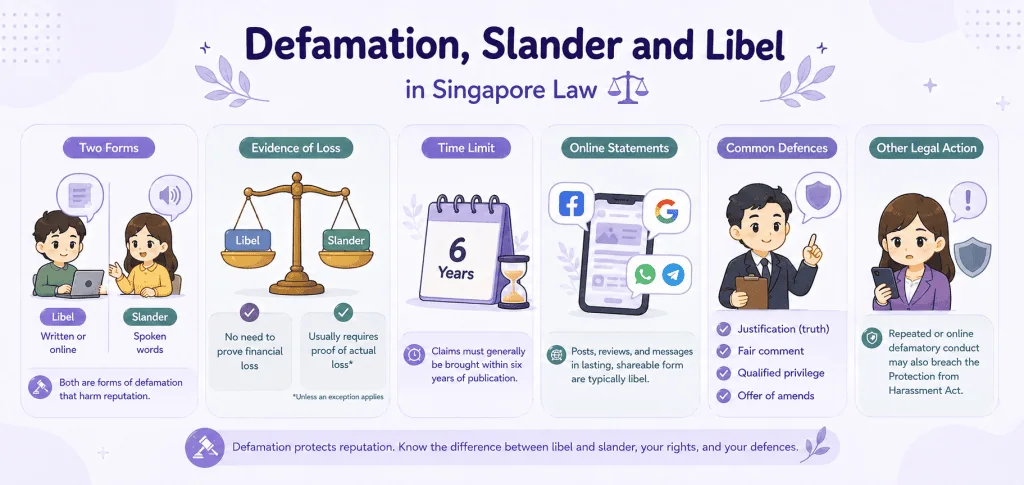
Defamation covers false statements that damage a person’s or a company’s reputation, and Singapore law recognises two forms of it: libel, a statement in written or otherwise permanent form, and slander, a statement that is spoken or otherwise transient.
Both are governed primarily by the Defamation Act 1957 together with common law principles developed by the Singapore courts. Here’s what this guide covers.
- Libel (written or online statements) is actionable without proving financial loss, while slander (spoken words) usually requires proof of actual loss, unless it falls into a small set of exceptions
- Both libel and slander claims must generally be brought within six years of publication under the Limitation Act
- Facebook posts, Google reviews, and WhatsApp or Telegram messages are typically treated as libel because they exist in a lasting, shareable form
- Common defences include justification (truth), fair comment, qualified privilege, and an offer of amends
- Defamatory conduct that is repeated or online may also fall within the Protection from Harassment Act, separately from a defamation claim
- RBN Chambers advises on assessing claims, sending letters of demand, and pursuing settlement or litigation where necessary
What Constitutes Defamation?
A statement is defamatory if it lowers the claimant’s reputation in the eyes of right-thinking members of society, or exposes them to hatred, contempt or ridicule. To be actionable, the statement must clearly refer to the claimant and must have been published to at least one person other than the claimant.
It must also be presented as fact rather than mere opinion, though an unsubstantiated “opinion” with no factual basis can still be treated as defamatory if it damages someone’s standing.
Most people protecting their reputation in Singapore pursue a civil claim under the Defamation Act and the tort of defamation, which is the focus of this guide.
Separately, Singapore’s criminal law also recognises defamation as an offence under sections 499 and 500 of the Penal Code, though criminal prosecution is comparatively rare and depends on proof of intent or knowledge that the statement would harm the victim’s reputation.
Also Read: What Is Arbitration? Resolving Disputes in Singapore
Libel vs Slander in Singapore
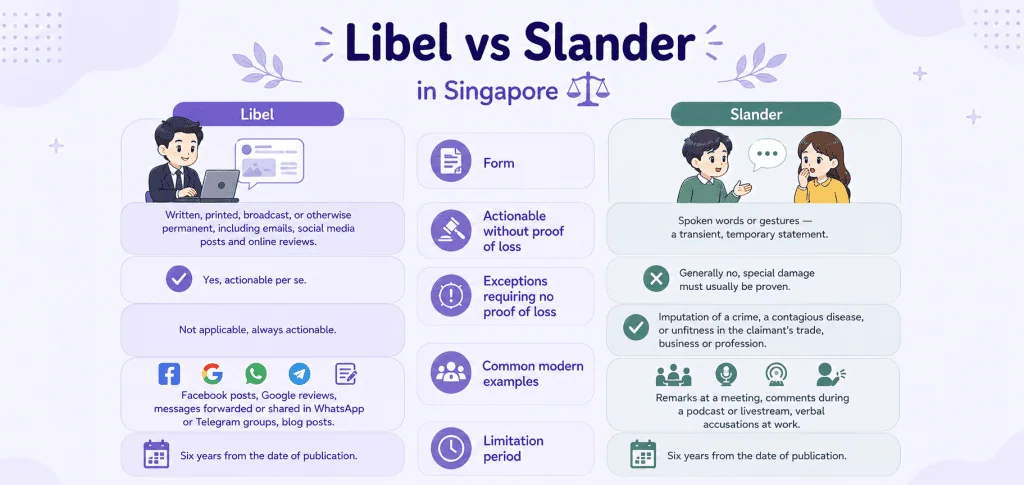
Although libel and slander are both forms of defamation, Singapore law treats them differently in one important respect: whether the claimant has to prove actual loss. The table below sets out the key distinctions.
| Aspect | Libel | Slander |
|---|---|---|
| Form | Written, printed, broadcast, or otherwise permanent, including emails, social media posts and online reviews | Spoken words or gestures — a transient, temporary statement |
| Actionable without proof of loss | Yes, actionable per se | Generally no, special damage must usually be proven |
| Exceptions requiring no proof of loss | Not applicable, always actionable | Imputation of a crime, a contagious disease, or unfitness in the claimant’s trade, business or profession |
| Common modern examples | Facebook posts, Google reviews, messages forwarded or shared in WhatsApp or Telegram groups, blog posts | Remarks at a meeting, comments during a podcast or livestream, verbal accusations at work |
| Limitation period | Six years from the date of publication | Six years from the date of publication |
Because a written or recorded statement is treated as libel, disputes involving Facebook, Instagram, Google reviews and even WhatsApp messages usually fall on the libel side of the line rather than slander, since they leave a permanent record.
This matters in practice, because a libel claim generally does not require the claimant to prove specific financial loss, unlike many slander claims.
Establishing a Claim for Slander or Libel
Whether you’re pursuing a claim in libel or slander, Singapore courts generally look for the same core elements, with slander carrying one additional requirement in most cases.
- Defamatory statement. The words must lower the claimant’s reputation in the eyes of right-thinking members of society, or expose them to hatred, contempt or ridicule.
- Reference to the claimant. The statement must clearly identify, or be reasonably understood to refer to, the person or company bringing the claim.
- Publication to a third party. The statement must be communicated to at least one person other than the claimant.
- Special damage (slander only, with exceptions). For most slander claims, the claimant must show actual loss, such as financial loss or loss of employment, unless the statement imputes a crime, a contagious disease, or unfitness in the claimant’s trade, business or profession.
A defendant who cannot justify the statement as substantially true, or rely on another defence, may be found liable for damages.
Common Scenarios Where Slander and Libel Happen
Defamation arises in everyday situations more often than people expect, and increasingly online.
| Scenario | What Typically Happens |
|---|---|
| Workplace gossip | A colleague falsely accuses someone of dishonesty or misconduct |
| Business competition | A rival spreads unfounded rumours to damage another business’s reputation |
| Online reviews and social media | A Facebook post, Google review, or Instagram comment falsely accuses a person or business of wrongdoing |
| WhatsApp or Telegram groups | A message accusing someone of misconduct is sent to a group chat or forwarded on |
| Personal disputes | False accusations made in social settings harm a person’s standing among peers |
| Public speaking or livestreams | Defamatory claims are made during speeches, podcasts, webinars or meetings |
Even informal or offhand remarks may amount to slander or libel if they unjustly harm someone’s reputation.
Defamation Defences and Responsible Expression
A person accused of defamation in Singapore has several defences available, and understanding them also helps explain what responsible expression looks like.
- Justification (truth). Under section 8 of the Defamation Act, a statement that is substantially true is not actionable, though the person who made the statement carries the burden of proving it.
- Fair comment. An honestly held opinion on a matter of public interest, based on facts that are true or protected by privilege, is generally protected.
- Qualified privilege. Statements made in certain relationships or contexts, such as an employment reference or a fair report of court or parliamentary proceedings, may be protected unless made with malice.
- Absolute privilege. Statements made in Parliament or in the course of judicial proceedings are immune from suit.
- Offer of amends. A person accused of defamation can formally apologise and correct the record; if the claimant accepts, this can resolve the dispute without a full trial.
To stay on the right side of the law, verify information before repeating it, rely on credible sources, and separate opinion clearly from fact. In an age where content spreads through AI and social media within minutes, taking a moment to check accuracy before sharing can prevent an offhand remark from becoming a costly dispute.
Online Defamation on Social Media and WhatsApp
A Facebook post, Google review, Instagram comment, or a message shared in a WhatsApp or Telegram group can amount to libel because it exists in a permanent, shareable form. A single WhatsApp message sent to even one other person may satisfy the “publication to a third party” requirement, particularly if it is later forwarded or screenshotted.
The reach of a platform affects how damages are assessed rather than whether a claim can be brought at all. A post seen by thousands will usually attract higher damages than the same words said to one person in private, but both can be actionable in principle.
Forwarding or resharing someone else’s defamatory post can also carry liability, since republishing a statement is generally treated as a fresh publication.
Defamation and the Protection from Harassment Act
A defamatory statement made online, or repeated as part of a pattern of conduct, may also fall within the Protection from Harassment Act 2014 (POHA), which is separate legislation from the Defamation Act. The two can overlap, but the remedies aren’t identical.
- POHA allows a victim to apply for a Protection Order or an Expedited Protection Order, including orders requiring offending content to be taken down or corrected
- POHA does not require the same reputational threshold as a defamation claim, and interim relief can sometimes be obtained faster
- A defamation claim generally focuses on compensating reputational harm through damages, while POHA is oriented toward stopping the conduct and providing broader protection against harassment
- Depending on the facts, the two routes can sometimes be pursued together
Which route, or combination of routes, makes sense depends on the specific facts of the case, including whether the conduct is ongoing and whether monetary compensation or a quicker stop to the behaviour matters more.
Also Read: What Is an Originating Claim in Singapore?
Cost and Time Limits for Suing for Defamation in Singapore
Civil defamation claims in Singapore are brought in the State Courts or the High Court depending on the value of the claim, and legal costs vary with how far the matter proceeds. Many disputes are resolved at the letter of demand stage, while a contested claim that goes to trial can take considerably longer and cost significantly more.
The court can review, or “tax,” a lawyer’s bill if it appears excessive, but as with most civil litigation, costs generally rise with the length and complexity of the dispute.
Under the Limitation Act, a civil claim for defamation or malicious falsehood must generally be brought within six years from the date the statement was published.
After this period, the right to sue is normally lost, even if the statement is discovered later. Because evidence such as screenshots, message metadata and witness recollection can degrade over time, addressing a defamatory statement sooner rather than later strengthens both the chances of an early resolution and, if needed, a later court claim.
Why Early Legal Advice Matters in Defamation Cases
Many victims adopt a wait-and-see approach, hoping damaging statements will naturally dissipate. This strategy often proves counterproductive. Swift legal consultation offers several advantages that can significantly affect the outcome.
Evidence preservation becomes critical as time passes. Witness recollections fade, messages get deleted, and circumstances change in ways that make reconstructing the facts difficult. Early action helps secure proof while it remains available and reliable.
A proper legal assessment also clarifies whether reputational or financial harm can be documented, and whether your situation meets the threshold for a successful claim. Timely intervention through a formal letter of demand or a request for retraction can produce results quickly, often deterring continued defamatory statements and securing an apology without the need for full litigation.
How RBN Chambers Can Help with Defamation, Slander and Libel Claims
At RBN Chambers, we understand how distressing it is to suffer reputational harm from false statements, whether they were said in a meeting, posted online, or shared in a group chat.
Led by Ramesh Bharani Nagaratnam, our team provides clear, strategic advice on assessing defamation, slander and libel claims, gathering evidence, sending letters of demand, negotiating settlements, and pursuing civil litigation where necessary.
If you believe you’ve been the victim of a false and damaging statement, whether spoken, written, or posted online, contact RBN Chambers to explore your legal options and take the first step toward defending your reputation.
Frequently Asked Questions
What is the difference between slander and libel?
The distinction lies in the medium. Slander involves spoken false statements, while libel concerns written or otherwise permanently recorded defamatory content.
Can I sue someone for slander even if the statement was made casually?
Yes. Slander claims can proceed regardless of whether the speaker considered their statement casual or insignificant, provided the legal elements are satisfied—the statement was false, communicated to others, and damaged your reputation.
Do I need to prove financial loss to sue for slander?
In many cases, yes—unless the false statement accuses you of a crime, disease, professional misconduct, or similar serious matters.
What if the person apologises?
An apology can help mitigate damages, but it does not erase the harm done to your reputation. You may still have the right to claim compensation.
How can RBN Chambers assist with slander cases?
We help assess your situation, gather evidence, draft letters of demand and represent you if formal legal action is necessary.
Delivering Solutions not just Answers to your legal disputes
We provide solutions to all our clients regardless of the scale or complexity of the cases. Let us know how we can help.
Contact UsAny information of a legal nature in this blog is given in good faith and has been derived from resources believed to be reliable and accurate. The author of the information contained herein this blog does not give any warranty or accept any responsibility arising in any way, including by reason of negligence for any errors or omissions herein. Readers should seek independent legal advice.