

General |
What Is an Originating Claim in Singapore?

An Originating Claim (OC) is the document used to start a civil lawsuit in the Singapore courts when the facts of the dispute are contested.
It is addressed to the defendant, notifies them that legal proceedings have begun, and is generally filed together with a Statement of Claim, which sets out the facts the claimant relies on.
Under the Rules of Court 2021 (ROC 2021), which took effect on 1 April 2022, the Originating Claim replaced what was previously known as the Writ of Summons.
When You Need to File an Originating Claim
You should file an Originating Claim if your case involves a material dispute of fact, meaning the parties disagree on what actually happened, not just on how the law applies.
This covers most contract and tort claims, including breach of contract, negligence, fraud, misrepresentation, and defamation. It also applies to personal injury and death claims arising from accidents or negligence, intellectual property infringement claims, and admiralty or shipping actions.
If your dispute is instead about interpreting a written document or a point of law where the facts aren’t seriously contested, an Originating Application is typically the more appropriate route. Should a factual dispute emerge later in an Originating Application, the case can be converted into an Originating Claim.
Originating Claim vs Originating Application
| Key Difference | Originating Claim | Originating Application |
|---|---|---|
| Used when | There’s a material dispute of fact | The dispute mainly concerns law or interpretation of a document |
| Supporting document | Statement of Claim | Supporting affidavit |
| Typical cases | Contract, tort, personal injury, IP, admiralty | Statutory applications, construction of documents, matters with limited factual dispute |
| Process | Involves pleadings and, often, a trial | Generally faster, decided on affidavit evidence |
How to File an Originating Claim in Singapore
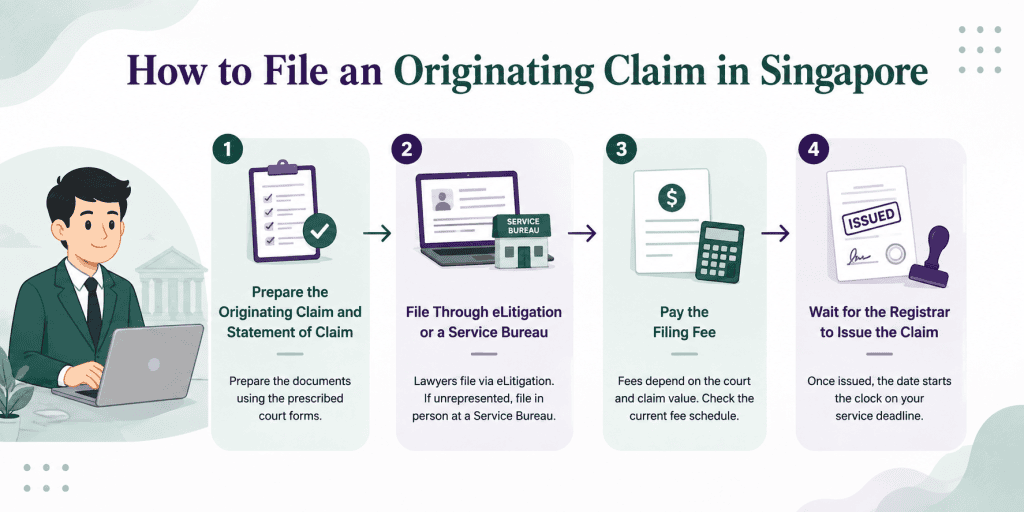
1. Prepare the Originating Claim and Statement of Claim
Before filing, you’ll need to prepare the Originating Claim together with the Statement of Claim, which sets out the material facts supporting your case. These are drafted using the prescribed court forms and should clearly identify the parties, the basis of the claim, and the relief you’re seeking.
2. File Through eLitigation or a Service Bureau
If you’re represented, your lawyer files the Originating Claim and Statement of Claim through eLitigation, the online platform used by law firms. If you’re unrepresented, you’ll need to file in person at a LawNet & CrimsonLogic Service Bureau, where staff will help prepare the filing based on the forms you complete.
3. Pay the Filing Fee
Filing fees depend on the court hearing your claim and the value of the claim, so it’s worth checking the current court fee schedule before filing.
4. Wait for the Registrar to Issue the Claim
Once the Registrar accepts, signs, seals, and dates your Originating Claim, it is officially issued, and this date starts the clock on your service deadline.
Time Limits Under the Limitation Act
Before filing, check that your claim falls within the applicable limitation period. These are general guidelines only; the Limitation Act sets out the specifics.
| Type of Action | Time Limit |
|---|---|
| Contract | 6 years |
| Tort | 6 years |
| Personal injury | 3 years |
| Recovery of land and rent | 12 years |
Serving the Originating Claim on the Defendant
Once issued, you’re expected to take reasonable steps to serve the Originating Claim and Statement of Claim within 14 days if the defendant is in Singapore, or 28 days if they’re overseas.
This is a separate, tighter deadline from the 3-month validity period, and it’s a common trap for self-represented claimants who assume they have the full 3 months before needing to act. The court can dismiss an action if it isn’t satisfied that the claimant took reasonable steps to serve promptly, so treating service as urgent from the day of issue matters.
Also Read: What Makes a Contract Legally Binding in Singapore
Extending the Validity of an Originating Claim
An Originating Claim is valid for service for 3 months from its date of issue, regardless of whether service happens in or out of Singapore. If it can’t be served within that window, whether before or after it expires, the claimant can apply to the court for an extension. The extension takes effect the day after the original expiry date, and except in special cases, the court will only grant it twice, for up to 3 months each time.
“Special cases” generally cover situations where the court considers an extension necessary to ensure justice is done or to prevent abuse of the court’s process, such as genuine difficulty locating or serving a defendant.
Where a defendant needs to be served outside Singapore, claimants are generally expected to apply for the extension and for approval to serve out of jurisdiction together, and to ask for a period that realistically matches how long service is likely to take. Letting the validity period lapse without applying for an extension in time can mean having to start the filing process over.
Common Mistakes When Filing an Originating Claim
A few recurring issues can delay or derail an Originating Claim before it even reaches a hearing.
- Filing the wrong originating process. Choosing an Originating Application when the facts are genuinely disputed, or vice versa, can mean refiling or converting the claim partway through.
- Treating the 3-month validity as the service deadline. As above, reasonable steps to serve must generally be taken within 14 or 28 days, well before the 3-month mark.
- Incomplete or incorrect forms. Missing information, using outdated forms, or errors in the Statement of Claim are common reasons for a claim to be rejected or queried by the court.
- Missing the limitation period. Filing after the relevant limitation period under the Limitation Act has expired can bar the claim entirely, regardless of its merits.
- Improper service. Service that doesn’t meet the personal or substituted service requirements can be challenged by the defendant, sometimes forcing the claimant to serve the claim again.
What Happens After the Originating Claim Is Served
Once served, the defendant must file and serve a Notice of Intention to Contest or Not Contest within 14 days (if served in Singapore) or 21 days (if served overseas) of receiving the Statement of Claim. If they intend to contest the claim, they must then file and serve their Defence within 21 days (Singapore) or 5 weeks (overseas) of the Statement of Claim being served.
If the defendant does not respond within these timeframes, or files a notice stating they don’t intend to contest, the claimant may apply for default judgment.
The Simplified Civil Process for Smaller Claims
Cases begun by an Originating Claim in the Magistrate’s Court, where the claim doesn’t exceed S$60,000, are automatically handled under the simplified civil process. District Court cases can also use this process if both parties consent.
The simplified process front-loads document production, uses more active case management, and moves unresolved disputes toward a simplified trial rather than the standard litigation track.
Also Read: Letter of Demand Singapore: How to Send or Respond
Getting Help with an Originating Claim at RBN Chambers
Filing an Originating Claim is only the first step in a civil dispute, and getting the material facts, timelines, and supporting documents right early on can shape how the rest of the case unfolds. Missteps in service or filing can delay a claim or, in some cases, put it at risk of dismissal.
If you’re considering commencing legal proceedings in Singapore, or need to respond to an Originating Claim served on you, Ramesh Bharani Nagaratnam and the team at RBN Chambers can advise on the right course of action. Contact us to discuss your case.
Frequently Asked Questions
How long do I have to serve an Originating Claim?
You should take reasonable steps to serve it within 14 days if the defendant is in Singapore, or 28 days if they’re overseas. The Originating Claim itself stays valid for service for 3 months from its date of issue.
Can I extend the validity of an Originating Claim if I can’t serve it in time?
Yes. You can apply to the court for an extension before or after the claim expires. Except in special cases, the court will generally only grant this twice, for up to 3 months each time.
What documents must accompany an Originating Claim?
An Originating Claim is generally filed together with a Statement of Claim, which sets out the material facts supporting the claim. Both are typically drafted using the prescribed court forms.
What happens if I file the wrong originating process?
If the facts turn out to be more disputed than expected, an Originating Application can generally be converted into an Originating Claim. Choosing incorrectly at the outset can still cause delays, which is one reason it’s worth getting legal advice before filing.
What happens if the defendant does not respond to an Originating Claim?
If the defendant fails to file a Notice of Intention to Contest or Not Contest, or fails to file a Defence within the required timeframe, the claimant may apply to the court for a default judgment.

Delivering Solutions not just Answers to your legal disputes
We provide solutions to all our clients regardless of the scale or complexity of the cases. Let us know how we can help.
Contact UsAny information of a legal nature in this blog is given in good faith and has been derived from resources believed to be reliable and accurate. The author of the information contained herein this blog does not give any warranty or accept any responsibility arising in any way, including by reason of negligence for any errors or omissions herein. Readers should seek independent legal advice.