

Business |
Director Fees, Bonuses & Remuneration in Singapore: What You Need to Know

When it comes to running a company, director compensation is more than just a pay package—it reflects the company’s approach to corporate governance, performance, and transparency. In Singapore, understanding the legal framework surrounding director fees, bonuses, and remuneration is essential to ensure that directors are fairly compensated while maintaining accountability to shareholders.
Director compensation can take various forms, including fixed fees for non-executive directors, performance-based bonuses for executive directors, and comprehensive remuneration packages. Let’s break down the legal considerations and best practices for handling director compensation in Singapore.
Director Fees in Singapore
A director’s fee is a payment made to someone for holding the office of director, separate from any salary paid for day-to-day employment duties. It is the standard form of compensation for non-executive directors, though director-shareholders in private companies often combine a fee with a salary and dividends. Directors have no automatic right to be paid for their directorial services; a company only pays fees if its shareholders agree to it.
This guide covers:
- Shareholder approval requirements for director fees under Section 169
- Whether director fees attract CPF contributions
- How director fees are taxed, including rules for non-resident directors
- Nominee director fees and typical cost ranges
- How director fees compare with salary and dividends
- Bonuses, remuneration committees, and disclosure practice
Director Fees and Shareholder Approval
Under Section 169 of the Companies Act 1967, a company cannot pay or increase a director’s fee unless the payment is approved by a resolution passed at a general meeting, and that resolution must deal with director’s fees only, not bundled together with other business. A resolution that breaches this requirement is void, which means fees paid without proper approval are technically invalid, even if the company has already transferred the money.
This requirement applies regardless of company size. Even a company with a sole shareholder who is also the sole director still needs a members’ resolution on record; the process is simpler, but the paperwork is not optional.
How director fees get approved
- The board proposes a fee amount or formula, for example a fixed sum per director per year.
- The proposal is tabled as a standalone resolution at an AGM, an EGM, or by written resolution for a private company.
- Members pass an ordinary resolution approving the fee.
- The approval and amount are recorded in the company’s minutes and register.
- Payment can then proceed for the period the resolution covers.
A director’s salary, by contrast, is paid for employment duties under a contract of service and does not need this shareholder approval; the board of directors can approve it on its own.
Director Fees and CPF Contributions
Director fees are not classified as wages, so they do not attract CPF contributions, regardless of the director’s citizenship or residency status. This is one of the main reasons director-shareholders in Singapore structure part of their compensation as fees rather than salary.
CPF only becomes payable where a director is also engaged under a genuine contract of service and paid a salary for that employment role. In that case, the salary portion attracts CPF at the standard rates for Singapore Citizens and Permanent Residents.
Labelling ordinary employment income as a “director’s fee” to avoid CPF does not change its legal character; what matters is whether the payment is genuinely for holding office as director and has been properly approved under Section 169, not what the payment is called in the company’s books.
Also Read: How to Legally Start a Business in Singapore (2026)
How Director Fees Are Taxed
Director fees are taxable as income in the year the director becomes legally entitled to the fee, which is not always the year the underlying service was performed. If fees for financial year 2025 are only approved at an AGM held in April 2026, the fee is generally taxed in the year of assessment following that approval, not the year the director actually sat on the board.
Tax treatment also differs by residency:
- Singapore tax resident directors are taxed on director fees together with their other income, at the prevailing progressive personal income tax rates.
- Non-resident directors, generally those who spend fewer than 183 days in Singapore in the relevant year, are subject to a flat withholding tax, currently 24%, unless a Double Taxation Agreement between Singapore and the director’s home country provides for a reduced rate.
- Fees from a company with no presence in Singapore are generally not taxable here, even if board meetings are occasionally held locally; only the portion tied to duties actually carried out in Singapore is taxed.
For the full mechanics, including worked examples, the IRAS guide on the tax treatment of director’s fees is the authoritative reference.
Nominee Director Fees
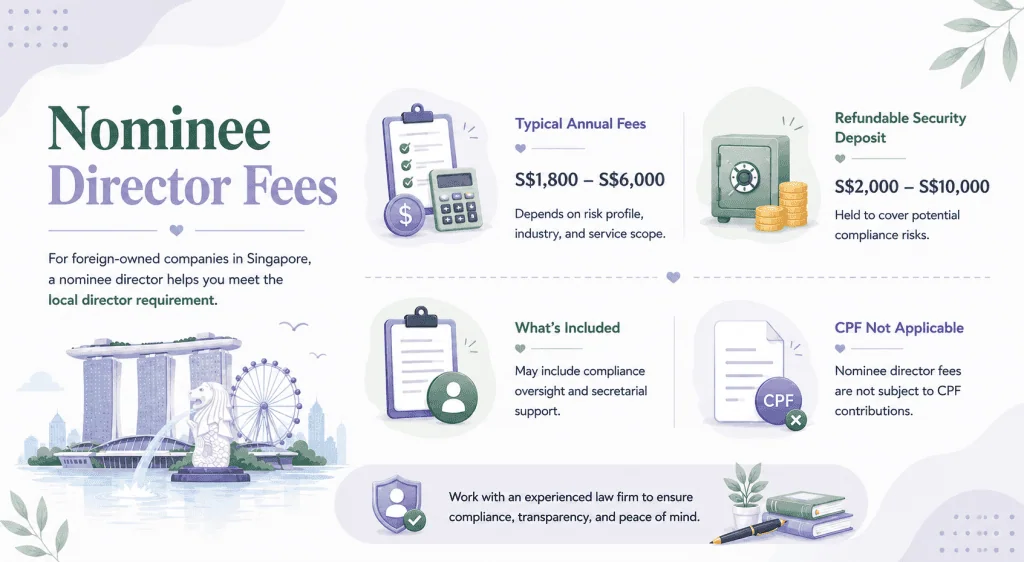
Separately from ordinary board compensation, companies that need a Singapore-resident director but do not have a suitable local founder or shareholder often engage a nominee director. This is common for foreign-owned companies incorporating in Singapore, since the Companies Act requires at least one director who is ordinarily resident here.
Nominee director fees typically range from around S$1,800 to S$6,000 per year, depending on the company’s risk profile, the industry, and how much compliance and secretarial support is bundled into the service.
Many providers also require a refundable security deposit, often S$2,000 to S$10,000, to cover their exposure if the company runs into compliance issues. Like other director fees, nominee director fees are not subject to CPF.
Director Fees for Private Companies
Most of the compliance discussion around director remuneration, remuneration committees, SGX disclosure rules, is written with listed companies in mind, but private companies and SMEs are where the bulk of director fee questions actually arise.
For a private company, the core legal requirement does not change: any director’s fee still needs Section 169 approval by ordinary resolution, and directors still owe the company fiduciary duties under Section 157 when proposing or voting on their own compensation. What does differ is disclosure.
Unlike SGX-listed companies, which face specific remuneration disclosure obligations under the Code of Corporate Governance, private companies are not automatically required to disclose individual director fee amounts in their financial statements, though members can request this disclosure under Section 164A, and voluntary disclosure in the annual report remains good governance practice.
A company secretary can help set up the resolution wording and record-keeping correctly from the start, which matters more for private companies precisely because there is less external scrutiny forcing the paperwork to be done properly.
Also Read: Due Diligence in Singapore: Legal Guide for Businesses
Director Fees vs Salary vs Dividends
Director-shareholders in private companies usually have three levers to extract income from their company, and each comes with different CPF, approval, and tax consequences.
Fees offer flexibility and no CPF cost but require a formal resolution each time; salary builds CPF savings but comes with a mandatory employer contribution; dividends are tax-exempt to the shareholder but can only be paid out of real, distributable profits under Section 403. Most advisors recommend a blended structure rather than relying on a single method.
| Basis | Director’s Fee | Salary | Dividend |
|---|---|---|---|
| Paid for | Holding office as director | Employment duties under contract of service | Return on shareholding |
| Approval needed | Shareholders’ resolution (Section 169) | Board approval | Board resolution, subject to available profits |
| CPF payable | No | Yes, for Citizens/PRs | No |
| Personal tax | Yes, progressive rates | Yes, progressive rates | No, tax-exempt under one-tier system |
| Timing flexibility | Lump sum, tied to AGM cycle | Regular, monthly | As and when profits allow |
Bonuses for Executive Directors
Bonuses function as performance-based incentives for executive directors responsible for the company’s operating results, and unlike fixed fees, they are tied directly to financial performance or individual targets.
Under Section 157 of the Companies Act, directors must act in the best interests of the company, and a bonus structure that rewards reckless short-term risk-taking at the expense of the company’s long-term stability could sit uneasily with this fiduciary duty.
Where a bonus is paid to a director in respect of their office rather than as part of an employment package, it may also fall within the Section 169 approval requirement in the same way as a director’s fee.
Companies increasingly build in clawback provisions, allowing them to recover a bonus already paid if financial statements are later restated or misconduct comes to light, and tie bonus structures to sustained, multi-year performance metrics rather than a single strong quarter.
Remuneration Committees for Singapore Companies
For SGX-listed companies, forming a remuneration committee is a requirement under the Singapore Code of Corporate Governance, not just good practice. The committee, made up of independent directors, oversees executive pay to keep it aligned with company performance and to manage the conflict of interest that arises under Section 156 whenever directors would otherwise be setting their own pay.
Private companies are not legally required to form a remuneration committee, but larger or fast-growing SMEs sometimes adopt one voluntarily once compensation packages become more complex, particularly where stock options or long-term incentive plans are involved.
Getting Your Director Compensation Structure Right
Director fees, bonuses, and remuneration all carry legal consequences that go beyond the payment itself, from shareholder approval and CPF treatment to fiduciary duties and tax timing.
Getting the structure wrong, whether by skipping a Section 169 resolution or mislabelling salary as fees, can create liability for both the company and the individual director, often long after the payment has already been made.
If your company needs help structuring director compensation, drafting the necessary resolutions, or reviewing your existing remuneration policy for compliance, Ramesh Bharani Nagaratnam and the team at RBN Chambers offer practical, Singapore-specific legal counsel tailored to your company’s stage and structure. Contact us today to make sure your director compensation strategy is legally sound.
Frequently Asked Questions
What is a director’s fee in Singapore?
A director’s fee is a payment made to someone for holding the office of director, as distinct from a salary for employment duties. It usually requires shareholder approval under Section 169 of the Companies Act.
Do director fees attract CPF contributions?
No. Director fees are not treated as wages, so CPF contributions are not payable on them, regardless of the director’s citizenship or residency status. CPF applies only where the director also receives a salary under a genuine employment contract.
Is shareholder approval mandatory for director bonuses?
It depends on how the bonus is characterised. A bonus paid in respect of a director’s office may fall under Section 169 in the same way as a fee. A bonus paid purely as part of an employment package is generally a board-approved matter, though it should still be consistent with the director’s fiduciary duties.
What is the difference between a director’s fee and a salary?
A director’s fee compensates someone for holding office as director and needs shareholder approval; a salary compensates a director for employment duties under a contract of service and is approved by the board. Only salary attracts CPF.
How are non-resident director fees taxed?
Non-resident directors, generally those spending fewer than 183 days a year in Singapore, are subject to a flat 24% withholding tax on director fees, unless a Double Taxation Agreement provides for a lower rate.
How much does a nominee director typically cost in Singapore?
Nominee director fees generally range from around S$1,800 to S$6,000 per year, depending on the provider, the company’s risk profile, and whether a refundable security deposit and secretarial support are included.

Delivering Solutions not just Answers to your legal disputes
We provide solutions to all our clients regardless of the scale or complexity of the cases. Let us know how we can help.
Contact UsAny information of a legal nature in this blog is given in good faith and has been derived from resources believed to be reliable and accurate. The author of the information contained herein this blog does not give any warranty or accept any responsibility arising in any way, including by reason of negligence for any errors or omissions herein. Readers should seek independent legal advice.