

Employment |
Who Is Covered Under Employment Act Singapore? A Legal Guide

The Employment Act 1968 is Singapore’s main labour law, but it does not apply to everyone who works for money. Whether you are covered depends on how you are engaged, what you do and, for some protections, how much you earn.
Since 1 April 2019, almost every employee in Singapore falls within the Act’s core protections, yet many employers and employees still assume that managers, part-timers or contract staff sit outside it. This guide explains who is covered, how the Act treats each type of employee and how Part 4 changes the picture, based on current Ministry of Manpower (MOM) guidance.
Who Is Covered Under Employment Act Singapore
In general, the Employment Act covers every employee who works under a contract of service with an employer in Singapore, whether a citizen, permanent resident or foreigner. MOM excludes only seafarers, domestic workers, statutory board employees and civil servants.
Coverage therefore turns on two questions: whether the worker is an employee at all, and, for hours of work and overtime, whether Part 4 applies. Both are explained below.
Types of Employees Covered Under the Employment Act
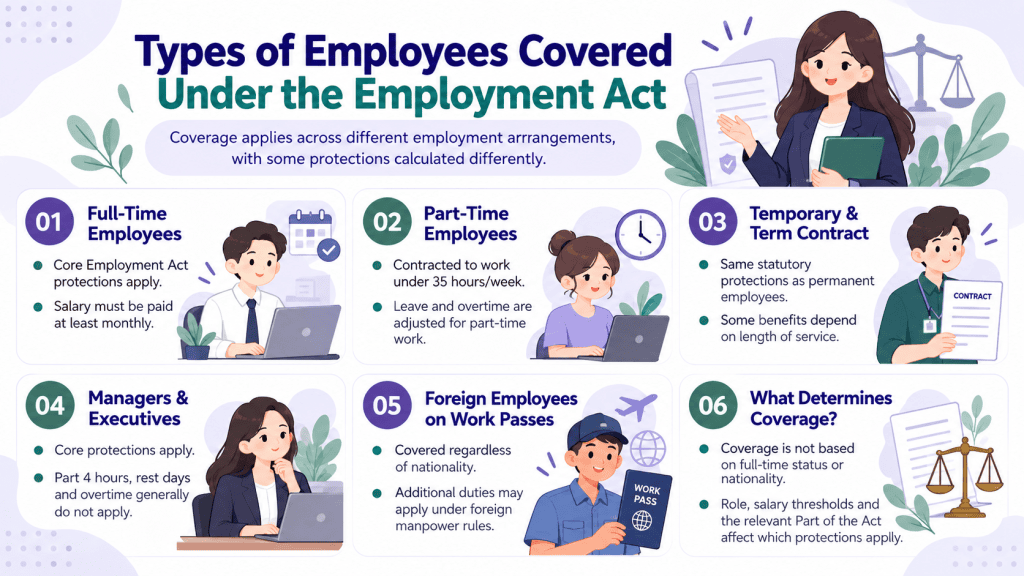
The Act defines an employee by reference to a contract of service and expressly includes a workman. Coverage does not depend on whether the employee is full-time, part-time, temporary or on contract, on how pay is calculated (hourly, daily, monthly or piece-rated), or on nationality. What changes between types of employee is how the Act’s protections are calculated and which supporting rules apply.
1. Full-Time Employees
Full-time employees receive the Act’s core provisions in full. Beyond leave, which is covered in our guide to employee rights in Singapore, these include the salary payment rules in Part 3 of the Act. A salary period cannot exceed one month, and salary must be paid at least once a month and within seven days after the period ends, with overtime pay due within 14 days.
Final salary is due on the last day of employment, within three working days if that is not possible on dismissal or termination, or within seven days if the employee resigns without serving notice.
Deductions are limited to the reasons the Act allows and cannot exceed 50% of the salary payable in a salary period. Employers must also keep detailed employment records, and covered employees are protected against wrongful dismissal under section 14.
2. Part-Time Employees
Part 6A of the Act defines a part-time employee as one required under the contract of service to work less than 35 hours a week. The test is contracted hours, not hours actually worked, so a “part-time” label on a contract requiring 35 hours or more changes nothing.
The Employment of Part-Time Employees Regulations adapt the Act, and MOM requires the contract to state the hourly basic rate, the hourly gross rate, the working hours per day or week, and the working days per week or month.
Leave is pro-rated against a similar full-time employee and granted in hours. After three months, a part-timer working 20 hours a week is entitled to about 25.5 hours of annual leave. Overtime also works differently: hours beyond the part-timer’s normal hours but within a full-time employee’s normal hours are paid at the basic hourly rate, and only hours beyond a full-time employee’s normal hours attract 1.5 times.
Part 4 still applies if the part-timer is within the salary caps, including one rest day a week where the part-timer works at least five days. Part-timers working 30 to 34 hours over at least five days cannot encash annual leave into their hourly rate.
3. Temporary and Term Contract Employees
MOM states that the Act makes no distinction between temporary, contract, daily-rated and tenured employees, so a fixed-term employee has the same statutory protections as a permanent one, adjusted for length of service. The difficulty is eligibility thresholds. Annual leave and paid sick leave only begin after three months of service, so repeated short contracts could otherwise keep an employee below them.
The Tripartite Advisory on the Employment of Term Contract Employees and the related Tripartite Standard respond by treating fixed-term contracts of 14 days or more, renewed within one month of the previous contract ending, as continuous service. They also recommend notice before early termination or non-renewal that is proportionate to cumulative service. These are guidelines rather than legislation, but MOM encourages employers to adopt them.
4. Managers and Executives
Until 1 April 2019, managers and executives earning more than S$4,500 a month sat outside the Act. The Employment (Amendment) Act 2018 extended the core provisions to all employees, so managers and executives now have statutory annual leave, paid public holidays and sick leave, timely payment of salary and protection against wrongful dismissal.
They do not have Part 4, so hours of work, rest days and overtime are governed by the employment contract.
MOM treats someone as a manager or executive by reference to duties, such as deciding on recruitment, discipline, termination, performance assessment and reward, formulating policy or running the business. It also includes professionals, such as advocates and solicitors, chartered accountants and practising doctors and dentists, whose terms resemble those of managers.
A senior-sounding title without real decision-making authority may not take an employee outside Part 4.
5. Foreign Employees on Work Passes
The Act applies to foreign employees on the same footing as local employees, whatever pass they hold. Foreign employees with a work pass are also covered by the Employment of Foreign Manpower Act, which adds obligations on top of the Employment Act rather than replacing it.
For Work Permit holders, the employer is responsible for medical expenses, cannot deduct salary to recover the foreign worker levy, must notify MOM before introducing or increasing deductions, and must pay salary into the employee’s Singapore bank account on request.
Part 4 coverage depends on the same role and salary tests as for local employees, and Employment Pass holders in managerial, executive or professional roles may fall outside it. For how the two statutes interact, see our guide to Singapore labour law for foreign workers.
Contract of Service vs Contract for Services
The Act protects employees, not independent contractors. A person engaged under a contract for services, such as a freelancer, independent contractor or sole proprietor, is a self-employed person and is not covered by the Employment Act.
The label in the contract is not conclusive. MOM states that there is no single conclusive test and looks at the actual relationship between the parties, so a “freelancer” treated like an employee may still be covered. Misclassification is the most common source of coverage disputes and can expose a business to claims for unpaid leave and salary.
Platform workers are a separate category. Since 1 January 2025, the Platform Workers Act has given them work injury compensation, CPF contributions and a representation framework without making them employees under the Employment Act.
Who Is Covered Under Part 4 of the Employment Act
Part 4 adds rules on hours of work, rest days and overtime, but covers only workmen earning a monthly basic salary of S$4,500 or less and non-workmen (employees who are neither workmen nor managers or executives) earning S$2,600 or less.
Managers and executives are excluded whatever they earn. Basic salary excludes overtime pay, bonuses, annual wage supplements, productivity incentives, reimbursements and allowances, so coverage turns on basic pay rather than take-home pay.
The table below summarises how the Act applies to each category.
| Worker category | Core provisions | Part 4 (rest days, hours, overtime) |
|---|---|---|
| Full-time or temporary employee (not a manager or executive) | Covered | Covered if within the S$4,500 (workman) or S$2,600 (non-workman) cap |
| Part-time employee | Covered | Depends on role and salary, with entitlements based on hours worked |
| Manager or executive | Covered | Not covered |
| Foreign employee under a contract of service | Covered | Same tests as local employees |
| Seafarer, domestic worker, statutory board employee or civil servant | Not covered | Not covered |
| Self-employed person or independent contractor | Not covered | Not covered |
Employment Act Review and Upcoming Changes
The Employment Act is under its first major review since 2019. A Tripartite Workgroup was formed in August 2025 and was expected to submit recommendations by the second half of 2026, with commentators expecting it to look at annual leave, the Part 4 salary thresholds and automatic employee transfers under section 18A. The figures in this guide reflect MOM’s published guidance at the time of writing, so check the current position before relying on them.
The Workplace Fairness Act 2025, which prohibits workplace discrimination, is expected to take effect by the end of 2027. It is a separate statute and does not extend to platform workers or contractors.
When to Seek Legal Advice on Employment Act Coverage
Coverage is not always obvious. Common situations that call for advice include a contractor who works like an employee, a manager told they have no leave or notice entitlements, a term-contract employee whose repeated contracts have never counted as continuous service, or an employer unsure whether Part 4 applies to a role. Getting the classification wrong can lead to employment disputes and claims before the Employment Claims Tribunals.
Early advice helps both sides. Employers can review their employment contracts and job classifications against MOM’s compliance checklist before a dispute arises, and employees can understand which protections they hold.
Speak to RBN Chambers About Your Employment Act Position
RBN Chambers advises employers and employees on Employment Act coverage, employment contracts and disputes in Singapore. Led by Ramesh Bharani Nagaratnam, our team can review your contract, assess whether you are covered by the Act and Part 4, and advise on the best course of action.
Contact RBN Chambers today to arrange a consultation with our employment lawyers.
Frequently Asked Questions
Are foreign employees on work passes covered by the Employment Act?
Yes. The Act covers local and foreign employees under a contract of service, whatever their nationality. Work pass holders are also subject to the Employment of Foreign Manpower Act.
Does the Employment Act cover freelancers or independent contractors?
No. The Act covers employees under a contract of service, not self-employed persons under a contract for services. However, MOM looks at the actual relationship rather than the label, so a freelancer who is in substance an employee may be covered.
Are interns covered by the Employment Act?
It depends on the arrangement. An intern who works for a company under a contract of service and is paid may be an employee and covered, while a purely educational placement that does not amount to employment is not.
Are company directors covered by the Employment Act?
A director is covered only if they also work under a contract of service as an employee. Holding a directorship or shares alone does not make someone an employee.
Are managers and executives covered by the Employment Act?
Yes, by the core provisions, regardless of salary. They are not covered by Part 4, so their hours of work and overtime depend on their employment contract.

Delivering Solutions not just Answers to your legal disputes
We provide solutions to all our clients regardless of the scale or complexity of the cases. Let us know how we can help.
Contact UsAny information of a legal nature in this blog is given in good faith and has been derived from resources believed to be reliable and accurate. The author of the information contained herein this blog does not give any warranty or accept any responsibility arising in any way, including by reason of negligence for any errors or omissions herein. Readers should seek independent legal advice.