

Business |
Dispute Resolution in Construction Industry Singapore

A withheld progress payment, a contested variation or a delay claim can stall cash flow, strain relationships with subcontractors and put a project timeline at risk. Construction disputes are rarely just legal problems, which is why the way they are resolved matters as much as who is right.
Singapore offers a layered system for dispute resolution in construction industry projects, from mediation and statutory adjudication to arbitration and the courts. This guide explains how each option works, how they compare and what to put in place before a dispute escalates.
Dispute Resolution in Construction Industry
Dispute resolution in construction industry refers to the contractual and statutory processes used to settle claims arising from a building or infrastructure project, such as payment, variation, delay and defect disputes.
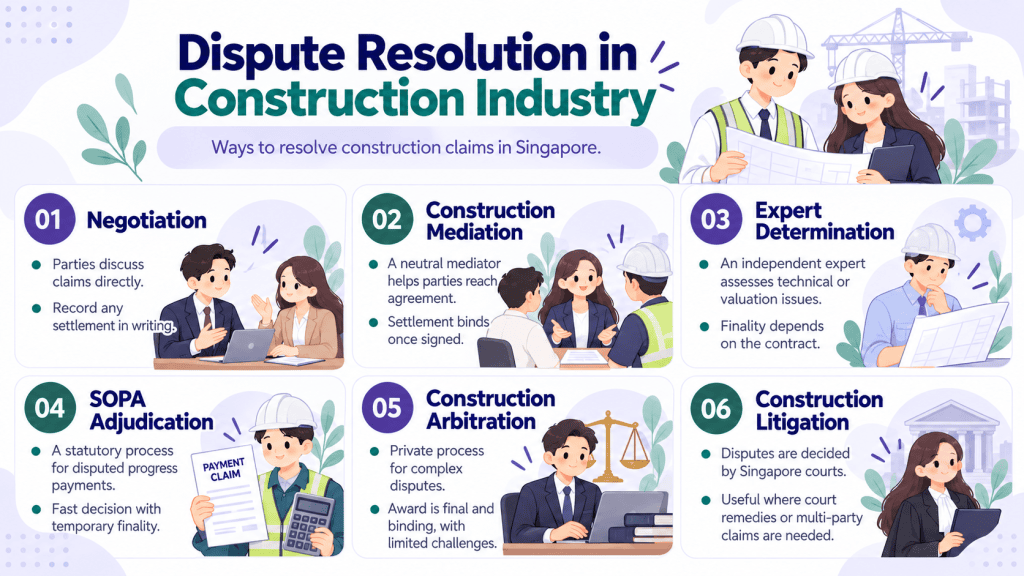
Arbitration clauses are a staple of construction contracts in Singapore, but they sit within a wider range of alternative dispute resolution methods and court options. The methods below run from the least to the most formal.
1. Negotiation
Direct negotiation between the parties, often at contract administrator or senior management level, is the first step in most tiered clauses. It is the cheapest option, but it produces a binding outcome only if the parties record the settlement in writing.
2. Construction Mediation
Construction mediation is a voluntary and confidential process in which a neutral mediator helps the parties reach their own settlement. The Singapore Mediation Centre (SMC) has handled construction disputes since 1997, and the Singapore Contractors Association (SCAL) launched the Singapore Construction Mediation Centre for disputes where at least one party is a SCAL member or a listed trade subcontractor.
Mediation may help preserve working relationships, although it does not guarantee that outcome, and it binds the parties only once a settlement agreement is signed.
3. Expert Determination
Expert determination refers a defined technical or valuation issue, such as the cost of defects or the value of variations, to an independent expert. Whether the expert’s decision is final depends on the contract, so the clause should say so expressly. SMC also offers neutral evaluation.
For large infrastructure projects, the Singapore Infrastructure Dispute-Management Protocol (SIDP) provides for a dispute board that follows the project and can mediate, give an opinion or make a determination. It is recommended for projects above S$500 million.
4. Adjudication Under SOPA
The Building and Construction Industry Security of Payment Act 2004 (SOPA) gives parties who carry out construction work, or supply related goods or services, a statutory right to progress payments. It also creates a fast adjudication process when a payment claim is disputed.
The determination has only temporary finality, so a losing respondent can challenge it in court, but only after the adjudicated sum is paid in first. The stages and deadlines are covered in the SOPA section below.
5. Construction Arbitration
Construction arbitration is the usual forum for large or complex disputes that negotiation or adjudication cannot settle. Parties can appoint arbitrators with construction or engineering experience, the proceedings are private, and an award is final and binding with limited grounds of challenge. Under the New York Convention, Singapore awards can be enforced in over 160 countries.
Arbitration in Singapore is commonly administered by SIAC. In 2025, construction, infrastructure and engineering accounted for 82 of SIAC’s 886 new cases, about 9%.
The SIAC Rules 2025 took effect on 1 January 2025 and include a Streamlined Procedure under which cases are concluded within three months of the tribunal being constituted. That procedure is available for qualifying cases only.
6. Construction Litigation
Construction litigation takes place in the Singapore courts, and hearings are generally public. The courts also enforce adjudication determinations, hear applications to set them aside and support arbitrations. Litigation is more likely where the contract has no arbitration clause, where court remedies such as injunctions are needed, or where several parties are involved.
Alternative Disputes Resolution (ADR) Process in Construction
The ADR process in construction groups the methods above that resolve disputes without a full court trial. They are often chosen because they can be faster, can draw on technical expertise and can run while the project continues.
| Method | Typical Duration | Cost Level | Binding Status | Best For |
|---|---|---|---|---|
| Mediation | Days to weeks | Low | Non-binding until a settlement agreement is signed | Preserving working relationships on ongoing projects |
| Expert determination | Weeks to months | Moderate | Depends on the contract, often binding | Technical or valuation issues such as defects |
| SOPA adjudication | Weeks, under statutory timelines | Moderate | Temporarily binding | Progress payment disputes and cash flow |
| Arbitration | Months to years | High | Final and binding | High-value, complex or cross-border disputes |
Durations and costs are indicative and vary with the size and complexity of the dispute. Parties often combine these methods in a tiered clause that escalates from negotiation to mediation, adjudication and then arbitration.
Common Causes of Construction Disputes
SCAL has noted that the most common construction disputes relate to payment, defects and liquidated damages. Scope changes and delays sit behind many of them.
Payment Disputes
Late payment, short payment and disagreements over the value of work done are common triggers, particularly between main contractors and subcontractors.
Variations and Scope Changes
Work added or changed without clear instructions or agreed pricing often leads to disputes over entitlement and cost.
Delay and Liquidated Damages
Disagreements over who caused a delay, extension of time claims and liquidated damages deductions frequently overlap with payment claims.
Defects and Workmanship
Parties dispute whether work is defective, who must rectify it and how much can be set off or retained.
Claims Management Process
Disputes are cheaper to resolve when they are caught early. A sound claims management process starts with contemporaneous records, meaning documents created at the time of events, such as site instructions, variation orders, daily reports, meeting minutes and contractual notices.
Records made at the time carry more weight than accounts reconstructed later, and statutory timelines leave little room to assemble evidence once a dispute is live.
Serving notices on time, tracking variations and delay events as they arise, and using the contract’s own escalation steps help stop minor disagreements from becoming formal claims.
Also Read: Shareholder Disputes in Singapore: Causes & How to Resolve Them
Adjudication of Construction Disputes Under SOPA
SOPA has limits: it does not apply to contracts for construction work on residential property that does not require BCA approval. Strict timelines apply at every stage, and the High Court has set aside a determination where the application was lodged too early. The stages below show the sequence.
| Stage | Timeline | Who Acts |
|---|---|---|
| Payment response | As stated in the contract, up to 21 days, or 14 days if the contract is silent | Respondent |
| Dispute settlement period | 7 days after the payment response is due | Both parties |
| Adjudication application | Within 7 days after the entitlement arises | Claimant, through an authorised nominating body such as SMC |
| Adjudication response | Within 7 days of receiving the application | Respondent |
| Determination | Generally 7 to 14 days after the response is due | Adjudicator |
| Payment | By the date stated in the determination | Respondent |
After the Determination
Once an adjudicator issues a determination, the following points apply:
- The adjudicated amount must be paid by the due date in the determination.
- If the respondent does not pay, the claimant can seek leave to enforce the determination as a court judgment under section 27 of SOPA.
- A party challenging the determination or the enforcement judgment must pay the unpaid adjudicated amount into court as security. In Lim Kim Huat Building Construction Pte Ltd v LBD Engineering Pte Ltd [2026] SGHC 28, the High Court dismissed the defendant’s application, noting that this security had not been paid.
- Where an adjudicated sum remains unpaid, the claimant may have a statutory right to suspend work under section 26 of SOPA.
- The determination does not end the dispute, as the underlying rights can still be decided in arbitration or court.
Payment Dispute Resolution
Contractors and subcontractors facing non-payment can protect their position in stages. Because SOPA deadlines are short, the early steps matter most.
Secure the Claim
- Serve a compliant payment claim and keep proof of the date of service, since disputes over deemed service have led to determinations being set aside.
- Diarise the payment response deadline and the 7-day dispute settlement period.
Escalate Early
- Run negotiation or mediation in parallel if both sides are willing, without letting the adjudication window lapse.
- Lodge the adjudication application within 7 days after the entitlement arises, and not before.
Enforce and Protect Your Position
- Enforce an unpaid determination as a judgment under section 27.
- Treat suspension of work as a last resort, exercised strictly under section 26 and the contract, because a wrongful suspension can expose the contractor to delay claims.
Arbitration Clause Drafting
A dispute resolution agreement is easiest to settle before the project starts. Vague or inconsistent clauses can create separate disputes about jurisdiction before the real dispute is even heard. Institutions such as SMC publish model clauses that can be adapted to the project.
A well-drafted arbitration clause should cover:
- Dispute board: whether the SIDP applies on a large infrastructure project.
- Seat: the legal place of arbitration, which determines the supervisory court.
- Governing law: the law that governs the contract.
- Institution and rules: for example, administration by SIAC under the SIAC Rules.
- Tribunal: the number of arbitrators and how they are appointed.
- Language: the language of the proceedings.
- Escalation steps: negotiation, mediation and adjudication stages with clear time limits.
When to Involve a Construction Dispute Lawyer
Early advice usually costs less than late advice. A lawyer can review the dispute resolution agreement before you sign, check that payment claims and notices comply with SOPA and the contract, and assess whether mediation, adjudication or arbitration suits the dispute. Because SOPA windows are measured in days, a delay can cost you a right.
Legal input is especially valuable when the claim is large, when the contract has a tiered or bespoke dispute clause, when a determination is being enforced or challenged, or when the matter may proceed to arbitration or court.
Also Read: Employment Disputes Singapore: Types, Process & How to Handle
Speak to RBN Chambers About Your Construction Dispute
Construction disputes put cash flow, timelines and reputation at risk, and the right strategy depends on the contract, the amounts involved and the deadlines you face. RBN Chambers is a full-service arbitration and litigation law firm in Singapore, formed by Mr Ramesh Bharani Nagaratnam, advising multinational corporations, SMEs and individuals in high-value disputes.
To protect your project’s bottom line, contact RBN Chambers for a consultation on your construction dispute. Our team can advise on the route that fits your contract and timeline, whether that means negotiation, adjudication, arbitration or court proceedings.
Frequently Asked Questions
What is the fastest way to resolve a construction payment dispute in Singapore?
For most payment disputes covered by SOPA, statutory adjudication is the fastest formal route. A determination is generally issued within weeks. Mediation can be quicker where both sides are willing to settle.
Can a contractor stop work if it has not been paid?
Only in limited circumstances. Under SOPA, the statutory right to suspend work can arise where an adjudicated amount remains unpaid, and it must be exercised in line with the Act. Otherwise, suspension depends on the contract, and a wrongful suspension may expose the contractor to delay claims or termination, so take legal advice first.
Is a Singapore arbitration award enforceable overseas?
Generally yes. Under the New York Convention, which has over 160 contracting states, awards made in Singapore can be enforced in other member countries, subject to the limited grounds for refusal that the convention and local law allow.
Does SOPA apply to every construction contract?
No. It covers most construction work and related goods and services, but it excludes some contracts, including construction work on residential property that does not require BCA approval. Check whether your contract falls within the Act before relying on its timelines.
Delivering Solutions not just Answers to your legal disputes
We provide solutions to all our clients regardless of the scale or complexity of the cases. Let us know how we can help.
Contact UsAny information of a legal nature in this blog is given in good faith and has been derived from resources believed to be reliable and accurate. The author of the information contained herein this blog does not give any warranty or accept any responsibility arising in any way, including by reason of negligence for any errors or omissions herein. Readers should seek independent legal advice.