

Business |
PDPA Guidelines for Singapore Businesses

A Singapore logistics company receives a WhatsApp from a customer asking why their NRIC number appears in an invoice shared with a third-party courier.
The operations team is unsure whether the data was collected properly, whether the courier should have seen it, and whether the company must report anything. Situations like this are common because most businesses only look up the PDPA guidelines after something has already gone wrong.
Under the Personal Data Protection Act 2012 (PDPA), the issue is never just what data you hold, but how you collect, use, disclose, store, and protect it.
PDPA Guidelines Checklist for Singapore Businesses
Below is a step-by-step walkthrough you can pair with your internal controls, staff training, and vendor management procedures.
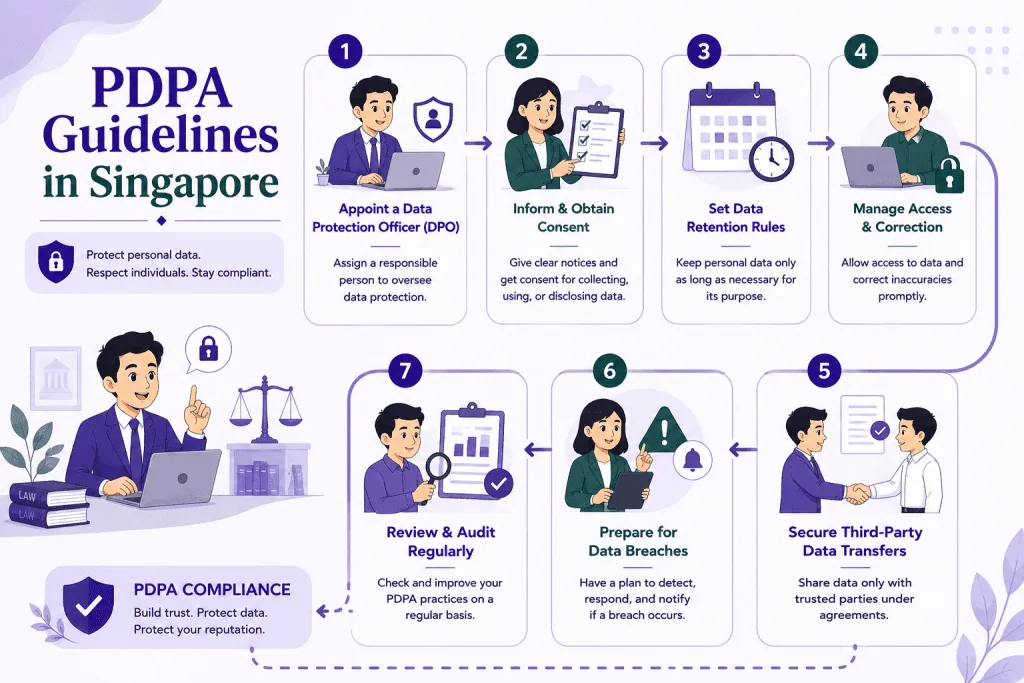
| Compliance Step | Estimated Timeline | Key Stakeholders |
|---|---|---|
| Appoint and define the Data Protection Officer role | 1 to 2 weeks | Management, HR, Legal, Compliance |
| Implement consent management process | 2 to 4 weeks | Marketing, Sales, Legal, IT |
| Establish data retention policy | 1 to 3 weeks | Legal, Records Management, IT |
| Manage access and correction requests | 1 to 2 weeks | Customer Service, HR, Legal, IT |
| Secure third-party transfers with data sharing agreement | 2 to 4 weeks | Procurement, Legal, IT, Vendors |
| Develop data breach response plan | 1 to 2 weeks | IT, Legal, Communications, Management |
| Schedule regular PDPA compliance audit | Quarterly or semi-annually | Compliance, Legal, IT, Business Owners |
Appoint and Define the Data Protection Officer Role
Every organisation must designate at least one individual as the Data Protection Officer, or DPO, under section 11 of the PDPA. The person does not need to be full-time, but the role must be real and accessible. In practice, that means customers, employees, and regulators should know who to contact about data protection matters.
Your DPO should have clear responsibility for policy oversight, staff awareness, incident escalation, and coordination with business units. In smaller businesses, the DPO may also be the compliance manager, HR lead, or operations head. What matters is accountability.
Make sure the DPO role includes:
- Maintaining the organisation’s PDPA guidelines checklist
- Reviewing collection notices and consent language
- Overseeing access and correction request handling
- Tracking vendor and cross-border transfer risks
- Leading the data breach response plan
Publish the DPO’s business contact details and keep them updated. If the role is outsourced, ensure the service scope covers response times, incident handling, and compliance reporting.
Also Read: What to Include in a Singapore Partnership Agreement
Implement a Robust Consent Management Process
Consent management is one of the most common pain points for Singapore businesses. Under the PDPA, organisations generally need consent before collecting, using, or disclosing personal data, unless an exception applies. The key is to build a process that records what was told to the individual, what they agreed to, and how they can change their mind later.
Collecting, using, and disclosing data. Use clear notices at the point of collection. State what data you collect, why you need it, and which third parties may receive it. Avoid vague wording such as “for business purposes.” Instead, explain the actual purpose, such as processing orders, verifying identity, or sending service updates.
For websites and forms, keep consent records linked to timestamps, form version numbers, and the exact wording shown. For offline collection, use controlled scripts or signed forms. Where possible, align the notice with your privacy policy and internal data map.
Key controls include collecting only the data needed for the stated purpose, using plain-English consent language, keeping proof of consent for audit purposes, and reviewing whether any use or disclosure goes beyond the original purpose.
Managing withdrawal of consent. Individuals must be able to withdraw consent, and your process should make that easy. If a customer unsubscribes from marketing or a former employee asks you to stop using certain data, the business should have a workflow that routes the request to the right team.
Your withdrawal process should include a simple contact channel such as email or a web form, internal logging of the request and response date, an assessment of whether the data can still be retained for legal or contractual reasons, and instructions for downstream teams and vendors.
Under PDPC guidance, you should not create unnecessary friction — a request should not require multiple approvals if it can be resolved by a standard workflow.
Establish a Clear Data Retention Policy
A data retention policy tells your teams how long personal data may be kept and when it must be deleted, anonymised, or archived. The retention limitation obligation requires organisations to cease retention when there is no longer a legal or business purpose for holding the data.
Your policy should be practical, not theoretical. Start by mapping the main categories of data in your business: customer records, employee files, CCTV footage, payroll data, supplier contracts, and website logs. Then define a retention period for each category based on law, business need, and operational risk.
A good policy should cover:
- Data category and owner
- Purpose of retention
- Retention period or review cycle
- Deletion or anonymisation method
- Escalation where legal hold or dispute applies
If your company operates in regulated sectors, align the retention schedule with sector-specific rules and the Singapore statutes stored on Singapore Statutes Online. For the current version of the PDPA guidelines, refer directly to the Personal Data Protection Commission website.
Manage Access and Correction Requests
Individuals have the right to request access to personal data held by your organisation and to request corrections where appropriate. This means your business needs a consistent process for receiving, verifying, assessing, and responding to requests.
Frontline teams often receive these requests first, so they should know what to do. If a customer emails asking for a copy of their account records, or an employee asks to update their address, the request should not disappear into a shared inbox.
Build a workflow that includes:
- Request intake through one official channel
- Identity verification before disclosure
- Tracking of deadlines and response status
- Legal review for exemptions or sensitive records
- Correction updates across systems and vendors
Document how your business handles an access and correction request from start to finish. This reduces delays, improves customer trust, and supports audit readiness.
Secure Third-Party Transfers with a Data Sharing Agreement
Many PDPA breaches happen through vendors, cloud platforms, payroll providers, marketing agencies, and logistics partners. Before you share personal data with another organisation, you need a contractual framework that requires comparable protection.
A data sharing agreement should set out the purpose of the transfer, permitted uses, security safeguards, breach notification duties, subcontracting limits, and return or deletion obligations at the end of the relationship. If data is transferred outside Singapore, check whether the recipient can provide a standard of protection comparable to that under the PDPA.
At a minimum, your agreement should address:
- Who is the data controller or recipient
- What data may be shared
- Why the sharing is necessary
- Security measures required by the recipient
- Notification timelines for incidents and access requests
- Deletion, return, or destruction at contract end
For higher-risk suppliers, conduct due diligence before onboarding. Ask for their security controls, breach history, access management standards, and incident response procedures. The contract should reflect the risk level of the data involved.
Also Read: Essential Shareholder Agreement Clauses in Singapore
Develop an Actionable Data Breach Response Plan
A data breach response plan helps your business act fast when data is lost, exposed, or accessed without authorisation. Under the Data Breach Notification obligation, organisations must assess whether a breach is notifiable and, where required, notify the PDPC and affected individuals within the required timeline.
Your plan should be clear enough for staff to use during a real incident. It should state who receives the alert, who investigates, who decides on reporting, and who manages communications. Do not wait until an incident happens to decide the chain of command.
Include these steps:
- Contain the incident immediately
- Preserve logs, evidence, and affected systems
- Assess whether personal data is involved
- Determine risk of harm
- Escalate to management and legal review
- Prepare notifications where required
- Fix root causes and document lessons learned
| Breach Severity | Notification Requirement (PDPC) | Notification Requirement (Individuals) | Action Steps |
|---|---|---|---|
| Low risk, no likely harm, limited data exposure | No, if not a notifiable breach | No, if not a notifiable breach | Contain incident, investigate, document findings, remediate controls |
| Potentially notifiable, but risk assessment pending | Assess within the required timeframe | Assess after confirming notifiability | Preserve evidence, assess scale, consult legal and DPO |
| Notifiable breach involving significant harm or large scale exposure | Yes, within the PDPA notification timeline | Yes, where required under the PDPA | Notify, contain, investigate root cause, and implement corrective action |
For the latest reporting requirements, check the PDPC’s official breach notification guidance on the PDPC website.
Schedule a Regular PDPA Compliance Audit
Compliance with the PDPA guidelines is not a one-time project. Business processes change, staff leave, vendors change, and new tools are introduced. A regular PDPA compliance audit helps you spot weak points before they become penalties or complaints.
Audit at least quarterly for high-risk operations, or semi-annually for lower-risk businesses. Review both policy and practice. A policy that says one thing but staff do another will not protect the business.
Your audit should test:
- Whether the DPO is current and accessible
- Whether consent records are complete
- Whether retention deadlines are being followed
- Whether access and correction requests are tracked
- Whether vendor contracts contain data protection clauses
- Whether breach drills and training have been completed
Use the findings to update your checklist, retrain staff, and assign corrective actions with owners and deadlines. If you need support, our team can help with a structured review through our PDPA compliance audit service.
Need Help Applying These PDPA Guidelines?
Understanding the PDPA guidelines is only useful if it changes how your team actually handles data day to day. Businesses that treat these obligations as a living operational system, not a policy document filed away after signing, are the ones that avoid costly incidents and keep customer trust intact.
If your business needs help translating the PDPA guidelines into practical policies, contracts, and response plans, Ramesh Bharani Nagaratnam and the RBN Chambers team work with Singapore business owners, in-house legal teams, and compliance officers on exactly this.
Get in touch to discuss a DPO-as-a-Service arrangement, a data sharing agreement review, or a full PDPA compliance audit through our DPO-as-a-Service, corporate compliance services, and PDPA compliance audit pages.
Frequently Asked Questions
What are the mandatory steps for PDPA compliance in Singapore?
At minimum, businesses should appoint a DPO, manage consent properly, maintain a retention policy, respond to access and correction requests, protect vendor transfers, and have a breach response plan.
Who needs to appoint a Data Protection Officer (DPO)?
Every organisation subject to the PDPA in Singapore must designate at least one DPO and make the contact details available.
How quickly must a business report a data breach to the PDPC?
A notifiable breach must be assessed and reported within the PDPA timeline after the organisation determines that notification is required. Check the current PDPC guidance for the latest reporting rules.
What should be included in a data retention policy?
A data retention policy should state what data is kept, why it is kept, how long it is retained, when it must be deleted or anonymised, and who owns the review process.

Delivering Solutions not just Answers to your legal disputes
We provide solutions to all our clients regardless of the scale or complexity of the cases. Let us know how we can help.
Contact UsAny information of a legal nature in this blog is given in good faith and has been derived from resources believed to be reliable and accurate. The author of the information contained herein this blog does not give any warranty or accept any responsibility arising in any way, including by reason of negligence for any errors or omissions herein. Readers should seek independent legal advice.