
Employment |
Workplace Dispute Resolution in Singapore: Options and Steps

On Monday morning, an employee in Singapore receives a WhatsApp message saying their bonus will not be paid because of a manager discretion clause, even though the contract shows a different bonus formula in writing. Situations like this are common, and they can quickly affect pay, trust, and working relationships.
Whether the issue involves wages, leave, termination, or conduct, it helps to know which path applies and which authority handles each stage. Singapore’s workplace dispute framework is shaped by the Ministry of Manpower (MOM), the Tripartite Alliance for Dispute Management (TADM), and the Employment Claims Tribunals (ECT).
The right next step depends on whether the dispute is internal, individual, or collective, and whether it involves discrimination.
Internal Workplace Conflict Management
Most workplace disputes should begin with internal workplace conflict management. In Singapore, this usually means checking the employment contract, company handbook, HR policy, and any grievance procedure already in place. Many disagreements can be resolved faster when both sides follow a documented HR dispute resolution process before escalating externally.
Internal resolution is especially important because it creates a record of what was raised, when it was raised, and how the employer responded. That record may matter later if the dispute goes to TADM, the ECT, or legal counsel. It also gives employers a chance to correct payroll errors, clarify expectations, or address conduct issues before positions harden.
HR Dispute Resolution Process
A typical HR dispute resolution process in Singapore usually follows a clear set of steps. Working through them in order helps both employees and employers stay organised and reduces the chance of missing a detail that matters later. Here is how the process usually unfolds.
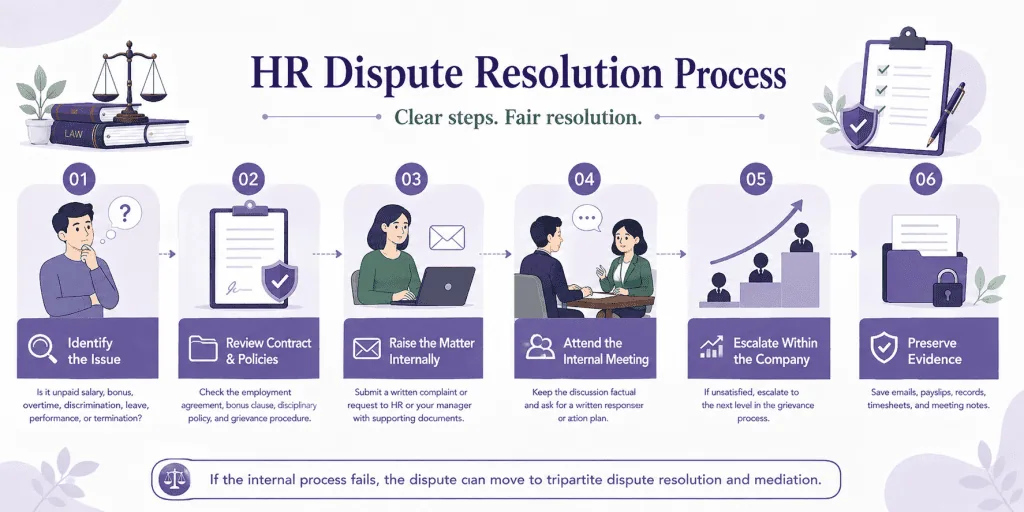
Step 1: Identify the Issue Clearly
Is it unpaid salary, bonus, overtime, discrimination, leave, performance, or termination?
Step 2: Review the Contract and Company Policies
Check the employment agreement, bonus clause, disciplinary policy, and grievance procedure.
Step 3: Raise the Matter Internally
Send a written complaint or request to HR or the reporting manager with dates, amounts, and supporting documents such as payslips, emails, or WhatsApp messages.
Step 4: Attend the Internal Meeting
Keep the discussion factual and ask for a written response or action plan.
Step 5: Escalate Within the Company if Needed
If the first response is unsatisfactory, use the next level in the grievance process, such as HR head, senior management, or compliance.
Step 6: Preserve Evidence
Save correspondence, attendance records, timesheets, salary slips, and meeting notes.
For employers, standardising these steps helps with workplace conflict management and reduces legal risk. For employees, it helps show that the matter was raised properly and that the issue is genuine, not speculative. If the internal process fails, the dispute can move to tripartite dispute resolution and mediation.
Also Read: Know Your Employee Rights in Singapore
| Dispute Stage | Resolution Method | Governing Body |
|---|---|---|
| Internal grievance | HR dispute resolution steps | Employer or internal HR |
| Unresolved individual employment issue | Workplace dispute mediation | TADM under the MOM framework |
| Claim that remains unresolved after mediation | Tribunal hearing | Employment Claims Tribunals, State Courts |
| Discrimination-related claim | Mandatory mediation, then ECT or High Court | MOM, TADM, and the ECT under the Workplace Fairness Act |
| Collective industrial conflict | Collective disputes mediation or arbitration | Tripartite bodies or statutory arbitration channels |
Tripartite Dispute Resolution and Mediation
When internal resolution does not solve the issue, the next step is often tripartite dispute resolution and mediation. In Singapore, this is a structured process rather than a casual negotiation. It is designed to help both sides reach a practical settlement without immediately going to court.
This stage is important because many workplace disputes are better resolved through discussion, especially where the facts are clear but the parties disagree on interpretation, quantum, or fairness. TADM plays a central role in this process for employment-related claims.
Workplace Dispute Mediation via TADM
Workplace dispute mediation through TADM is commonly used for salary claims and other employment-related disputes that fall within Singapore’s employment claims framework. According to TADM and MOM guidance, parties are expected to attempt mediation before escalation to the ECT for eligible claims.
The process usually involves submitting the claim or request for assistance through the proper channel, providing supporting documents such as employment contracts, payslips, attendance records, and correspondence, attending a mediation session with the other party, and trying to reach a settlement agreement with the help of a neutral mediator.
Mediation is generally less formal than a tribunal hearing. It is also typically faster and less adversarial. However, it only works if both sides are willing to engage meaningfully. If no settlement is reached, the dispute may move to the next stage.
For official process details, readers should refer to the Tripartite Alliance for Dispute Management and Ministry of Manpower websites.
MOM Mediation and the Industrial Arbitration Court
MOM’s Labour Relations and Workplaces Division and the Industrial Arbitration Court (IAC) become relevant mainly in collective or industrial disputes, rather than ordinary individual salary disagreements. These bodies sit within the broader Singapore dispute resolution framework for disputes affecting groups of employees and, in some cases, unions and employers.
In practical terms, the Labour Relations and Workplaces Division helps manage collective disputes by supporting structured discussions and encouraging settlement before matters move further through mediation and conciliation. If the dispute cannot be resolved this way, it may be referred to the IAC for arbitration and a binding award. This is especially important where the dispute affects workplace stability, bargaining, or sector-wide operations.
For employees and employers, the key point is to distinguish between an individual grievance and a collective dispute. That distinction determines whether the matter should go to TADM, MOM’s Labour Relations and Workplaces Division, or the Industrial Arbitration Court.
Escalating to the Employment Tribunal Singapore
If mediation does not resolve an eligible individual claim, the next formal step may be the Employment Claims Tribunals in Singapore, often referred to informally as the employment tribunal Singapore. The ECT deals with certain employment-related disputes and offers a court-based forum within the State Courts structure.
This stage is not the first stop for most disputes. It is usually the escalation point after the required mediation process has been completed or where the claim otherwise qualifies under the applicable rules. The tribunal process is designed to provide a more formal determination when settlement is not possible.
MOM Dispute Resolution and Salary Claims
Salary claims, unpaid wages, wrongful deductions, and contractual sums, are commonly handled through MOM’s employment claims pathway, subject to eligibility rules.
If an employer has not paid what the contract requires, the claim usually goes through TADM mediation first, then the ECT if unresolved. Employers should have payroll records, attendance data, and contract terms ready.
The ECT is appropriate when:
- The claim is eligible
- Mediation has been attempted
- A formal decision is needed after settlement fails
For termination strategy or contractual disputes, it is worth consulting an employment lawyer before filing or defending a claim.
Arbitration for Complex and Collective Disputes
Not every workplace dispute ends at mediation or the ECT. Some matters are collective, complex, or legally structured to move through arbitration. In Singapore, arbitration is more common in disputes involving unions, collective bargaining, or statutory dispute resolution mechanisms that require a binding determination.
Understanding the difference between mediation and arbitration is critical. Mediation aims to help the parties agree to a mutually acceptable solution. Arbitration asks a neutral decision maker to make a binding outcome, usually after hearing both sides.
Collective Disputes Mediation
Collective disputes mediation is used when the conflict affects a group of employees, a union, or wider workplace conditions. These disputes can involve pay structures, benefits, industrial relations, or other terms affecting multiple workers at once.
Because collective disputes can affect operations and staff morale, Singapore’s framework encourages structured negotiation and mediation before escalation. Employers should ensure that only authorised representatives engage in these discussions. Employees and unions should also keep clear records of proposals, counterproposals, and meeting outcomes.
Where collective discussions do not resolve the issue, the matter may proceed into a statutory arbitration process depending on the legal basis and the nature of the dispute.
Labour Arbitration in Singapore
Labour arbitration in Singapore is usually relevant where the dispute is not suitable for ordinary individual claims handling and requires a formal binding decision. Unlike mediation, labour arbitration in Singapore typically ends with an award or decision that the parties must follow, subject to the rules governing the process.
This option is especially important where the dispute is technically complex, involves statutory processes, or concerns collective industrial relations. It is generally less common than internal resolution or TADM mediation, but it is a key part of the escalation ladder.
The Statutory Arbitration Process
The statutory arbitration process refers to arbitration provided for under Singapore law or linked to a specific statutory framework. It is not the same as simply agreeing to arbitrate privately. The process, authority, and legal effect depend on the governing statute and the type of dispute involved.
Statutory arbitration is generally used when:
- The dispute falls within a category that law or regulation sends to arbitration
- Collective or industrial issues need a formal binding outcome
- Mediation has failed and the legal framework allows escalation
For readers, the most important takeaway is this, do not assume every workplace dispute can go straight to arbitration. The pathway depends on the claim type, the parties involved, and the legal forum available under Singapore law.
| Feature | Workplace Dispute Mediation | Labour Arbitration Singapore |
|---|---|---|
| Process type | Facilitated negotiation | Formal adjudicative process |
| Binding nature | Only if settlement is reached and documented | Usually binding by award or decision |
| Cost | Generally lower | Usually higher than mediation |
| Typical duration | Often faster | Usually longer and more procedural |
| Best for | Individual salary and contract disputes | Complex or collective disputes needing a binding outcome |
For a visual summary, this escalation path is often shown as a flowchart, Internal HR, then TADM Mediation, then Employment Claims Tribunals or Arbitration, depending on the dispute type.
Readers should also note the value of preventive planning. Employers can reduce disputes by improving contract drafting, keeping a clear HR compliance checklist, and applying consistent termination procedures. Employees should retain copies of contracts, amendments, and salary records from the start of employment.
Also Read: Employment Contract in Singapore: Legal Guide & Key Terms
Talk to an Employment Lawyer at RBN Chambers
Workplace disputes rarely resolve themselves once positions have hardened, and the right strategy often depends on details that are easy to miss without legal training, from which mediation route applies to how a new law like the Workplace Fairness Act will affect a claim’s timeline and value.
Getting advice early, before a dispute escalates past the point of easy settlement, tends to save both time and money for employees and employers alike.
RBN Chambers, led by Ramesh Bharani Nagaratnam, advises both employers and employees on workplace disputes in Singapore, from internal grievance strategy through to TADM mediation and ECT proceedings.
If you are facing a workplace dispute or want to review your grievance handling process ahead of the Workplace Fairness Act, get in touch with RBN Chambers for tailored advice. Contact us here!
Frequently Asked Questions
What are the standard HR dispute resolution steps before seeking external help?
Start by reviewing the employment contract and HR policy, raise the issue in writing, attend an internal meeting, and follow the company grievance process before escalating to TADM or legal advice.
How does workplace dispute mediation work through TADM?
TADM mediation brings the parties together with a neutral mediator to try to settle eligible employment disputes such as salary claims, using documents and discussion to reach an agreement without a tribunal hearing.
When should a case be escalated to the Employment Tribunal Singapore?
A case may be escalated to the Employment Claims Tribunals after the required mediation steps are completed and the dispute remains unresolved, provided the claim is eligible under Singapore’s employment claims framework.
Who handles collective disputes in Singapore?
MOM’s Labour Relations and Workplaces Division helps manage collective workplace disputes by supporting structured discussions and settlement efforts through mediation and conciliation. If the dispute cannot be resolved this way, it may be referred to the Industrial Arbitration Court (IAC) for arbitration and a binding award.
What is the Workplace Fairness Act and when does it take effect?
The Workplace Fairness Act introduces Singapore’s first dedicated framework for workplace discrimination claims, made up of two Bills passed in January 2025 and November 2025, with full implementation expected by the end of 2027.
How much will the Employment Claims Tribunals be able to hear under the new law?
For workplace discrimination claims under the Workplace Fairness Act, the Employment Claims Tribunals will be able to hear claims up to and including S$250,000, up from the current general cap of S$30,000.
Delivering Solutions not just Answers to your legal disputes
We provide solutions to all our clients regardless of the scale or complexity of the cases. Let us know how we can help.
Contact UsAny information of a legal nature in this blog is given in good faith and has been derived from resources believed to be reliable and accurate. The author of the information contained herein this blog does not give any warranty or accept any responsibility arising in any way, including by reason of negligence for any errors or omissions herein. Readers should seek independent legal advice.