

General |
Mediation in Singapore: Process, Costs & Enforceability

Mediation is a voluntary, confidential process in which a neutral third party, the mediator, helps two or more parties negotiate their own resolution to a dispute, rather than having a judge or arbitrator decide the outcome for them.
In Singapore, mediation sits at the centre of the legal system’s approach to dispute resolution and is supported by dedicated institutions, a dedicated statute in the Mediation Act 2017, and active encouragement from the courts themselves.
Mediation is not binding on its own; parties are free to walk away at any point. But once an agreement is reached and properly formalised, it can carry real legal weight and be enforced in the same way as a court judgment. This guide explains how mediation works in Singapore, where to access it, what it costs, and how a lawyer can strengthen your position throughout the process.
How Mediation Works
A mediation session is led by a trained, neutral mediator who does not take sides or impose a decision. Instead, the mediator helps each party understand the other’s position, clarifies the issues in dispute, and guides the conversation toward practical solutions both sides can accept.
Everything discussed during mediation is confidential and conducted on a “without prejudice” basis, meaning nothing said in the session can later be used as evidence if the dispute proceeds to litigation. Sessions are informal compared to a courtroom, and most disputes are resolved within a single day or a few short sessions rather than months of proceedings.
If you are weighing mediation against other options, our guide to Alternative Dispute Resolution methods in Singapore compares mediation with arbitration, conciliation, neutral evaluation and expert determination side by side.
Where to Get Mediation in Singapore
Mediation in Singapore is offered through several different channels, and the right one depends on the type of dispute and whether you want a free, court-linked process or a private one.
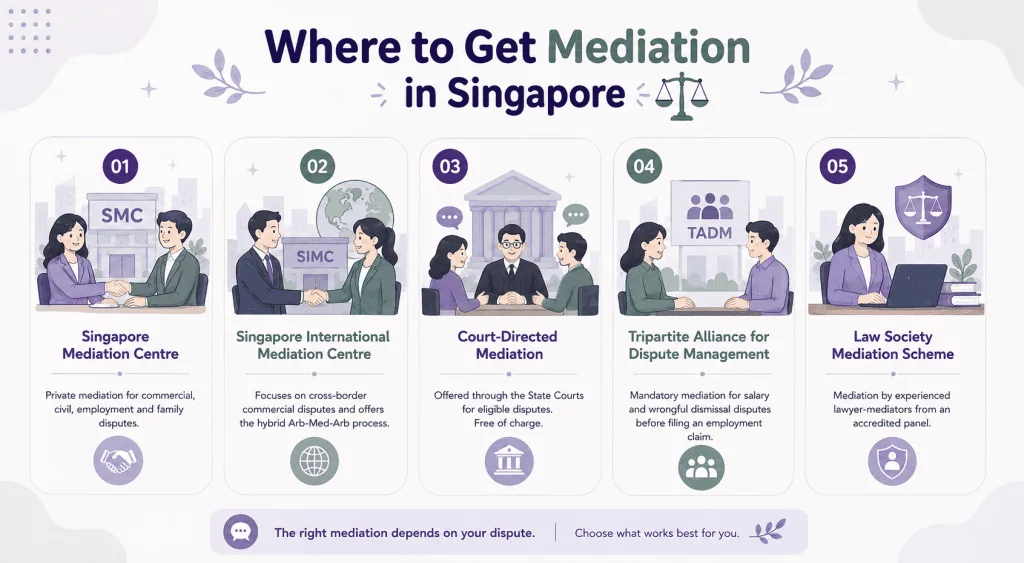
Singapore Mediation Centre
The Singapore Mediation Centre (SMC) is Singapore’s leading private mediation institution, handling domestic commercial, civil, employment and family disputes. SMC reports a settlement rate of around 70%, with the large majority of successful cases resolved within a single working day.
Singapore International Mediation Centre
The Singapore International Mediation Centre (SIMC) focuses on cross-border commercial disputes. It also offers a hybrid Arb-Med-Arb process, where parties begin arbitration, pause to attempt mediation, and record any settlement as a consent arbitral award if successful — combining mediation’s cost savings with an arbitral award’s international enforceability.
Court-Directed Mediation
Where a case is already in the State Courts, parties can be referred to mediation through the Court Dispute Resolution Cluster, which handles civil claims, small claims, employment claims, and Protection from Harassment Court matters. This service is free of charge, and the judge who mediates a case will never be the judge who hears the trial if a settlement is not reached.
Tripartite Alliance for Dispute Management
For salary and wrongful dismissal disputes, mediation through the Tripartite Alliance for Dispute Management (TADM) is compulsory before a claim can proceed to the Employment Claims Tribunals. Our Alternative Dispute Resolution guide covers this employment mediation track in more detail.
Law Society Mediation Scheme
The Law Society of Singapore also runs its own mediation scheme, where disputes are mediated by experienced lawyer-mediators from an accredited panel, offering a middle ground between a fully private commercial mediator and a free court-linked process.
Is Mediation Legally Binding in Singapore
Mediation itself does not produce a binding outcome, nothing is imposed on the parties, and either side can walk away at any time before an agreement is reached. However, once parties sign a settlement agreement, it becomes an enforceable contract, and under Section 12 of the Mediation Act 2017, it can go a step further and be recorded as an Order of Court.
To be recorded as an Order of Court, the mediation generally needs to have been administered by a designated mediation service provider, such as SMC, or conducted by a certified mediator. A court may decline to record the agreement in certain circumstances, including where the agreement was procured through fraud or misrepresentation, where its terms cannot be enforced as a court order, or where doing so would not be in a child’s best interests or would be contrary to public policy. Once recorded, the settlement can be enforced in exactly the same way as a court judgment.
For cross-border disputes, the Singapore Convention on Mediation Act 2020 goes further still, allowing an international mediated settlement to be enforced directly in any signatory country, without it needing to be treated as an ordinary contract first.
Also Read: 5 Common Types of Legal Disputes in Singapore (2026 Guide)
Common Scenarios Where Mediation Is Effective
Mediation is more common in daily life than most people realise. Here are some real-world examples where it often helps:
| Scenario | Examples |
| Contract disputes between businesses | Disagreements over payment terms, service delivery, or contractual obligations |
| Employment related matters | Claims involving dismissal, harassment, or salary disputes. |
| Family and divorce matters | Couples seek amicable arrangements on asset division or custody without lengthy court battles. |
| Landlord-tenant issues | Disputes arise over deposits, maintenance, or breaches of tenancy agreements. |
| Neighbourhood conflicts | Residents disagree over noise, property boundaries, or shared facilities. |
| Cross-border commercial disagreements | Businesses from different countries prefer mediation over complex international litigation. |
Singapore’s emphasis on Alternative Dispute Resolution (ADR) has made mediation accessible across a wide range of industries and personal matters.
Mediation for Commercial Disputes and SMEs
Commercial mediation is particularly well-suited to small and medium enterprises, where the cost and time of litigation can be disproportionate to the value of the dispute, and where preserving a business relationship with a supplier, customer, or partner often matters as much as the outcome itself.
Because SMC’s fees are pegged to the value of the claim, mediation tends to scale sensibly with the size of the dispute rather than the flat, escalating costs typical of a full trial. It is also confidential, which protects an SME’s commercial reputation during disputes over contracts, payment terms, or service delivery — matters that could otherwise become public if litigated. SMC also runs subsidised mediation schemes for specific industries, including tenancy, intellectual property and healthcare disputes.
Mediation vs Litigation and Arbitration
| Factor | Mediation | Arbitration | Litigation |
|---|---|---|---|
| Decision maker | The parties themselves | An appointed arbitrator or panel | A judge |
| Binding status | Not binding until a settlement is signed | Binding award, enforceable like a judgment | Binding judgment |
| Confidentiality | Private and without prejudice | Private | Generally open to the public |
| Typical duration | A single day to a few sessions | Around 12 to 24 months | Can take well over a year |
| Cost | Lowest, scaled to claim value | Moderate to high | Highest |
Mediation is generally the fastest and least expensive route, but it depends on both parties being willing to negotiate. Where a dispute requires a definitive legal ruling, such as interpreting a disputed contract clause, or where one party refuses to engage, arbitration or litigation may be more appropriate.
The Role of a Lawyer in Mediation
Although the mediator is neutral, mediation is not a process you need to navigate alone. A lawyer who understands your case can help you enter mediation from a position of strength rather than uncertainty.
Before the session, a lawyer can assess the legal merits of your position, so you know realistically what a court would likely decide if mediation fails, and what a fair settlement should look like. During the session, a lawyer can help you avoid conceding points you do not need to and keep the negotiation focused on your actual interests.
Afterwards, a lawyer’s involvement matters most in the paperwork: a settlement agreement needs to be properly drafted so its terms are clear, enforceable, and capable of being recorded as an Order of Court if needed. A poorly worded settlement can end up creating a fresh dispute rather than resolving one.
Also Read: Arbitration Tribunal in Singapore: How It Works & What It Costs
How to Prepare for Mediation
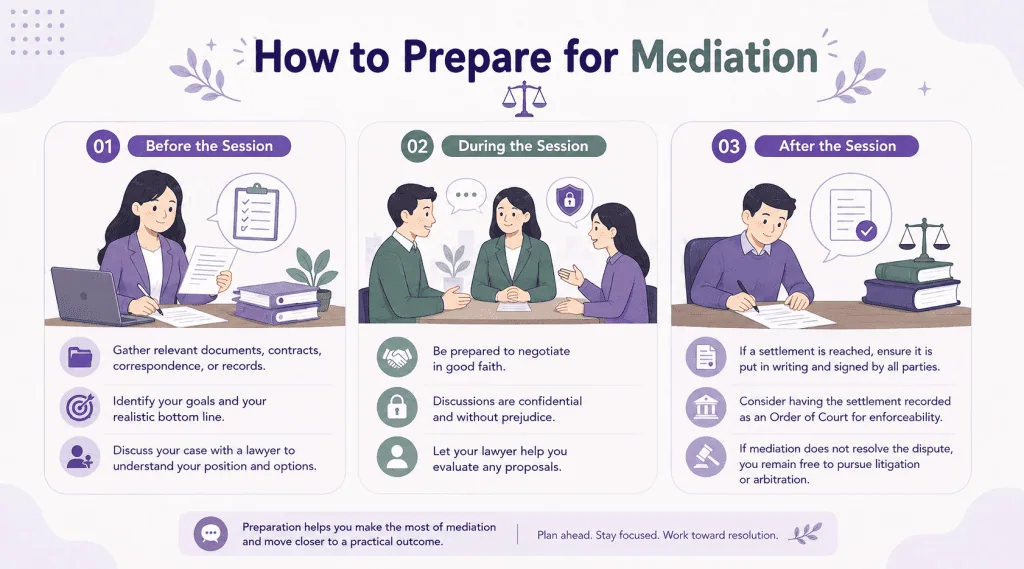
Before the Session
- Gather relevant documents, contracts, correspondence, or records that support your position
- Identify your goals and your realistic bottom line before you walk in
- Discuss your case with a lawyer so you understand your legal position and options if mediation does not succeed
During the Session
- Be prepared to negotiate in good faith rather than simply restate your position
- Remember that discussions are confidential and without prejudice, so they cannot be used against you later
- Let your lawyer, if you have one, help you evaluate any proposals as they come up
After the Session
- If a settlement is reached, ensure it is put in writing and signed by all parties
- Consider having the settlement recorded as an Order of Court under the Mediation Act 2017 for direct enforceability
- If mediation does not resolve the dispute, you remain free to pursue litigation or arbitration
How RBN Chambers Can Help With Mediation Matters
At RBN Chambers, we see mediation as a first step in resolving disputes, not a last resort. Our team advises on whether mediation is suitable for your dispute, prepares you thoroughly before each session, and supports negotiations to secure outcomes that are both fair and enforceable.
Whether your dispute involves a business partner, employer, contractor, or a party overseas, we provide legal and strategic support throughout the mediation process, and can act quickly if the matter needs to proceed to arbitration or litigation instead.
Every dispute carries its own pressures, and knowing whether mediation is the right first move, and how to use it to your advantage, can make a significant difference to the outcome.
Ramesh Bharani Nagaratnam and the team at RBN Chambers regularly advise both individuals and businesses on preparing for and navigating mediation, from assessing whether it suits your dispute to drafting an enforceable settlement once terms are reached. Contact RBN Chambers to discuss your options.
Frequently Asked Questions
What is mediation?
Mediation is a voluntary, confidential process where a neutral mediator helps disputing parties negotiate their own settlement, rather than having a judge or arbitrator decide the outcome for them.
How much does mediation cost in Singapore?
Mediation through the State Courts is free of charge. Private mediation through the Singapore Mediation Centre starts from around $218 per party for disputes up to $60,000, or from around $981 per party per day for larger disputes, with fees scaling to the value of the claim.
What is the difference between a mediator and a lawyer?
A mediator is a neutral third party who facilitates discussion and does not represent either side or give legal advice. A lawyer represents your interests specifically, advises you on your legal position, and can negotiate and draft the settlement on your behalf.
Can I enforce a mediation agreement if the other party backs out?
Yes, if the settlement agreement was properly recorded as an Order of Court under the Mediation Act 2017, it can be enforced in the same way as a court judgment. An unrecorded settlement can still be enforced as an ordinary contract, though this generally takes longer.
How long does mediation usually take?
Most mediations are completed within a single day or a few sessions, depending on the complexity of the dispute, compared to litigation which can take well over a year.
Can I still go to court if mediation fails?
Yes. Mediation does not prevent you from pursuing litigation or arbitration if the parties are unable to reach a settlement.

Delivering Solutions not just Answers to your legal disputes
We provide solutions to all our clients regardless of the scale or complexity of the cases. Let us know how we can help.
Contact UsAny information of a legal nature in this blog is given in good faith and has been derived from resources believed to be reliable and accurate. The author of the information contained herein this blog does not give any warranty or accept any responsibility arising in any way, including by reason of negligence for any errors or omissions herein. Readers should seek independent legal advice.