

General |
How to Sue Someone in Singapore? 8 Steps (2026)

Suing someone in Singapore is a significant decision that involves specific procedures, costs, and timelines.
Whether you’re dealing with an unpaid debt, a breach of contract, or another dispute that can’t be resolved amicably, this guide walks through the 8 steps involved in commencing a civil claim, from assessing your case to trial, and what to expect along the way.
What Does It Mean to Sue Someone in Singapore
Suing someone means starting a civil lawsuit, where one party (the claimant) brings a claim against another (the defendant) to recover money, enforce an obligation, or obtain another court remedy. This is separate from criminal proceedings, which are brought by the state.
Civil claims in Singapore are handled by the Small Claims Tribunals, the State Courts, or the High Court, depending on the value and nature of the dispute, and most claims can, in principle, be brought by a person representing themselves, though legal advice is strongly recommended once the claim moves beyond a very small or simple matter.
Also Read: Debt Recovery in Singapore: A Complete Guide
Common Reasons to Sue Someone in Singapore
Civil suits in Singapore arise from a wide range of disputes between individuals and businesses. Some of the most common grounds include:
- Unpaid debts, loans, or overdue invoices
- Breach of a contract, including partnership or joint-venture agreements
- Defamation, where false statements have damaged someone’s reputation
- Negligence or personal injury claims
- Property, tenancy, or renovation disputes
- Employment-related claims, such as unpaid compensation
- Infringement of intellectual property rights
How to Sue Someone in Singapore
Suing someone in Singapore, whether an individual or a company, generally follows the same sequence of stages regardless of the size of the claim. Some steps may be skipped or run in parallel depending on how the other side responds, but this is the general path a civil claim follows from start to finish.
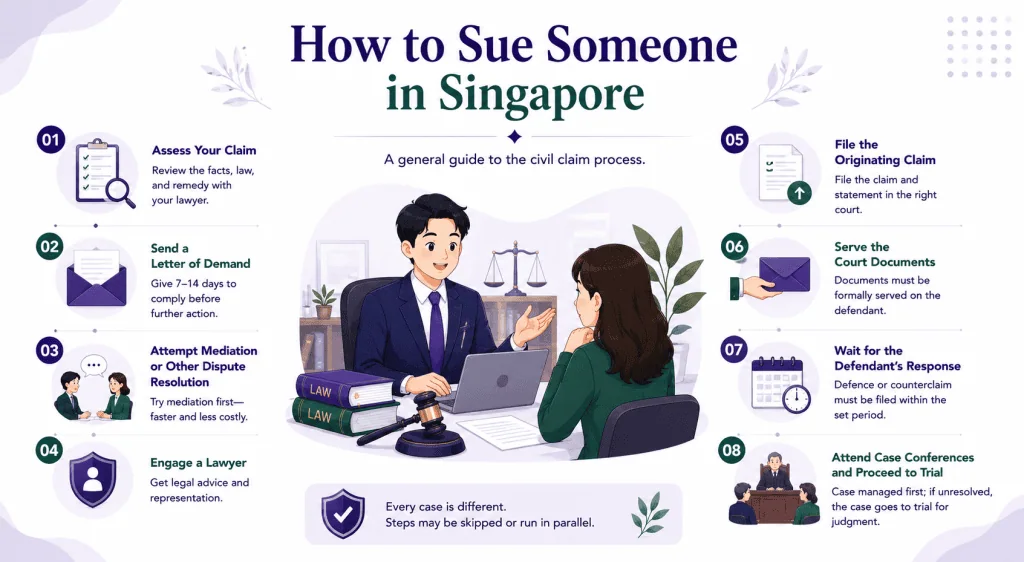
1. Assess Your Claim
Before anything else, review the facts, the relevant law, and the remedy you’re seeking, whether that’s monetary damages or a specific action from the other party. A lawyer can help confirm whether your claim is legally sound and whether its value justifies the time and cost of pursuing it.
2. Send a Letter of Demand
A Letter of Demand is a formal letter setting out your claim and giving the other party a deadline, commonly 7 to 14 days, to comply before you take further action. It isn’t a court document, but the Rules of Court generally expect parties to attempt an amicable resolution before litigation, and a well-drafted letter can also prompt an early settlement.
3. Attempt Mediation or Other Dispute Resolution
If the letter of demand doesn’t resolve the matter, consider mediation through the Singapore Mediation Centre, the Singapore International Mediation Centre, or a relevant government or industry body, before filing a claim. Mediation is generally faster and less costly than litigation, and the court may later ask whether this was attempted.
4. Engage a Lawyer
Engaging a lawyer isn’t mandatory, but it’s strongly recommended once a dispute moves beyond a very small or straightforward claim. A lawyer can assess the merits of your case, advise on the right court to file in, and represent you through what can be a lengthy and procedurally strict process.
5. File the Originating Claim
If the dispute remains unresolved, your lawyer will prepare and file an Originating Claim (the current term for what was previously called a Writ of Summons) together with a Statement of Claim, setting out the facts and the relief you’re seeking. This is filed with the Magistrate’s Court, District Court, or High Court, depending on the value and nature of your claim.
6. Serve the Court Documents
Once filed, the Originating Claim and Statement of Claim must be formally served on the defendant. Proper service is a procedural requirement, and without it, the case generally cannot move forward.
7. Wait for the Defendant’s Response
The defendant has a set period to indicate whether they intend to contest the claim by filing a Defense or bringing a Counterclaim of their own. If they don’t respond in time, you may be able to apply for a default judgment.
8. Attend Case Conferences and Proceed to Trial
Case conferences are held before a court registrar to manage the case’s progress and set procedural timelines, and the court may direct the parties to attempt mediation again at this stage. If the dispute still isn’t resolved, the matter proceeds to trial, where both sides present evidence and arguments before a judge delivers a judgment.
Also Read: Contract Disputes in Singapore: Guide to Your Legal Options
Which Court Should You Sue In
Where you can file a claim in Singapore depends mainly on how much you’re claiming, and each forum has different requirements around legal representation and process.
| Forum | Claim Limit | Lawyer Required | Notes |
|---|---|---|---|
| Small Claims Tribunals | Up to $20,000 (or $30,000 with signed consent) | No, parties represent themselves | Limited to specific claim types, such as goods, services, and short tenancies |
| Magistrate’s Court | Up to $60,000 | Optional | Part of the State Courts |
| District Court | Above $60,000, up to $250,000 | Optional, but recommended | Part of the State Courts |
| High Court | Above $250,000 | Optional, but recommended | Also handles matters like winding up and bankruptcy |
How Much Does It Cost to Sue Someone in Singapore
Legal costs in Singapore generally consist of your lawyer’s professional fees, disbursements such as court filing fees, and, if the matter is contested, further costs as the case progresses.
Singapore follows a “costs follow the event” principle, meaning the losing party is typically ordered to pay a portion of the winning party’s costs, known as party-and-party costs. In practice, this usually covers only part of what you actually paid your own lawyer, known as solicitor-and-client costs, so even a successful claimant is likely to be out of pocket to some degree.
Straightforward claims that end in a default or summary judgment tend to cost far less than contested matters that go to trial, and fees in the High Court are generally higher than in the State Courts given the complexity of the cases heard there. Because pricing depends heavily on your specific facts and how the other side responds, it’s best to get a quote from a lawyer early on.
Get Legal Guidance Before You Sue at RBN Chambers
Deciding to sue someone in Singapore involves weighing the strength of your claim against the time, cost, and effort of pursuing it, and getting this assessment right from the outset can save significant money and stress down the line.
From sending a Letter of Demand to representing you at trial, the right legal guidance early on makes a real difference to how smoothly your case proceeds.
RBN Chambers, led by Ramesh Bharani Nagaratnam, advises individuals and businesses through every stage of civil litigation in Singapore, from the initial letter of demand to trial. If you’re considering legal action or have been served with a claim, contact RBN Chambers today for advice tailored to your situation.
Frequently Asked Questions
Can I sue someone without a lawyer in Singapore?
Yes. Claims at the Small Claims Tribunals are designed for self-represented parties, and you can technically represent yourself at any level of court. That said, once a matter moves beyond a small, straightforward claim, the process becomes procedurally demanding, and engaging a lawyer is strongly recommended.
Is there a minimum amount I can sue for?
There’s no statutory minimum amount to bring a civil claim. In practice, very small claims are usually better suited to the Small Claims Tribunals, and it’s worth weighing whether the amount involved justifies the time and cost of pursuing it through the courts.
How long does a lawsuit take in Singapore?
Timelines vary widely depending on the court and whether the claim is contested. As a general guide, proceedings in the State Courts commonly take around 12 to 18 months, while High Court matters can take 12 to 24 months or longer, depending on the complexity of the case and how the defendant responds.
What happens if I lose the case?
If you lose, you’re generally liable to pay your own lawyer’s fees in full, and the court may also order you to pay a portion of the winning party’s legal costs. The exact amount is at the court’s discretion and depends on the circumstances of the case.

Delivering Solutions not just Answers to your legal disputes
We provide solutions to all our clients regardless of the scale or complexity of the cases. Let us know how we can help.
Contact UsAny information of a legal nature in this blog is given in good faith and has been derived from resources believed to be reliable and accurate. The author of the information contained herein this blog does not give any warranty or accept any responsibility arising in any way, including by reason of negligence for any errors or omissions herein. Readers should seek independent legal advice.