

General |
Litigation: Comprehensive Guide & Process in Singapore

Navigating a legal dispute can be challenging, especially if you are unfamiliar with Singapore’s court system. Whether you are pursuing a claim against another party or defending yourself against legal proceedings, understanding the litigation process is essential.
Litigation is the formal process of resolving disputes through the courts. It allows individuals and businesses to enforce their legal rights and seek remedies such as monetary compensation, injunctions, declarations, or specific performance.
This guide explains the litigation process in Singapore, the different court stages involved, litigation costs, alternatives to court proceedings, and how an experienced litigation lawyer can help protect your interests.
What is Litigation?
Litigation is a legal process where parties involved in a dispute present their case in a court of law to resolve disputes by enforcing their legal rights and responsibilities. Litigation involves a claimant (the party that is suing) and a defendant (the party being sued), and the process is overseen by a judge.
In Singapore, litigation can take various forms, including civil litigation, which typically involves personal or non-commercial disputes, and commercial litigation, which deals with business-related conflicts such as contract breaches or shareholder disagreements. Besides litigation, Singapore also offers alternative dispute resolution methods like mediation and arbitration.
Other Forms of Dispute Resolution
- Mediation: Mediation is a process where an impartial third party (called the mediator) facilitates parties in disputes to have open discussions about the dispute, assisting them to resolve the dispute amicably. Mediation is consensual – that is, both the parties in dispute must agree to openly discuss the dispute with a view to resolving it.
- Arbitration: Arbitration is an alternative to litigation. It is a process where parties have agreed even before a dispute arises to resolve any dispute between them by way of an arbitration. In an arbitration, usually the parties in dispute will appoint an arbitrator or arbitrators to hear the parties’ respective cases before a decision is made. Arbitration is also confidential.
The arbitrator’s decision is often final, meaning that in most cases, you cannot appeal it if you disagree with the outcome, unlike with a judicial ruling.
Litigation vs Arbitration
These two are often confused, but they work quite differently. Litigation goes through the public court system before a judge, while arbitration only happens if both parties agreed in advance to let a private arbitrator decide instead — with a final, binding award and very limited grounds for appeal.
| Key Difference | Litigation | Arbitration |
|---|---|---|
| Decision maker | Judge | Arbitrator(s) chosen by the parties |
| Outcome | Binding judgment | Binding award |
| Confidentiality | Public record (generally) | Private |
| Appeal options | Available (subject to rules) | Very limited |
| Best suited for | Disputes needing a binding court ruling or enforcement | Parties who agreed in advance to arbitrate |
When to Choose Litigation
Litigation tends to make sense when:
- The other party won’t engage in mediation or negotiation.
- There’s no arbitration agreement in place and a binding, enforceable judgment is needed.
- The dispute involves complex legal questions that benefit from a court’s authority and procedural safeguards.
- You need court powers unavailable in arbitration or mediation, such as injunctions or freezing orders.
If none of these apply, alternative dispute resolution may save time and cost. Speaking with a litigation lawyer early can help you weigh the options before committing to a court process.
Litigation Process in Singapore
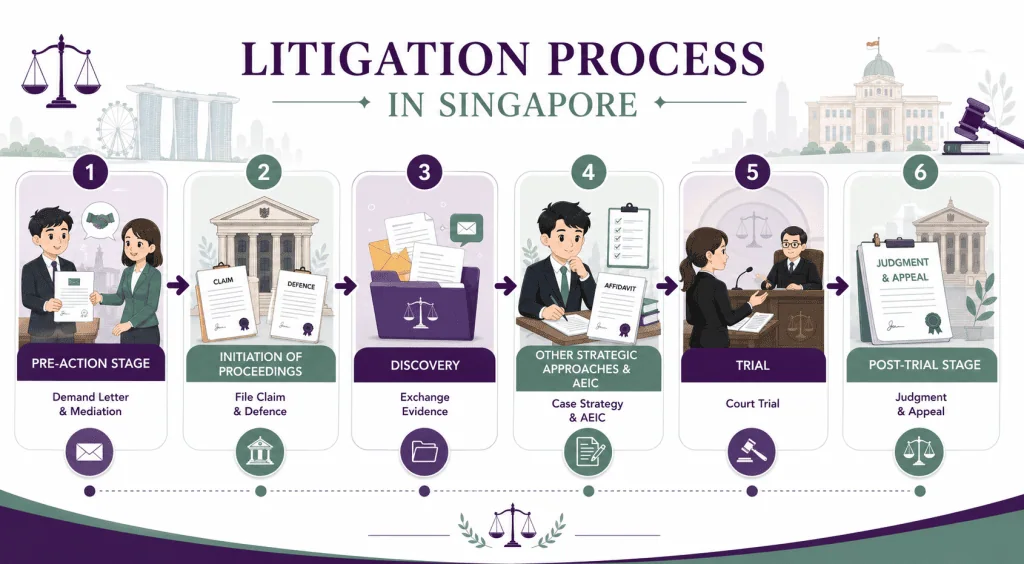
1. Pre-Action Stage
Prior to initiating litigation, parties may exchange demand letters or notices to encourage settlement and explore alternatives like mediation.
2. Initiation of Proceedings
- Filing of Originating Claim: For civil cases, the process usually begins with the Claimant filing a Originating Claim and the Statement of Claim in the Courts. The Statement of Claim will set out the Claimant’s case against the Defendant.
- Service of Documents: The Claimant then serves these documents on the Defendant who is then required to respond by informing the Court and the Claimant if the Defendant would be fighting the allegations. The Defendant then is required to set out his response to the Claimant’s allegation in his/her Defence.
3. Discovery
Exchange of Documents: Parties are required to disclose all relevant materials eg. agreements, text messages, email communication etc that support the parties’ respective cases. These are called evidence.
4. Other Strategic Approaches And Affidavits of Evidence In Chief
Once discovery is completed by the parties, they may consider, as a matter of strategy, various avenues to bolster their cases. In some cases, even before the completion of discovery of documents, the Court may direct parties to inform the Court of the various strategic avenues that they intend to take in the litigation.
If the dispute is proceeding for trial, parties are then required to file their Affidavit/s of Evidence In Chief. In the Affidavits of Evidence In Chief, each party will set out their case supported with evidence already disclosed in discovery.
5. Trial
At the trial, the parties through their appointed lawyers will present their respective cases to the Judge. The Judge would deliver his/her decision after hearing the respective cases and review of the evidence in support.
6. Post-Trial Stage
Appeal: Parties who are dissatisfied with the decision of the Judge who presides at the trial may appeal to the Appellate Division of the High Court and, where appropriate, to the Court of Appeal.
Also Read: 5 Common Types of Legal Disputes in Singapore (2026 Guide)
Enforcement of Judgments
If the losing party fails to comply with the decision of the trial Judge, then the victorious party may consider taking enforcement proceedings to compel the losing party to adhere to the decision of the trial Judge. For example, the victorious party may commence insolvency proceedings against the losing party so that the victorious party could recover the sums of monies which the trial Judge had ordered the losing party to pay.
Costs of Litigation
As a general rule, the losing party bears a portion of the winning party’s legal costs, as assessed by the court. Several factors affect the final figure, including the complexity of the dispute, the number of hearings, and how long the matter takes to resolve. Because costs vary significantly by case, it’s best to discuss likely costs upfront with a litigation lawyer rather than rely on a one-size-fits-all estimate.
Common Disputes That May Result in Litigation
Common disputes that may result in litigation include:
- Contractual disputes — disagreements over breach, non-performance, or interpretation of contract terms
- Shareholder disputes — conflicts between shareholders or with the company over rights, management, or share value
- Employment disputes — claims involving wrongful dismissal, breach of employment terms, or workplace grievances
- Debt recovery claims — pursuing repayment of unpaid debts owed by individuals or businesses
- Property disputes — disagreements over ownership, tenancy, or use of real estate
- Negligence claims — claims arising from a party’s failure to exercise reasonable care, resulting in loss or harm
- Defamation matters — claims involving false statements that damage a person’s or company’s reputation
- Construction disputes — disagreements over project delays, defects, or breach of construction contracts
In Singapore, litigation may take place before the Small Claims Tribunals, State Courts, or the Supreme Court, depending on the nature and value of the claim.
Court Jurisdictions in Singapore
| Court | Typical Claim Value |
|---|---|
| Small Claims Tribunals | Up to $30,000 (with parties’ consent for higher limits) |
| Magistrate’s Court | Up to $60,000 |
| District Court | Up to $250,000 |
| General Division of the High Court | Claims exceeding $250,000 or complex matters |
The appropriate court depends on both the monetary value and complexity of the dispute.
How Can a Litigation Lawyer Help?
A litigation lawyer does more than represent you in court. Their role typically includes:
- Assessing your case — reviewing the merits of your dispute and advising whether litigation, mediation, or arbitration is the better route, helping you avoid an expensive court process if it isn’t necessary
- Handling procedural requirements — preparing the Statement of Claim or Defence, managing discovery and evidence, and meeting court deadlines so nothing is missed that could weaken your position
- Building case strategy — anticipating the other side’s arguments and shaping your case to address them early
- Negotiating settlement — pursuing a favourable resolution outside of trial where it makes sense, to save time and cost
- Representing you at trial — presenting your case before the judge if the matter goes the distance
- Guiding enforcement — helping ensure a judgment in your favour is actually collected, not just won on paper
Having the right lawyer from the start can shape not just the outcome of a case, but how much time and money it takes to get there.
Also Read: Litigation vs Arbitration in Singapore: What’s Better for Resolving Disputes?
Speak to Experienced Litigation Lawyer in Singapore
Litigation can be costly and time-consuming, but the right strategy from the outset can make all the difference to how your dispute plays out.
Whether you’re weighing your options before taking action or have already been served with a claim, RBN Chambers can assess your case and advise on the best path forward, be it litigation, mediation, or arbitration.
Led by Ramesh Bharani Nagaratnam, our team has represented clients across civil and commercial disputes, from contract breaches to shareholder conflicts and beyond. Contact us here!
Frequently Asked Questions
What is commercial litigation?
Commercial Litigation refers to a legal dispute between two or more parties involving businesses or companies where one party seeks redress against another party.
What is involved in litigation?
Litigation involves filing a claim in court, exchanging evidence with the other party, and having a judge hear both sides before delivering a binding decision. It typically runs through pre-action correspondence, filing and service of documents, discovery, trial, and — if needed — enforcement of the judgment.
How long does a typical litigation case take in Singapore?
This varies widely depending on the complexity of the dispute, the court involved, and whether parties are willing to settle along the way. Straightforward claims may resolve in months; more complex commercial disputes can take significantly longer.
Is litigation funding legal in Singapore?
Yes, third-party litigation funding is legal in Singapore, but only for specific categories of proceedings, such as international arbitration, related court and mediation proceedings, and certain insolvency matters. It isn’t generally available for standalone domestic litigation outside these categories.
What are the alternatives to going to court?
Mediation and arbitration are the two main alternatives. Both can be faster and more private than litigation, though arbitration generally requires a prior agreement between the parties.
Can I represent myself in civil litigation?
For Small Claims Tribunal matters, lawyers cannot represent parties at the hearing itself, though they can still advise beforehand. For matters in the Magistrate’s Court, District Court, or High Court, parties can choose to represent themselves, but the procedural and legal complexity usually makes engaging a lawyer worthwhile.
How are legal costs calculated in Singapore?
Costs are generally assessed by the court and depend on factors such as case complexity, the length of proceedings, and the number of hearings involved. A lawyer can give a more accurate estimate based on the specifics of your dispute.

Delivering Solutions not just Answers to your legal disputes
We provide solutions to all our clients regardless of the scale or complexity of the cases. Let us know how we can help.
Contact UsAny information of a legal nature in this blog is given in good faith and has been derived from resources believed to be reliable and accurate. The author of the information contained herein this blog does not give any warranty or accept any responsibility arising in any way, including by reason of negligence for any errors or omissions herein. Readers should seek independent legal advice.