

Employment |
Restrictive Covenants in Singapore Employment Contracts: A Complete Guide

Restrictive covenants, often referred to as “restraint of trade” clauses, are a standard yet highly contested part of Singapore employment contracts.
Whether you are an employer seeking to protect trade secrets or an employee transitioning to a new role, understanding the enforceability of these clauses is critical. This guide explores how Singapore courts balance business interests with the right to work.
What Is a Restrictive Covenant?
A restrictive covenant is a clause — or set of clauses — commonly found in employment contracts that restricts the actions of an employee after the termination of their employment.
During the course of employment, an employee may acquire knowledge of the employer’s business operations, confidential information, or trade secrets that give the employer a competitive advantage. A departing employee who joins a competitor or sets up a rival business could use that knowledge to the detriment of their former employer.
Restrictive covenants are incorporated into employment contracts to guard against this risk. They are most commonly used for employees in senior, executive, or client-facing roles, where the potential for competitive harm is greatest.
Types of Restrictive Covenants in Singapore
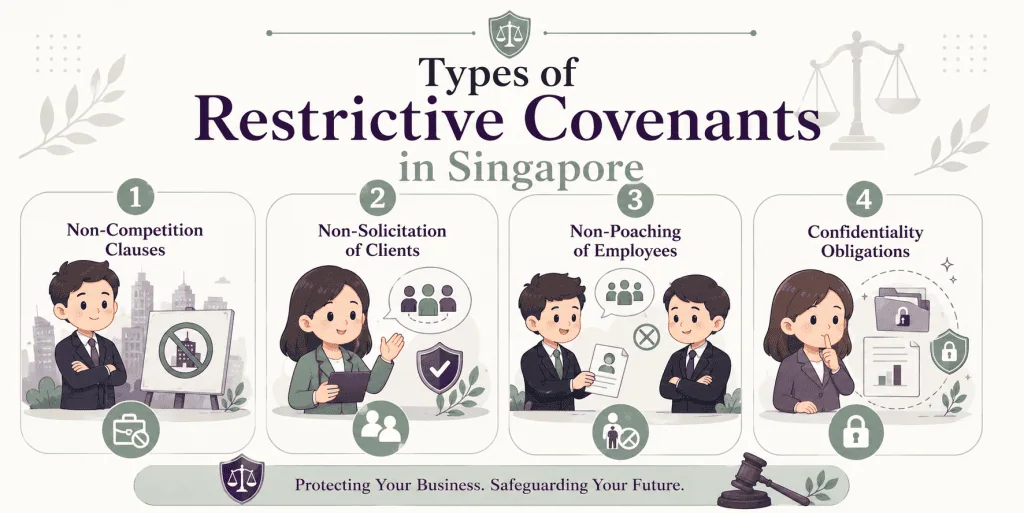
1. Non-Competition Clauses
A non-competition clause prevents a departing employee from working for a competitor or setting up a competing business for a specified period after the termination of employment. Any such duration must be reasonable — courts will not uphold a clause that is excessive relative to the legitimate interest it seeks to protect.
2. Non-Solicitation of Clients
A non-solicitation clause prevents a departing employee from contacting or dealing with the former employer’s clients, customers, or contacts for a defined period. These clauses typically take one of two forms: a “non-solicitation” clause (which restricts active approaches to clients) or a more onerous “non-dealing” clause (which prohibits any contact, even where the client initiates it).
It is important to note the distinction between non-solicitation of clients and non-solicitation of employees — both are separate covenants with different legal considerations.
3. Non-Poaching of Employees
A non-poaching clause prevents a former employee from enticing or recruiting key employees away from the employer. This protects the employer’s workforce and institutional knowledge from being systematically drawn away to a competing business.
4. Confidentiality Obligations
Confidentiality obligations protect proprietary information and often survive termination of employment.
Examples include:
- Client databases
- Pricing strategies
- Financial information
- Product development plans
- Trade secrets
Unlike non-compete clauses, confidentiality obligations are generally more readily enforceable.
Also Read: Wrongful Dismissal Under Singapore Law: Key Considerations for Employers and Employees
How Are Restrictive Covenants Enforced in Singapore?
The starting point in Singapore law is that post-termination restrictive covenants are void on public policy grounds, as they constitute a restraint of trade. However, they may be upheld if the employer can show that the covenant is protecting a legitimate business interest.
Legitimate interests that courts have recognised include the employer’s relationships with clients and customers, confidential information, and trade secrets.
The Reasonableness Test
Even where a legitimate interest exists, Singapore courts apply a two-stage reasonableness test before enforcing a restrictive covenant:
- Stage 1 — Reasonableness between the parties. The court considers whether the scope, duration, and geographical reach of the covenant are no wider than reasonably necessary to protect the employer’s legitimate interest. A non-compete that covers an entire industry globally for five years is unlikely to be upheld; one covering a defined competitor set within Singapore for twelve months may well be.
- Stage 2 — Public interest. Even a covenant that is reasonable between the parties may be struck down if it is contrary to the public interest — for example, if it prevents a skilled professional from working in their field entirely.
The following questions guide the court’s analysis:
- Is the employer seeking to prevent the ex-employee from making a living in their chosen field, rather than genuinely protecting a business interest?
- Is the covenant broader than reasonably necessary in the circumstances?
- Does the employer have a legitimate proprietary interest requiring protection?
- Are the restrictions reasonable given the employee’s seniority, access to confidential information, and client relationships?
The Blue Pencil Rule
Where a restrictive covenant is found to be partially unenforceable, Singapore courts may apply the “blue pencil rule” severing the offending portion and enforcing the remainder, provided what remains is still a coherent and meaningful clause. Courts will not, however, rewrite or modify a clause to make it enforceable; they can only delete.
Garden Leave vs. Restrictive Covenants
Garden leave and restrictive covenants serve similar protective purposes but operate differently. Understanding the distinction is important for both employers drafting contracts and employees approaching resignation.
| Key Difference | Garden Leave | Restrictive Covenant |
|---|---|---|
| Employment status | Employee remains employed | Employee has left |
| Salary | Full salary and benefits paid | No payment from former employer |
| Work duties | Suspended — employee stays home | Restricted activities only |
| Duration | Length of notice period | Defined post-termination period |
| Requires express clause? | Yes | Yes |
Garden leave allows an employer to require the employee to remain at home for all or part of their notice period, while continuing to receive their usual salary and benefits. During this time, the employee cannot take up new employment, access company systems, or engage with clients or colleagues.
Garden leave is commonly used alongside restrictive covenants for maximum protection. However, an employer can only place an employee on garden leave if there is an express clause in the employment contract permitting this, and the clause must be reasonable in the circumstances.
A prolonged garden leave period may also be taken into account by a court when assessing the enforceability of a subsequent post-termination restriction — a court may reduce the length of a non-compete if the employee has already served a lengthy garden leave.
Remedies for Breach of Restrictive Covenants
Where an employer has reasonable grounds to believe that a former employee has breached a restrictive covenant, the following remedies may be available:
Damages
The employer may bring a claim for breach of contract and seek compensation for loss suffered as a result of the breach. This typically includes loss of profits on contracts diverted by the former employee, or losses arising from clients or employees who have been solicited away.
Injunction
The employer may apply to court for an injunction to restrain the former employee from continuing the prohibited activity. Injunctions are particularly effective where the breach is ongoing — for example, where a former employee is actively soliciting clients in violation of a non-solicitation clause.
Speed is critical in injunction applications. Courts will consider whether the employer acted promptly upon discovering the breach and whether damages alone would be an adequate remedy.
Also Read: Employment Disputes: Common Types of Employment Issues in Singapore and How to Handle Them
Restrictive Covenants for Employers: Best Practices for Drafting Enforceable Clauses
A restrictive covenant is only as effective as its drafting. Courts in Singapore will not save a poorly worded clause — and one that is too broad will be struck down entirely, leaving the employer unprotected.
- Identify the legitimate interest you are protecting. The scope of the covenant must correspond directly to the interest being protected, whether that is client relationships, confidential information, or a stable workforce. A clause that goes further than necessary will not survive judicial scrutiny.
- Tailor the covenant to the employee’s role. A clause appropriate for a senior executive with direct client access may be wholly unreasonable for a junior employee. Courts assess reasonableness based on the specific employee’s seniority and actual exposure to sensitive information.
- Be precise about scope, duration, and geography. Identify specific competitor categories, limit the geographic scope to markets where your business operates, and set a duration that reflects the realistic shelf life of the interest being protected. Durations of six to twelve months are generally more defensible than those exceeding two years.
- Review contracts periodically. An employee’s role and access to confidential information may change over time. Regular contract reviews ensure that covenants remain proportionate — and therefore enforceable.
Restrictive Covenants for Employees: What to Do If You Have Been Served a Claim
Receiving a letter of demand from a former employer over a restrictive covenant can be alarming. However, not every covenant is automatically enforceable — and there are important steps to take before responding.
- Assess whether the covenant is actually enforceable. Signing a contract does not mean the clause will be upheld in court. Consider whether it protects a genuine business interest and whether it is reasonable in scope and duration relative to your actual role. Many broadly drafted covenants do not withstand legal scrutiny.
- Do not ignore a letter of demand. A letter of demand requires a prompt, considered response. Ignoring it may be used as evidence that you had notice of the covenant and chose to disregard it. Engaging a lawyer to respond on your behalf opens the door to early negotiation.
- Explore negotiation before litigation. Many restrictive covenant disputes are resolved without going to court. With the right legal strategy, it may be possible to agree on modified terms — a shorter restricted period or narrower scope — that satisfy both parties without the cost of litigation.
- Seek legal advice before your start date at a new employer. If you are aware of restrictive covenants in your previous contract, obtain legal advice before joining a competitor or contacting former clients. Acting with clear legal guidance reduces your exposure significantly.
Speak to an Employment Lawyer at RBN Chambers
Whether you are an employer seeking to enforce a restrictive covenant or an employee facing a claim for breach, the outcome will depend heavily on the specific terms of your contract and the facts of your situation.
At RBN Chambers our employment dispute lawyers provide clear, practical advice on the drafting, enforceability, and litigation of restrictive covenants in Singapore. We act for both employers and employees and are experienced in urgent injunction applications where time is critical.
Contact us to discuss your matter in confidence.
Frequently Asked Questions
Are non-compete clauses legal in Singapore?
Yes, but they are not automatically enforceable. Singapore courts will only uphold a non-compete clause if it protects a legitimate business interest and is reasonable in scope, duration, and geographic reach. A clause that is overly broad may be struck down entirely or reduced through the blue pencil rule.
How long can a restrictive covenant last?
There is no fixed maximum under Singapore law. Courts assess reasonableness on a case-by-case basis, taking into account the employee’s seniority, the nature of the business, and the interest being protected. In practice, durations of six to twelve months are more commonly upheld than those exceeding two years.
Can I be sued for breaching a non-solicitation agreement?
Yes. If you breach a valid non-solicitation clause, your former employer may seek damages for any loss suffered and apply for an injunction to stop the conduct. The strength of their claim will depend on whether the clause is enforceable and whether they can demonstrate actual loss.
What happens if my contract does not mention garden leave?
An employer cannot unilaterally place an employee on garden leave without an express contractual clause permitting it. Doing so without such a clause may itself constitute a breach of contract by the employer.
Can a restrictive covenant be negotiated before signing?
Yes. Restrictive covenants are contractual terms and are subject to negotiation. Employees in a strong bargaining position — particularly at a senior level — may be able to narrow the scope, duration, or geographic coverage of these clauses before signing. Legal advice at this stage is valuable.

Delivering Solutions not just Answers to your legal disputes
We provide solutions to all our clients regardless of the scale or complexity of the cases. Let us know how we can help.
Contact UsAny information of a legal nature in this blog is given in good faith and has been derived from resources believed to be reliable and accurate. The author of the information contained herein this blog does not give any warranty or accept any responsibility arising in any way, including by reason of negligence for any errors or omissions herein. Readers should seek independent legal advice.